
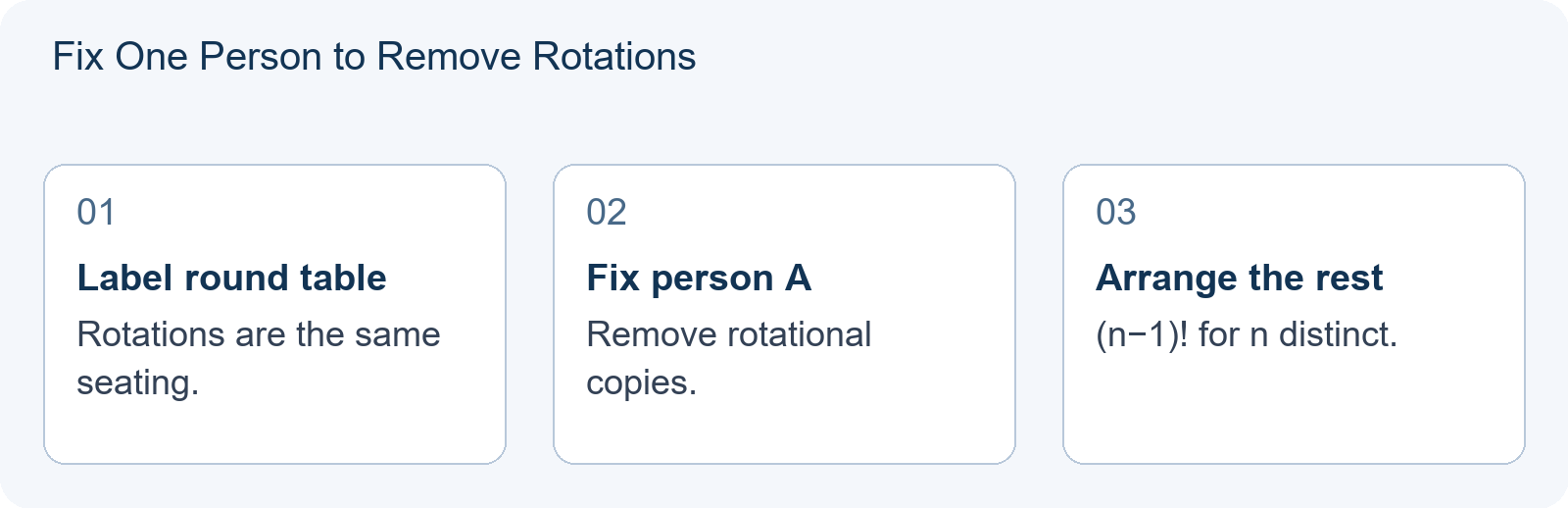
For AMO-style circular seating in Grades 5–8, fix one person before multiplying: if n distinct people sit around a round table and rotations count as the same, there are (n−1)! arrangements. Numbered seats are different, so there the count is n!. Check whether the question also identifies mirror images before dividing by 2.
This article is a teaching clinic for a future AMO preparation cycle. Its examples are original teaching illustrations, not official AMO problems, and the methods are not official scoring guidance. Later sections give source and season context; the counting methods stand on their own.
Start with the seating model, not the formula
A circular-seating error can begin before any arithmetic. A child reads “around a table,” multiplies by n!, and produces an answer that is too large. The missing step is a decision: does rotating the whole arrangement create a new seating or the same seating? The table below separates three common models. Use it before choosing a method.
| Setting | What counts as the same? | Count for n distinct people | Quick check |
|---|---|---|---|
| Round table, rotations the same | Rotations | (n−1)! | 4 people: 3! = 6 |
| Numbered seats or fixed positions | Nothing; each labeled seat matters | n! | 4 seats: 4! = 24 |
| Round table, rotations and reflections both identified, explicitly stated | Rotations and mirror images | (n−1)!/2 for n≥3, all distinct | 4 people: 3!/2 = 3 |
The third row applies only when the problem explicitly says mirror images are the same. The word necklace is not a reliable shorthand: some texts use necklace for rotations only and bracelet for rotations plus reflections, but conventions differ. For ordinary round-table seating, reflections are different unless stated.
Why fixing one person removes the rotational copies
Take four distinct students A, B, C and D around a round table. In a line, there are 4! = 24 orders. Around a circle, each seating appears four times: once with A at the top, once with B at the top, once with C, and once with D. So 24 ÷ 4 = 6. That is 3!. Now fix A at the top. The remaining three students can be arranged in 3! = 6 ways. The answer is the same, but the reasoning is cleaner: fixing A removes the four rotational copies before counting, rather than dividing after counting.
For five distinct students, 5! = 120 linear orders. Divide by 5 rotations gives 24. Fix one student and arrange the remaining four: 4! = 24. The pattern is consistent. For n distinct people around a round table with rotations identified, the circular count is (n−1)!. The fix-one-person method is useful when the question adds a restriction, because the restriction can be checked inside the smaller arrangement.
This is the same double-counting discipline used in AMO Handshake Problems: Pair Counting Without Double Counting (Grades 4-8). In handshake problems, the error is counting each pair twice. In circular seating, the error is counting each rotation n times. The diagnostic question is similar: what has been counted more than once, and what is the clean way to remove the copies?
Teaching illustration 1: six students, two must not sit together
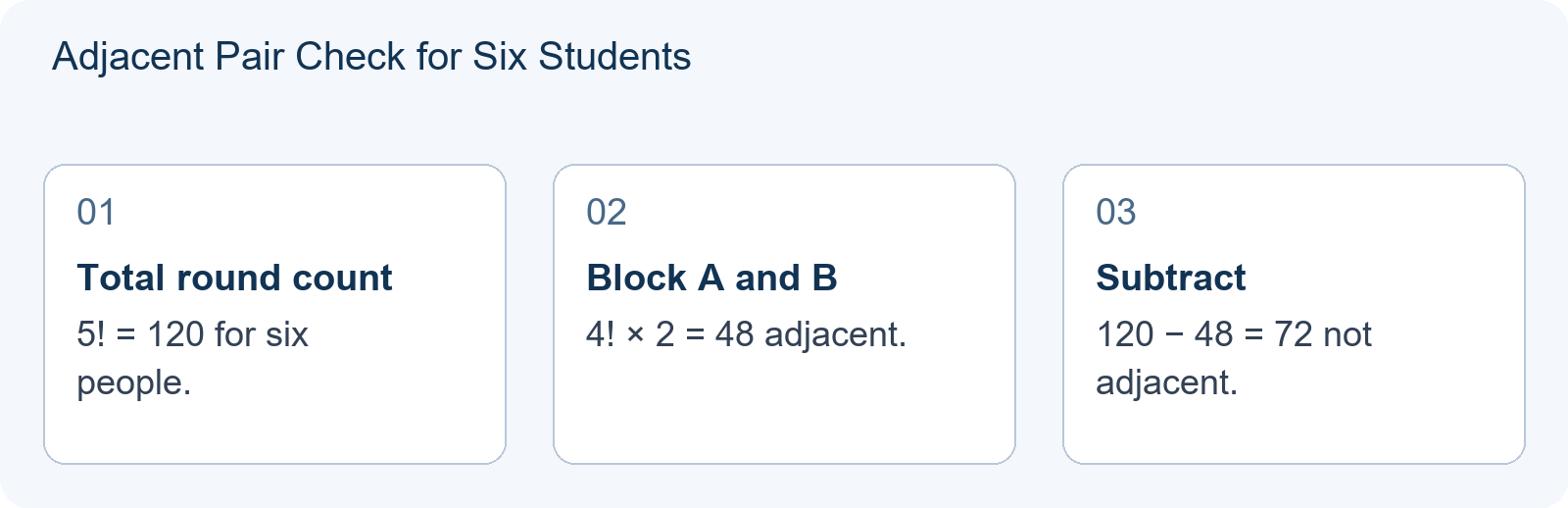
Teaching illustration (original exercise, not an official AMO problem). Six distinct students A, B, C, D, E and F sit around a round table. Rotations are the same; reflections are different. How many seatings have A and B not adjacent?
First count all circular seatings of six distinct students: (6−1)! = 5! = 120. Next count the seatings where A and B are adjacent. Treat the pair as one block. The block plus the other four students gives five objects around the circle. Five objects around a circle can be arranged in (5−1)! = 4! = 24 ways. Inside the block, A and B can be ordered in 2! = 2 ways. So adjacent seatings = 24 × 2 = 48. Therefore not adjacent = 120 − 48 = 72.
Check the same answer by fixing A. With A fixed, there are 5! = 120 arrangements of B, C, D, E and F in the five remaining positions. For B to be adjacent to A, B must take one of the two seats next to A. That gives 2 choices for B, then 4! = 24 arrangements for C, D, E and F. Adjacent = 2 × 24 = 48. Not adjacent = 120 − 48 = 72. The two methods agree. The complement step is the same logic used in AMO Probability: The ‘At Least One’ Complement Clinic: count the total once, count the unwanted case once, and subtract.
For contrast, put the same six students in six numbered chairs arranged in a circle. Now rotations are different. Total = 6! = 720. To count A and B adjacent, choose one of the six adjacent chair-pairs, place A and B in 2 orders, and arrange the other four in 4! = 24 ways: 6 × 2 × 24 = 288. Not adjacent = 720 − 288 = 432. The premises changed, so the answer changed.
Teaching illustration 2: four boys and four girls alternating
Teaching illustration (original exercise, not an official AMO problem). Four distinct boys and four distinct girls sit around a round table. Rotations are the same; reflections are different. How many seatings alternate boy and girl?
Fix one boy, say B1, at the top. This removes rotational copies. Because the seating must alternate, the pattern clockwise from B1 is fixed: B1, girl, boy, girl, boy, girl, boy, girl. The remaining three boys must fill the three boy positions, and the four girls must fill the four girl positions. The boys can be arranged in 3! = 6 ways. The girls can be arranged in 4! = 24 ways. Total = 6 × 24 = 144.
One tempting wrong answer is to multiply 4! × 4! × 2 and stop. That counts alternating arrangements in labeled seats: choose a starting gender, arrange the boys, arrange the girls. But around a round table, each seating is repeated eight times under rotation. The fix-one-boy method avoids that division and makes the alternating pattern visible. The answer 144 is less than the total circular seating count of 7! = 5040, which is a useful sanity check.
Three diagnostic questions before calculating
When a circular arrangement problem appears, ask these three questions in order. They help expose an overcount before it spreads through the calculation.
- Are seats numbered or positions fixed? If yes, rotations create different arrangements. Use n!, not (n−1)!. A stage with numbered chairs is a numbered-seat problem even if the chairs are arranged in a circle.
- Are clockwise and anticlockwise the same? If the problem explicitly says a flip produces the same arrangement—for example, it defines a bracelet convention or states “same when flipped”—reflections are identified. Do not infer this from the word necklace alone. For all-distinct people and n≥3, divide the circular count by 2 only under that explicit condition.
- Are all people distinct? If some people are identical for counting purposes, the simple factorial formula may not apply. Fixing one person can be ambiguous if that person is not unique. Use casework, a unique item, or explicit rotation checking; do not assume a factorial division by multiplicity.
A fourth question is useful when a restriction appears: does the restriction mention a specific seat or a specific person? If it mentions a specific seat, the rotational symmetry is broken; fixing that seat is usually the cleaner choice. If it mentions a specific person, fix that person. Matching the fixing choice to the restriction is the decision aid that keeps the count balanced.
Traps: reflections, identical items, and “together”
Reflections. A round-table answer of 6 for four distinct people becomes 3 only if mirror images are declared the same. A student may divide by 2 automatically because they remember a bracelet formula. For ordinary seating, that is an extra division. The problem must state the reflection condition.
Identical items. Suppose three identical red beads and three identical blue beads are arranged in a circle. Fixing “one red bead” is not well defined. It is tempting to take 5! and divide by 3!3!, but that division is not generally valid for circular arrangements: dividing by multiplicity factorials is a labeled-position shortcut for arranging a multiset in a row or in pre-labeled slots. Once cyclic rotations identify arrangements, identical items require their own case analysis, or a more advanced orbit-counting method. For Grades 5–8, handle small cases by fixing a seat, listing the distinct circular color patterns, and checking rotations explicitly; use a unique item if the problem supplies one. Do not force a factorial division that the problem does not support.
“Together” versus “adjacent.” In seating problems, “A and B sit together” means adjacent. “Not together” means not adjacent. The block method counts adjacent pairs. After blocking, the block and the remaining people form a smaller circular arrangement. For six people, the block plus four others is five objects, so the circular arrangement of objects is 4!, and the internal order is 2!. The product is 48. The complement 120 − 48 = 72 is the not-adjacent count.
The same discipline of separating objects before counting appears in AMO Grid Counting: Avoiding Double Counts in Rectangles and Paths. There, the risk is counting a rectangle or path more than once by choosing different starting points. Here, the risk is counting the same seating more than once by rotating the starting point. In both cases, the fix is to name what is being counted and remove duplicate representations before multiplying.
A 60-second answer check
Before your child writes the final answer, run four quick checks. First, for n distinct people around a round table with rotations the same, the answer should be (n−1)!, not n!. For six people, 5! = 120, not 6! = 720. Second, if the answer is much larger than (n−1)!, check whether rotations were counted. Third, if seats are numbered, n! is allowed; do not divide by n merely because the seats form a circle. Fourth, with a restriction, the answer should be less than or equal to the unrestricted count. In the six-student example, 72 is less than 120, which is consistent.
Do not use a divisibility test as a proof. The circular count (n−1)! need not be divisible by n. For four people, the answer is 6, and 6 is not divisible by 4. A student who rejects 6 because “it should divide by 4” has confused the linear count n! with the circular count (n−1)!. The linear count 24 is divisible by 4; the circular answer is the result after that division.
Source and season context
Hanlin’s AMO overview (2026 compilation) describes AMO as a Grade 2–12 competition and records a 90-minute, 25-question paper with no negative marking. That is format context for preparation; it does not supply a circular-seating rule or official scoring guidance for the teaching illustrations here. For current-season timing, SIMCC’s Upcoming Competitions page, retrieved 16 November 2026, lists the 2026 AMO windows as ended and establishes no 2027 dates. Readers should verify future dates with the organizer or an authorized registration channel when a new cycle is announced.
What to do next: bring one unsolved circular-counting problem
A useful next step is not another page of formulas. Ask your child to bring one unsolved circular-seating problem and, more importantly, the written solution attempt. The attempt shows whether the error is the seating model (round table versus numbered seats), the fixing choice (person versus seat), or the restriction (adjacent, alternating, identical items). A diagnosed error gives a clearer next practice target.
If the error is pair counting, the handshake clinic linked above is the adjacent technique. If the error is duplicate representations, the grid-counting clinic is the adjacent technique. If the error is a complement step, the “at least one” clinic is the adjacent technique. In a teaching conversation, bring the problem text, the child’s diagram, and the point where the count stopped matching. That is enough to decide whether the next practice should be fixing a person, fixing a seat, or switching to casework.
General event background is available at Event background.
Frequently Asked Questions
Why is the answer (n−1)! instead of n! for a round table?
Because n! counts each circular seating n times, once for each rotation. Fixing one person removes those n copies and leaves (n−1)! arrangements.
When should I divide by 2 for reflections?
Only when the problem explicitly says clockwise and anticlockwise are the same, such as a stated bracelet convention or a “same when flipped” condition. Ordinary round-table seating treats mirror images as different, and the word necklace alone is not enough because conventions vary.
How do I know whether the seats are numbered?
Read the wording. If seats are numbered, labeled, or fixed to a stage, rotations are different and the count is n!. If the problem says “around a round table” and treats rotations as the same, use (n−1)! or fix one person.