
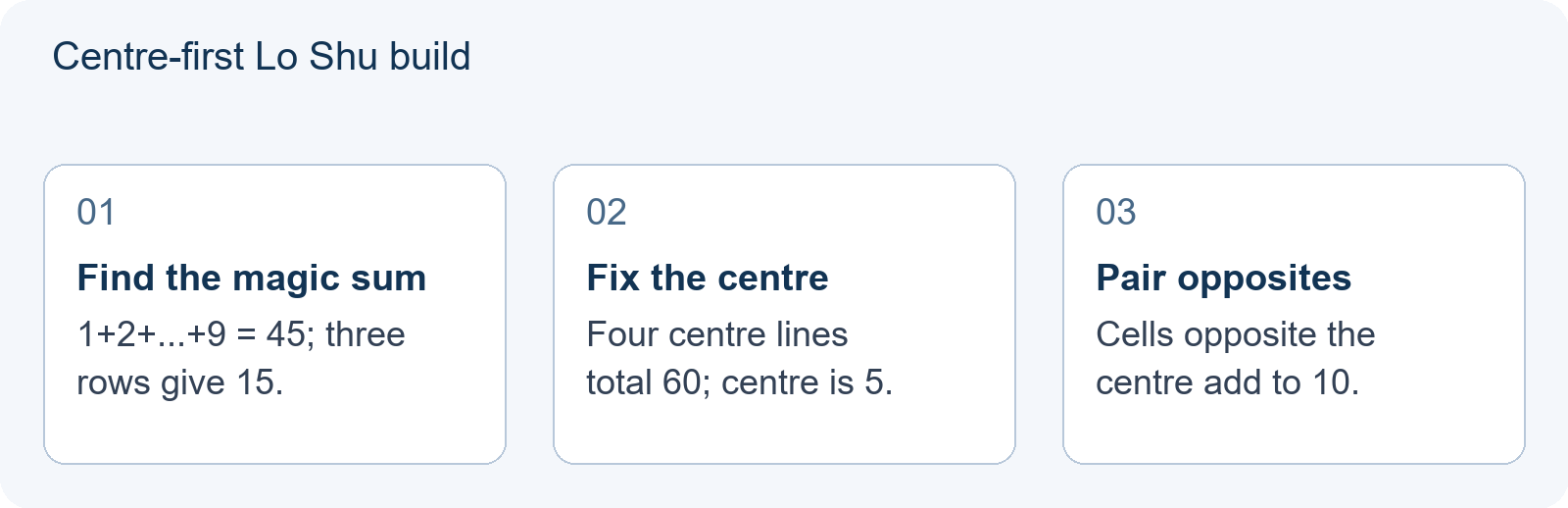
For a 3×3 magic square that uses the numbers 1 to 9 exactly once, do not begin by guessing where 1 or 9 goes. The three rows force the magic sum to be 15, and the four lines through the centre force the centre to be 5. Once those two facts are fixed, every pair of opposite cells adds to 10. The grids below are original teaching illustrations for AMO-style practice, not official AMO questions.
Why centre-first beats guessing
AMO Club’s competition information (2026) records a Grade 2–12 contest with a 90-minute, 25-question paper and no negative marking. Those format facts set the context for practice; they do not by themselves create a magic-square rule. In a 3×3 square, the centre is the hinge of four lines. A guess must be checked against rows, columns and both diagonals, while a derived centre turns the puzzle into four complementary pairs. SIMCC’s Upcoming Competitions page, retrieved on 16 November 2026, lists the 2026 AMO windows, all of which had ended by that date, and does not establish 2027 dates. This article therefore stays with practice technique. The method is a coaching judgment, not a claim that every paper contains a magic square.
Why the magic sum must be 15
Start with the premise. A standard 3×3 magic square uses each of 1, 2, 3, 4, 5, 6, 7, 8 and 9 exactly once and gives every row, column and diagonal the same total S. The sum of all nine entries is 1+2+3+4+5+6+7+8+9 = 45. There are three rows, each summing S, so 3S = 45 and S = 15. This is the first constraint. Any line with two known entries has its third entry forced by subtraction: third = 15 − first − second. If the problem uses a different set of nine numbers, the same logic applies with the new total T: S = T/3. If the problem permits repeats, the total may not be 45; do not carry the number 15 into a grid whose premise you have not checked. For the 1–9 version, however, 15 is fixed before a single placement is chosen. A child who writes the sum first has a reason to reject any line that cannot reach 15.
Why the centre must be 5
Now count the four lines through the centre: the middle row, the middle column, and the two diagonals. Each has sum 15, so these four lines total 4×15 = 60. Count the cells in those four lines. Every one of the nine cells appears once, except the centre. The centre appears in all four lines, so it is counted four times instead of once. That adds three extra copies of the centre c. Hence 60 = 45 + 3c, so 3c = 15 and c = 5. Once the centre is 5, any line through it has the form a + 5 + b = 15, so a + b = 10. The four opposite pairs are therefore (1,9), (2,8), (3,7) and (4,6). A child who remembers only “centre is 5” has a fact; a child who can reproduce this count has a check. The same counting idea generalises: for a 3×3 grid with total T, the magic sum is S = T/3 and the centre is c = S/3.
Building the Lo Shu square without guessing
Teaching illustration: build one valid 3×3 square using 1–9 once. Put 5 in the centre and keep the four opposite pairs. Choose 8 for the top-left as a starting branch; this is a construction choice, not a claim that 8 must go there. Its opposite, the bottom-right, must then be 2. The top row still needs 7 from two cells; choose 1 and 6, so the top row is 8, 1, 6. Now line sums force the rest. The cell opposite 1 is 9, so bottom-middle is 9. The cell opposite 6 is 4, so bottom-left is 4. The remaining middle-row pair is 3 and 7; the left column then forces 3 middle-left and 7 middle-right. The completed grid is:
| 8 | 1 | 6 |
| 3 | 5 | 7 |
| 4 | 9 | 2 |
Check: rows 15, 15, 15; columns 15, 15, 15; diagonals 8+5+2 = 15 and 6+5+4 = 15. The construction used one branch and then subtraction; it did not test random placements. Rotations and reflections give other printed versions of the same completed square, a point we return to below. The aim here is a valid build, not a uniqueness proof.
Using a partially filled grid: full lines first
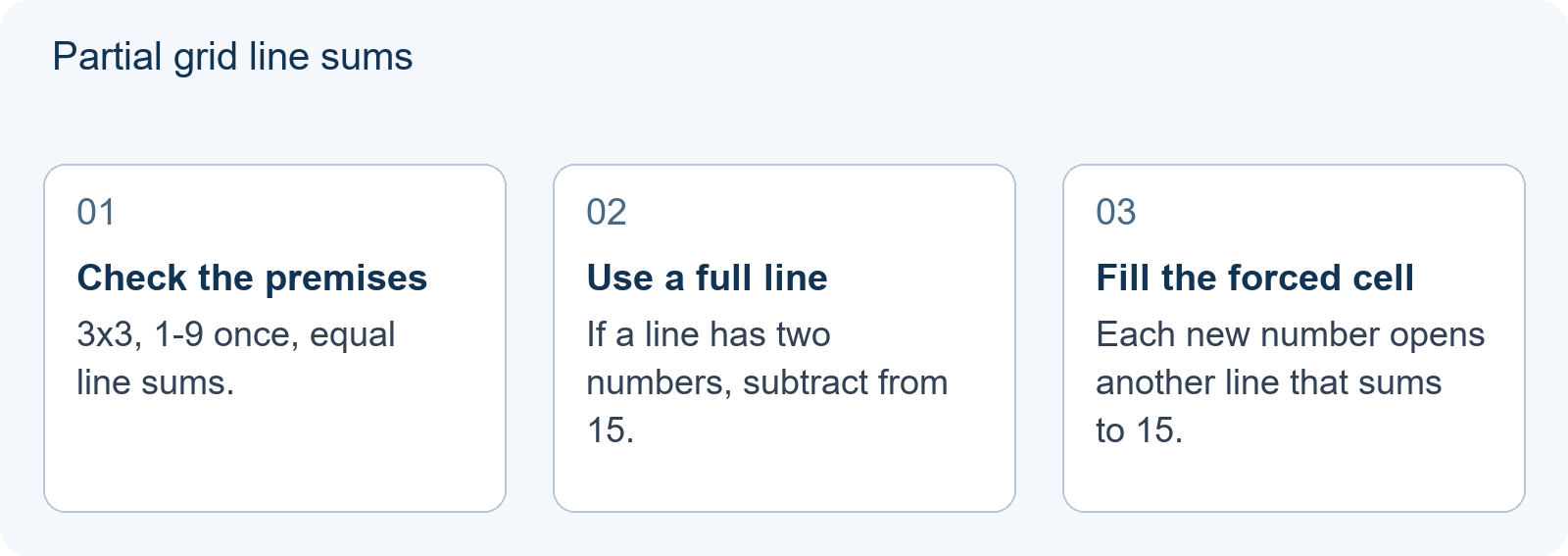
Teaching illustration: in a 3×3 magic square using 1–9 once, suppose the grid has 8, 6 and 2 in the corners shown, with 5 in the centre:
| 8 | ? | 6 |
| ? | 5 | ? |
| ? | ? | 2 |
Do not start with the corners. Use a line that already has two entries. Top row: 8 + ? + 6 = 15, so top-middle = 1. Middle column: 1 + 5 + ? = 15, so bottom-middle = 9. Right column: 6 + ? + 2 = 15, so middle-right = 7. Middle row: ? + 5 + 7 = 15, so middle-left = 3. Left column: 8 + 3 + ? = 15, so bottom-left = 4. The final grid matches the Lo Shu build. The order matters: each step uses a line that has become full enough to force one missing number. This is the same discipline as digit placement in counting problems, where a leading-zero restriction must be applied before multiplying choices; see AMO Digit Placement: Count Arrangements Without Allowing a Leading Zero. In both cases, the constraint is checked before the guess.
Premise check before you use the method
One risk in magic-square work is a premise error rather than an arithmetic error. Use a short table before solving.
| Premise | Consequence |
|---|---|
| 3×3, 1–9 once | T = 45, S = 15, centre = 5, opposites add to 10. |
| 3×3, another nine-number set | Compute T; S = T/3, centre = S/3, opposites add to 2S/3. |
| 4×4, 1–16 once | S = 34, but the 3×3 centre proof does not transfer. |
For a 3×3 grid with total T, the general relations are S = T/3 and c = S/3, with opposite cells adding to 2S/3. The familiar 15 and 5 are the special case T = 45. If a puzzle says “not necessarily distinct”, compute T from the actual entries or from the rule given; do not assume 45. If it is 4×4 using 1–16 once, the magic sum is 34 because 1+2+…+16 = 136 and 136/4 = 34, but the 3×3 centre proof does not transfer. Different grid size means a new count.
Teaching example with a shifted set: for a 3×3 magic square using 2 through 10 once, the total is 54, so S = 18, the centre is 6, and opposite cells add to 12. Adding 1 to every cell of the Lo Shu square gives 9, 2, 7 / 4, 6, 8 / 5, 10, 3; check that every row, column and diagonal sums to 18.
Three traps to check: diagonals, symmetry and early guessing
The first trap is checking rows and columns but forgetting diagonals. A grid can have three correct rows and still fail a diagonal. The second trap is deciding that rotations and reflections are automatically “the same” or automatically “different”. The right answer depends on the wording. If the task is to complete a fixed printed grid, symmetry does not change the missing numbers. If the task asks how many distinct printed squares can be made, check whether the question identifies rotated or reflected versions. Do not impose a symmetry convention that the question did not state. The third trap is guessing a placement before using the strongest line. In the partial grid above, the top row and middle column did almost all the work. Constraint-first thinking is also the point of AMO Cryptarithms: A Carry-Logic Clinic for Alphametic Puzzles, where carry information is extracted before digits are assigned. Magic squares are not cryptarithms, but the lesson is the same: use a reliable constraint to shrink the search.
A 10-minute checking routine
For home practice, use a fixed routine. (1) Write the premise: grid size, allowed numbers, and whether repeats are allowed. (2) Compute the magic sum from the total. (3) For a 3×3 1–9 square, mark the centre and opposite pairs. (4) Fill only where a row, column or diagonal already has two entries. (5) Check all three rows, three columns and two diagonals. (6) Count that each allowed number appears the correct number of times. A ten-minute session can use one completed grid and one partially filled grid; the goal is a repeatable check rather than speed. For a parent reviewing the work, ask which line was used first and where the first guess appeared. A useful question is “Which constraint should we practise next?” rather than “Is my child good at this?” For a related constraint exercise, AMO Remainder Word Problems: Finding the Smallest Number That Fits shows how a remainder condition narrows a search before arithmetic. The magic-square method is a teaching aid, not a predicted score or an award guarantee.
General event background is available at Event background.
Frequently Asked Questions
Why is the centre of a 1–9 magic square always 5?
For a 3×3 square using 1–9 once, the total is 45, so each of the three rows sums to 15. The four lines through the centre total 4×15 = 60. Those four lines count every cell once except the centre, which is counted four times instead of once, so 60 = 45 + 3c. Thus c = 5.
Do rotations and reflections count as different magic-square answers?
It depends on the wording. If the task is to complete a fixed printed grid, symmetry does not change the missing numbers. If the task asks how many distinct printed arrangements are possible, check whether the question treats rotated or reflected versions as the same. Do not assume a convention the question does not state.
Can I use the same centre-first method for a 4×4 magic square?
No, the centre-first proof is specific to the 3×3 layout. For a 4×4 square using 1–16 once, the magic sum is 34 because the total is 136 and there are four rows, but the same four-line argument does not fix a single centre cell. Different grid size requires a new constraint count.