
In AMO-style probability questions, when a counter is drawn and not returned, the next draw comes from a smaller set, so the second fraction must use a smaller denominator. Starting with 4 red, 3 blue and 2 green counters, the second denominator is 8, not 9. This gives P(no red) = 5/18 and P(at least one red) = 13/18. The clinic below trains that habit for ordered draws, unordered draws and items taken together.
What “without replacement” actually changes
With replacement, the bag is restored after every draw. Every fraction uses the same bottom number and the draws are independent. Without replacement, the item is gone. The denominator falls by one every time, and the numerator falls by one only on branches where the drawn item was the type you are tracking.
The multiplication rule does not change: the probability of a first event and then a second is the probability of the first multiplied by the probability of the second given what the first removed. What changes is the second factor. Without replacement, that second factor is a conditional probability doing ordinary work.
There is a second consequence that is easy to miss. When the first draw is not the colour being counted, the numerator can stay the same while the denominator drops. With 4 red out of 9, the red fraction is 4/9. After a blue is drawn, the red fraction becomes 4/8, which is larger. Drawing a non-red makes red more likely next. Drawing a red makes red less likely next. That asymmetry is the engine of these questions, and it is why the answers generally do not match the with-replacement version.
Build the draw tree before you multiply
A draw tree is three things written in three places. On each branch, write the numerator, how many of the wanted type remain; the denominator, how many items remain in total; and a short label so you can see what has already left.
Two checks keep the tree honest. At each node, the outgoing branch probabilities must add to 1. And the denominators must move down in step with the number of items removed, never in step with the number of draws you have written down. If the tree’s second column still reads 9, the tree is wrong before any arithmetic starts.
Then multiply along each path to a leaf, and add leaves only when the leaves are different ways for the same event to happen. A useful distinction is: multiplying is for a path, adding is for alternative paths.
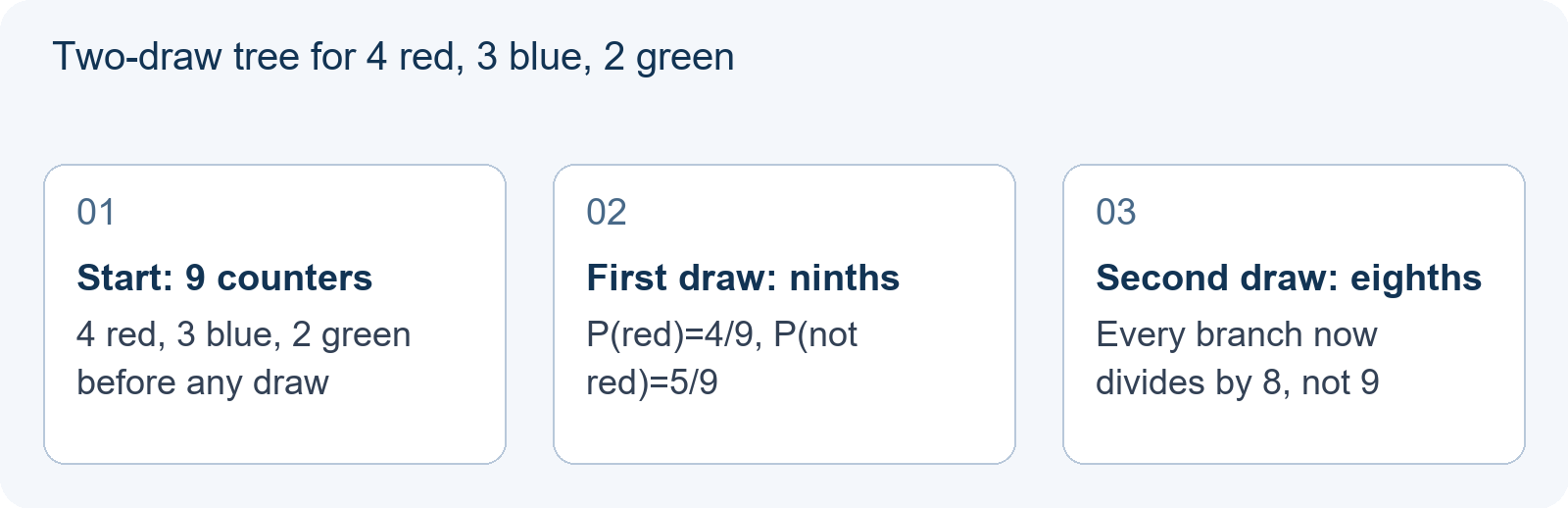
Worked teaching illustration: 4 red, 3 blue, 2 green
Teaching illustration (original, not an official AMO question). A bag holds 4 red, 3 blue and 2 green counters, nine in total. Two counters are drawn one after another and neither is put back.
| Event | Branches multiplied and added | Exact value | Approximate |
|---|---|---|---|
| No red | 5/9 x 4/8 | 5/18 | 0.278 |
| Exactly one red | 4/9 x 5/8 plus 5/9 x 4/8 | 5/9 | 0.556 |
| Two red | 4/9 x 3/8 | 1/6 | 0.167 |
| One red and one blue | 4/9 x 3/8 plus 3/9 x 4/8 | 1/3 | 0.333 |
| At least one red | 1 minus 5/18 | 13/18 | 0.722 |
The first three rows split the possibilities exactly, and 5/18 + 5/9 + 1/6 = 5/18 + 10/18 + 3/18 = 1. The last two rows overlap those three, so they are not a fourth and fifth slice of the same pie.
Read the second row slowly, because it is where the tree earns its keep. Exactly one red happens two ways: red then non-red, or non-red then red. The first path is 4/9 x 5/8 because five non-red counters remain. The second path is 5/9 x 4/8 because all four reds are still there when the second draw happens. Both paths use a denominator of 8, but they use it for different reasons.
The no-red event has one grouped path, while its complement collects several grouped paths; that is why the complement method later is economical. Two red also has a single grouped path, so “single path” is not by itself a reason to choose a complement.
Ordered versus unordered: when to add branches
Compare two sentences that look similar and are not.
- The first counter is red and the second is blue. Order is named, so there is one path: 4/9 x 3/8 = 1/6.
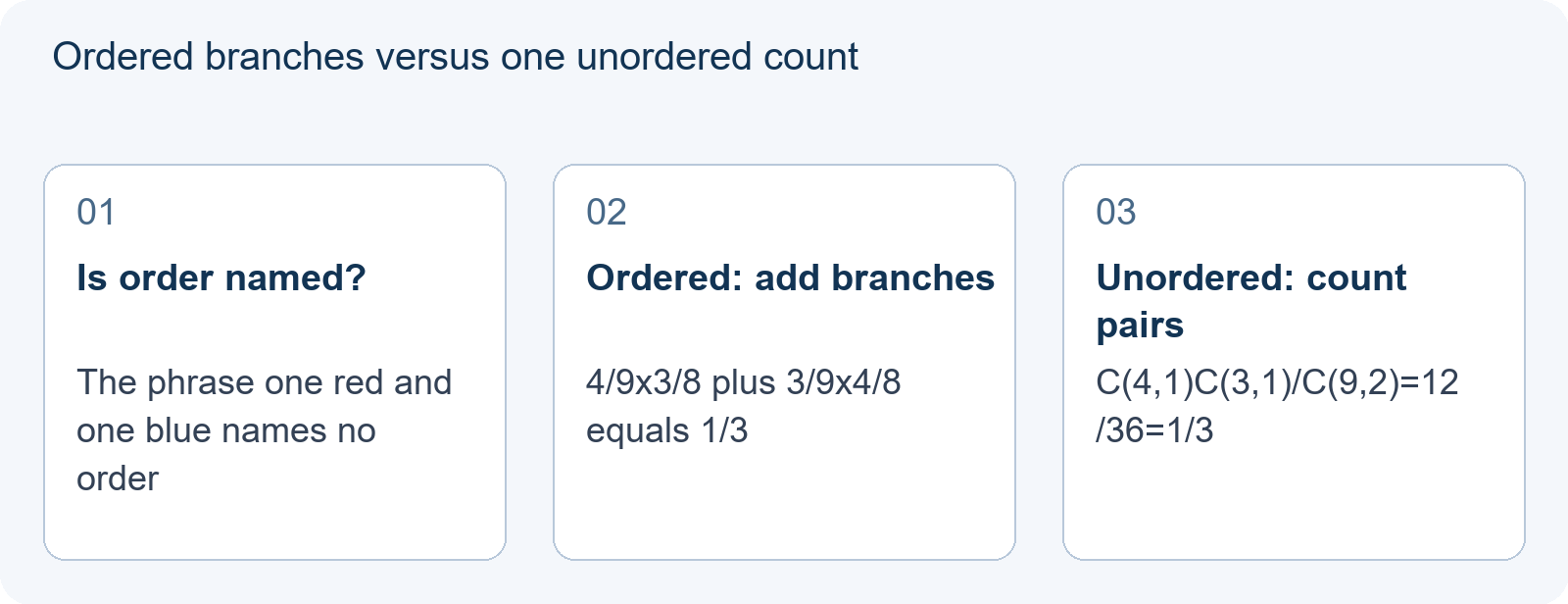
- One counter is red and one is blue. Order is not named, so there are two paths: 4/9 x 3/8 plus 3/9 x 4/8 = 1/6 + 1/6 = 1/3.
The combinations route reaches the same place in one line. Choosing two counters from nine gives C(9,2) = 36 equally likely unordered pairs. Red-and-blue pairs number 4 x 3 = 12, so the probability is 12/36 = 1/3. The two methods agree because dividing 9 x 8 = 72 ordered pairs by 2 is the same thing as collapsing the two branches into one.
That comparison gives a usable rule of thumb. If the wording names a position, such as first, second, then, in that order, or the card on the left, keep the branches separate and do not double. If the wording names only a collection, such as one of each, two counters, or the pair, either add the two branches or use a single combination count, but never both — adding branches and then also dividing by 2 counts the same pair twice. The same worry about counting a pair twice appears in AMO Grid Counting: Avoiding Double Counts in Rectangles and Paths, and the discipline transfers directly.
One exception keeps students out of trouble: when both drawn items are the same colour, the two branches are identical, so two red is a single term, 4/9 x 3/8, and matches C(4,2)/C(9,2) = 6/36 = 1/6. Doubling there is an over-count.
The complement shortcut for at least one
With the non-red counters grouped, at least one red covers three ordered paths. No red is one clean path. So work backwards: 1 minus 5/9 x 4/8 = 1 minus 5/18 = 13/18.
The method is only safe when the complement is genuinely the opposite. At least one red is the exact negation of no red. But at least one red and at least one blue is not negated by no red alone: a draw of one red and one green also fails the event. Two-colour complements need care, for example by subtracting both failure cases and adding back the overlap. If the negated sentence contains an and that becomes an or, stop and write the complement out in words before calculating.
The companion article AMO Probability: The ‘At Least One’ Complement Clinic works through when the shortcut is legitimate and when it quietly drops a case. The version here is the without-replacement half of the same idea.
The same bag with replacement: a two-column check
Putting the counter back changes every answer, and the direction of the change is worth knowing because it is a useful error check.
| Event | With replacement | Without replacement |
|---|---|---|
| No red | (5/9) squared = 25/81, about 0.309 | 5/18, about 0.278 |
| Two red | (4/9) squared = 16/81, about 0.198 | 1/6, about 0.167 |
| At least one red | 56/81, about 0.691 | 13/18, about 0.722 |
Without replacement, drawing red removes red, so, in this bag, two reds become slightly harder and at least one red becomes slightly easier. For these three events, if a student’s without-replacement answer is far from the with-replacement answer, or lies on the wrong side of it, that is a warning sign that the denominator failed to shrink.
One more equivalence belongs here. For probability calculations, choosing two items simultaneously is equivalent to drawing one, setting it aside, then drawing the second. Both are without replacement and both use shrinking denominators. Simultaneous does not mean independent.
Three diagnostic questions and the errors behind them
Teaching examples (original, not official AMO questions). Each of these has a complete statement and one intended error.
1. A box has 6 cards, 2 of them red. Two cards are removed at the same time. What is the probability that both are red? The answer is 2/6 x 1/5 = 1/15, which also equals C(2,2)/C(6,2) = 1/15. A child who answers 2/6 x 2/6 has treated simultaneous removal as replacement.
2. Five cards numbered 1 to 5 are shuffled. Two are drawn without replacement. What is the probability that the first card is even and the second is odd? Even cards are 2 and 4, so the first factor is 2/5. After an even card leaves, all three odd cards remain among four, so the second factor is 3/4, giving 6/20 = 3/10. A child who answers 2/5 x 3/5 has failed the denominator check.
3. Back to the 4 red, 3 blue, 2 green bag. What is the probability that the two counters are one red and one green? The answer is 4/9 x 2/8 plus 2/9 x 4/8 = 8/72 + 8/72 = 2/9, matching C(4,1)C(2,1)/C(9,2) = 8/36 = 2/9. A child who answers 1/9 has remembered to shrink the denominator but forgotten the second branch.
The examples isolate two different failure modes: examples 1 and 2 both reuse the first denominator, while example 3 forgets the second unordered branch. Diagnosing which one a student makes gives a clearer next step; a mixed set alone can hide it. Written working for these multi-step cases also belongs in the open-response style described in AMO Section B: A 5-Mark Open-Question Writing Clinic.
Where this fits the AMO paper
The AMO site reference (synced 14 July 2026) records a Grade 2 to Grade 12 competition with a 90-minute, 25-question paper and no negative marking, arranged in three sections: 15 multiple-choice questions at 3 marks, 5 open questions at 5 marks and 5 open questions at 6 marks, for 100 marks in total. A two-draw tree is quick to draw, which matters on a timed paper.
For season context only, SIMCC’s Upcoming Competitions page, checked on 16 November 2026, lists the 2026 AMO windows as finished — 30 October to 1 November for Singapore private candidates, 5 October to 5 November for Singapore school candidates, and 5 October to 8 November for international candidates — and shows no 2027 dates yet. Planning therefore rests on past papers and technique rather than a registration date.
Preparing a course-fit or resource question
If you ask a tutor or a coaching centre for help with this topic, bring three specific questions rather than a general description. Mark, on your child’s own working, which failure mode above appears. Note whether the wording named an order. Note whether the second denominator shrank. That is enough for a teacher to tell within a few minutes whether the gap is the conditional-probability idea, the ordered-versus-unordered language, or fraction arithmetic.
The same preparation helps with a resource request: state the grade, the number of draws, and whether replacement occurs, and ask for questions matching that description. A request phrased as ‘harder probability please’ can return a mixed set that re-tests what your child already does well.
Your next twenty minutes
Take three probability questions your child has already attempted. For each one, write the denominator above every draw. Circle the second denominator if it differs from the first. Then write one word beside the question: ordered, unordered or simultaneous. Any without-replacement question with an unchanged second denominator, or with no word beside it, is the one to redo first — and it should be redone as a tree, not as a fresh guess.
General event background is available at Event background.
Frequently Asked Questions
Why does the second fraction use 8 when nine counters started in the bag?
Because one counter has already been removed and not returned. The denominator counts the items still available at the moment of that draw. After the first draw, eight remain, so the second fraction divides by 8. The numerator drops to 3 only when a red was actually taken; on a blue-first branch all four reds are still there, giving 4/8.
Should my child add two branches or use combinations?
Either is correct as long as only one is done. Adding two branches suits ordered thinking and keeps the tree visible. A single combination count such as C(4,1)C(3,1)/C(9,2) can be more compact once the method is secure. Doing both — adding the red-then-blue and blue-then-red branches and then dividing by 2 — double-corrects the same pair and halves the intended probability. For same-colour events there is only one branch, so nothing is doubled and combinations also give the single count.
Are two counters taken at the same time the same as without replacement?
Yes. Choosing two items simultaneously is equivalent to drawing one, setting it aside, then drawing the second. Both are without replacement and both use shrinking denominators. The probability of two reds from 6 cards with 2 red is 2/6 x 1/5 = 1/15, the same whether the cards are taken together or one at a time.