
Understanding the Specific Challenge
Grid counting problems in the American Mathematics Olympiad (AMO) often trap students who apply standard formulas without verifying boundary conditions. The core difficulty lies not in knowing the formula for combinations, but in recognizing when distinct geometric configurations map to the same counted object. This article addresses that specific reasoning failure through practical examples, distinguishing itself from broader preparation guides like AMO Results: Choosing Your Next Maths Competition and Preparation Step.
Hypothetical Case 1: Rectangle Selection (Correct Approach)
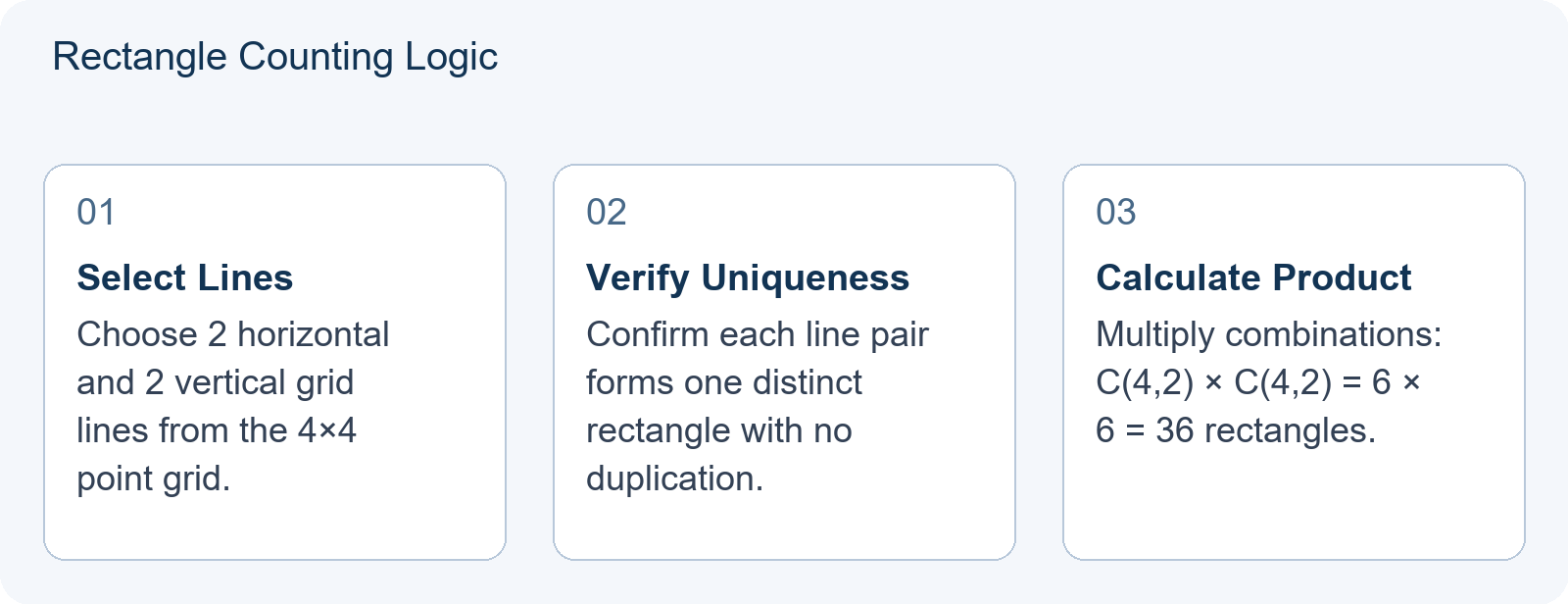
Consider a 4 × 4 grid of points. A common task is to count the number of rectangles with sides parallel to the grid lines. To solve this, we choose 2 distinct x-coordinates and 2 distinct y-coordinates from the available points. With 4 points in each direction, the calculation is C(4,2) × C(4,2) = 6 × 6 = 36 rectangles. This method is correct because every pair of horizontal lines intersects every pair of vertical lines exactly once to form a unique rectangle. There is no overlap or double counting here because the definition of the rectangle is strictly tied to the line pairs.
- Select Lines: Choose 2 horizontal and 2 vertical grid lines from the 4×4 point grid.
- Verify Uniqueness: Confirm each line pair forms one distinct rectangle with no duplication.
- Calculate Product: Multiply combinations: C(4,2) × C(4,2) = 6 × 6 = 36 rectangles.
Hypothetical Case 2: The Path Overlap Trap (Contrasting Mistake)
Now consider a problem asking for the number of paths from the bottom-left corner (0,0) to the top-right corner (3,3) on a grid, moving only right or up, that pass through a specific intermediate point (1,1).
Wrong approach: A student calculates the total paths to (3,3) as C(6,3) = 20, then tries to subtract paths that do not pass through (1,1). They reason: first count paths through (0,1), then paths through (1,0), then paths through (2,1)… but this collapses because these sets overlap—a single path can pass through multiple ‘avoided’ points, causing some paths to be subtracted twice while others are missed entirely. The subtraction method fails because ‘avoids (1,1)’ is not easily decomposed into non-overlapping categories.
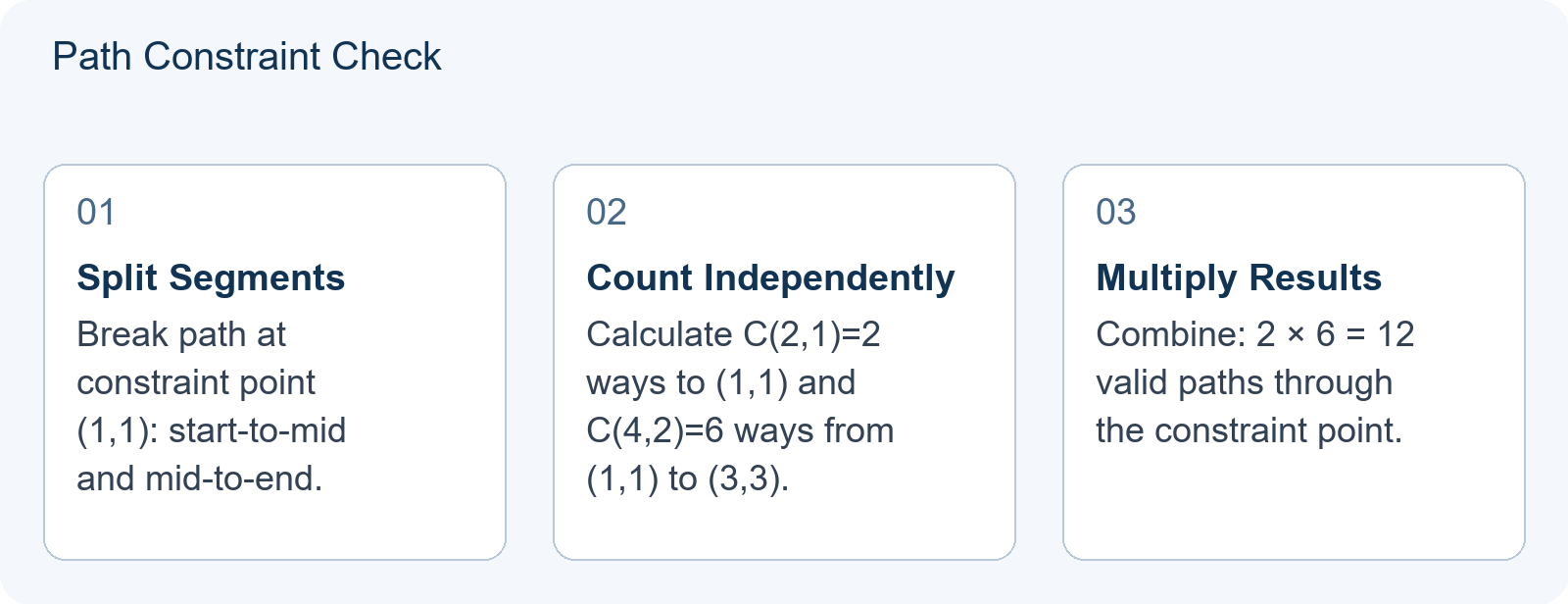
Correct approach: Use the multiplication principle on independent segments. Count paths from (0,0) to (1,1), then from (1,1) to (3,3), and multiply. Paths from (0,0) to (1,1) require 1 right and 1 up: C(2,1) = 2. Paths from (1,1) to (3,3) require 2 rights and 2 ups: C(4,2) = 6. The total is 2 × 6 = 12.
Why the mistake happens: The subtraction method fails because ‘avoids (1,1)’ is not easily decomposed. The set of paths through (1,1) and the set of paths through, say, (2,1) overlap unpredictably. The multiplication method works because the segments are sequential and independent—once you reach (1,1), how you got there doesn’t affect how you continue.
- Split Segments: Break path at constraint point (1,1): start-to-mid and mid-to-end.
- Count Independently: Calculate C(2,1)=2 ways to (1,1) and C(4,2)=6 ways from (1,1) to (3,3).
- Multiply Results: Combine: 2 × 6 = 12 valid paths through the constraint point.
Diagnostic Table for Common Errors
| Error Type | Symptom | Correction Strategy |
|---|---|---|
| Segment Independence Ignored | Attempting to subtract ‘bad’ paths from total without checking overlap between bad categories. | Break into sequential independent segments and multiply; verify segments don’t share interior points. |
| Boundary Misapplication | Formula works for interior but fails at edges. | Manually verify small cases (2 × 2 grids) to establish base patterns before generalizing. |
| Path Independence Assumption | Multiplying counts without checking that segment choices are truly sequential and non-overlapping. | Ensure each step in the multiplication represents a sequential, non-overlapping choice with no shared interior. |
Targeted Practice Sequence
To master this skill, learners should progress from static shape counting to dynamic path counting. Start with simple rectangle counts where all shapes are axis-aligned. Then, move to tilted squares within a grid, which requires careful coordinate geometry to avoid double-counting congruent shapes. Finally, tackle path problems with constraints. For broader context on test formats, refer to our guide on AMO Online vs Paper: Which Test Format Should Your Child Take?. Understanding the format helps calibrate how much time to spend on complex combinatorial reasoning versus speed drills.
Demonstrating Competence
The specific skill a learner should demonstrate is the ability to justify why a counting method does not overcount. This involves explicitly stating the bijection between the counted objects and the chosen parameters. For instance, “Each rectangle is uniquely determined by its top and bottom y-coordinates.” If you cannot state such a uniqueness condition, your count likely contains duplicates. For more foundational techniques, see AMO Algebra, Patterns and Sequences: How to Find the Rule and Work Backwards (2026). Additional preparation resources for building systematic counting habits are available in our overview of AMO Counting and Probability: Combinatorics, Logic and Arrangement Problems (2026).
Frequently Asked Questions
Why do I get different answers using symmetry vs direct counting?
Symmetry methods can overcount if the shape has rotational properties that map it onto itself in multiple ways. Direct counting via coordinates avoids this ambiguity.
Is it better to use inclusion-exclusion or complementary counting?
Complementary counting is often faster for ‘at least one’ conditions. Inclusion-exclusion is necessary when multiple overlapping constraints exist simultaneously.
How do I know if my grid assumption is valid?
Test your formula on a minimal case, such as a 2×2 grid. If the manual count matches the formula, the logic holds for larger grids.