
AMO algebra begins long before letters appear. A Grade 3 student who spots that a pattern grows by four each time is already doing it. This guide shows how patterns, sequences and unknowns develop across the AMO Grade 2–12 range, grouped into our own study bands, and teaches two methods that carry the most weight: the pattern pipeline, and working backwards.
The real gap: finding the rule, not solving the equation
Ask most students what algebra is and they will describe the last step — moving things across an equals sign. That step is rarely where marks are lost. In competition questions the difficulty sits one stage earlier: turning a situation into something you can operate on at all.
This is why a student can score well in school algebra tests and still stall on an AMO pattern question. School exercises hand over the equation; the student solves it. AMO hands over a staircase of tiles, or a machine that does something to a number, or a sequence with a gap in the middle, and asks the student to build the equation first. Building is a different skill from solving, and it responds to a different kind of practice.
A short note on what AMO is, since the name misleads: AMO is the American Mathematics Olympiad organised by SIMCC in Singapore together with Southern Illinois University Carbondale, open to Grades 2 to 12, with a framework aligned to the U.S. Common Core State Standards. It is not the AMC, which is a different competition run by the MAA in the United States. If that distinction is new, read what AMO is first.
The pattern pipeline: five steps, in order
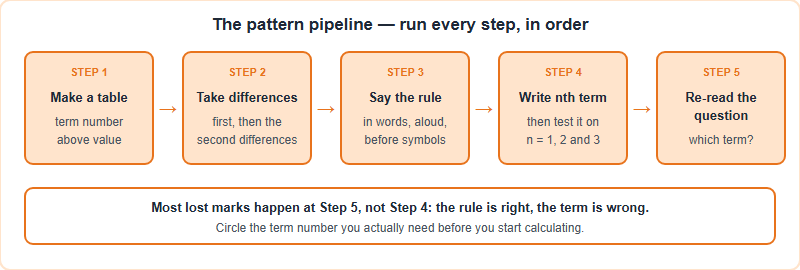
Pattern questions look different every year and yield to the same sequence of moves. Run all five, in order, every time — including the ones that feel unnecessary.
Step 1: make a table. Two rows: term number on top, value underneath. Students who try to hold a pattern in their head lose it at the fourth term. A table costs fifteen seconds and makes the next step possible.
Step 2: take the differences. Write the gap between consecutive values. If the gaps are constant, the rule involves multiplying the term number by that gap. If the gaps are not constant, take the differences of the differences: a constant second difference signals a square-type pattern.
Step 3: say the rule in words. “Four times the term number, then add one.” This is the step students skip, and skipping it is expensive: a rule you can say aloud can be checked aloud, while a rule that exists only as symbols cannot.
Step 4: write the nth term and test it. Convert your sentence into an expression, then substitute n = 1, n = 2 and n = 3 and confirm you reproduce the table you started from. Two of three is not a pass.
Step 5: re-read what was actually asked. The question may want the 50th term, or the term number that produces 201, or how many tiles are added between the 10th and 20th figures. A correct rule answered at the wrong point still scores zero.
Working backwards: the method that converts hard into easy
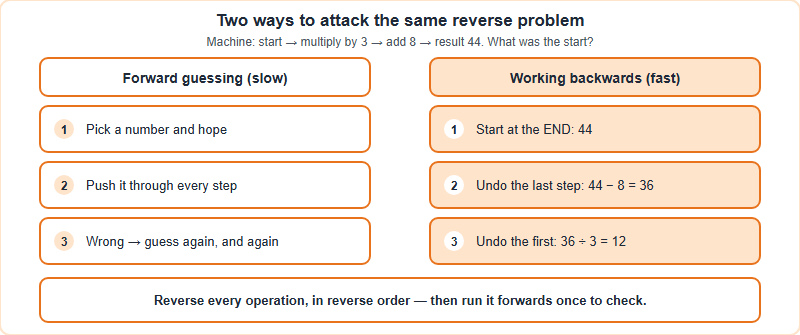
A whole family of AMO questions describes a process and gives you the end result. A number is tripled, then eight is added, and the answer is 44 — what was the number? A tank is half emptied, then twelve litres are added, and now it holds thirty litres. A shopper spends half her money, then three dollars, and has seven dollars left.
Students instinctively guess a starting value and push it through, then adjust. That works, slowly, and collapses as soon as the process has four stages or the numbers are not whole. The reliable method is to start at the end and undo each operation in reverse order: the last thing done is the first thing undone, and every operation is replaced by its opposite — add becomes subtract, multiply becomes divide, and so on.
Two habits make this dependable. First, write the process as a chain before you reverse it, so you can see the order. Second, once you have your answer, run it forwards through the original process once. That forward check costs a few seconds and catches the classic error of undoing operations in the order they were written rather than in reverse.
Naming the unknown — and when not to bother
Younger students meet unknowns as an empty box; older students meet them as x. The move that matters is identical: decide precisely what the letter stands for, and write it down in words. Not “let x be apples” but “let x be the number of apples Ben started with”. A large share of the algebra errors we see in marked practice papers are not manipulation errors — they are the student answering for a quantity slightly different from the one they defined.
The other half of the judgement is knowing when an equation is overkill. If a problem says one number is three more than another and they total 25, a quick trial is faster than formal setup. Reach for a written equation when at least one of these is true:
- Two or more unknowns are connected by two or more conditions.
- The relationships involve multiplying or dividing the unknown, not just adding to it.
- The numbers are awkward enough that trial-and-improvement would take more than a few attempts.
When you do set one up, substitution beats elimination for most competition problems at this level: use one condition to express one unknown in terms of the other, then push that into the second condition. And finish by substituting your values back into the original words of the problem, not into your own equation — that is the only check that catches a mis-translation.
Sequences worth recognising on sight
Recognition saves time that method alone cannot. A handful of sequences appear often enough across the AMO bands that they should be instant rather than derived.
| Sequence | First few terms | What gives it away | Typical band |
|---|---|---|---|
| Arithmetic (constant step) | 3, 7, 11, 15, … | First differences are equal | Grades 3–12 |
| Square numbers | 1, 4, 9, 16, 25, … | Second differences equal 2 | Grades 4–12 |
| Triangular numbers | 1, 3, 6, 10, 15, … | Differences increase by 1 each time | Grades 5–12 |
| Geometric (constant ratio) | 2, 6, 18, 54, … | Each term divided by the previous gives the same number | Grades 5–12 |
| Repeating cycle | 1, 2, 3, 1, 2, 3, … | Pattern returns to the start; use the remainder on division by the cycle length | Grades 6–12 |
| Add-the-previous-two | 1, 1, 2, 3, 5, 8, … | Neither differences nor ratios are constant, but each term is the sum of the two before it | Grades 7–12 |
The habit worth building is a triage reflex: on meeting any sequence, test the differences first, then the ratios, then the sum of consecutive terms. Three checks, perhaps twenty seconds, and the sequence is classified.
Where the marks actually leak
Sorted by how frequently we see them in students' marked practice papers, rather than by how serious they sound:
- The off-by-one nth term. A pattern starting at 5 and growing by 4 is 4n + 1, not 4n + 5. Testing n = 1 catches this instantly, which is why Step 4 exists.
- Answering the rule instead of the question. You derived 4n + 1 and wrote “4n + 1” when the question asked for the 20th term.
- Undoing in the written order. In working backwards, reversing the first operation first. The chain must be walked from the far end.
- Undefined letters. Using x for two different quantities inside one solution, usually after turning the page.
- Stopping at the equation. Setting it up correctly, solving correctly, and never converting the number back into the thing the question asked about — students, minutes, dollars.
Where a paper carries no penalty for wrong answers — confirm the current marking rules on the official AMO pages, and see how AMO scoring works — the cost of these slips is asymmetric: a blank and a near-miss score the same, so a partly-finished pattern question deserves your best estimate rather than nothing.
For practice, we would set this rhythm over four weeks: one week of pattern questions only, run through all five pipeline steps in writing even when the answer is obvious; one week of reverse-process questions with a compulsory forward check; one week of translating word problems into defined unknowns without solving them at all — setup only, ten problems a session; then one mixed week with no labels. Something families ask us often, as an authorised AMO registration partner in China, is whether their child should simply move to harder problems. Usually the more productive move is the setup-only week: it is the least popular exercise on this list and the one that changes scores most reliably.
Frequently asked questions
Does my child need formal algebra before trying AMO pattern questions?
No. Tables, differences and a rule stated in words carry the lower bands. Letters become a convenience later, not a prerequisite.
How much algebra is on an AMO paper?
The syllabus balance and paper structure are set by the organiser and can change between years. Confirm current details on the official AMO pages.
Is working backwards allowed if the question expects an equation?
Yes — any valid method that reaches the right answer is fine. How much of your working is recorded or assessed is set by the organiser, so check the current marking rules on the official AMO pages.
Is AMO algebra the same as AMC algebra?
No. AMO is run by SIMCC in Singapore with SIU for Grades 2–12; the AMC is a separate competition run by the MAA in the United States.
This site is operated by Hanlin Education as an authorized AMO registration partner for China. AMO (American Mathematics Olympiad) is run by SIMCC (Singapore International Mastery Contests Centre) together with Southern Illinois University; we are not the organiser. Registration windows, eligibility, paper structure, syllabus and award criteria are set by the organiser — please confirm all details on the official SIMCC / AMO pages. Factual corrections are made within 7 working days.