
Counting questions ask “how many ways” and need no advanced formula — which is exactly why they cost marks. Students answer from instinct instead of method, then double-count or miss cases. This guide maps how counting, probability and logic appear across the AMO Grade 2–12 range, grouped into our own study bands, and gives you five tools that handle most of them.
Why “how many ways” questions punish instinct
Most competition topics have a visible gate. If a question needs the area of a trapezium and you have never met a trapezium, you know immediately that you are stuck. Counting questions have no gate. Every student can read “In how many ways can four children sit in a row?” and every student feels able to start. That confidence is the trap.
In practice, counting answers go wrong in only two ways, and both are invisible from inside your own working:
- Missing cases. You listed some possibilities, felt you had them all, and stopped. Nothing on the page tells you a case is absent.
- Double counting. You counted the same arrangement twice under two different descriptions — the single most common cause of an answer that is exactly double, or exactly six times, the correct one.
There is a second reason counting deserves deliberate practice. Where a paper carries no penalty for a wrong answer — confirm the current marking rules on the official AMO pages, and see how AMO scoring works — students learn to put something down and move on. That instinct is correct for a question you genuinely cannot start. It is wasteful on a counting question, where thirty seconds of ordered listing very often produces the exact answer rather than a hopeful one.
One point of orientation before the mathematics. AMO is the American Mathematics Olympiad organised by SIMCC in Singapore together with Southern Illinois University Carbondale, open to students in Grades 2 to 12, with a framework aligned to the U.S. Common Core State Standards. It is not the AMC, which is a separate competition run by the MAA in the United States. If you are new to the distinction, start with what AMO is.
The five tools that solve most AMO counting questions
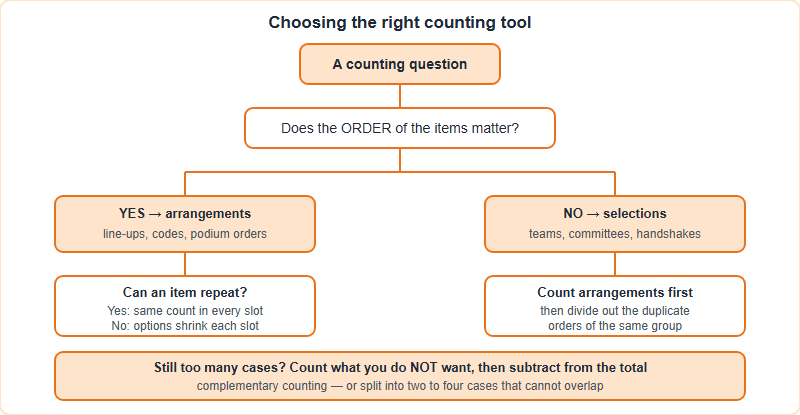
You do not need factorial notation to be good at this. You need five habits, applied in order.
1. Systematic listing. When the numbers are small, list — but list in a fixed order: alphabetical, or smallest-first, or by first digit. Random listing is what makes students miss cases. Ordered listing makes the gaps visible. This is a real technique for the youngest bands and a checking technique for the oldest.
2. The multiplication principle (slots). If a task is a sequence of independent choices, draw a slot for each choice and write the number of options above it, then multiply. Four-digit codes, outfits, routes, seat orders — all slots. The whole skill is deciding what counts as one slot and whether the options shrink after each choice.
3. The addition principle and casework. If the situation splits into scenarios that cannot happen together, count each scenario and add. The word that matters is cannot: your cases must not overlap, or you are back to double counting. Good casework is usually two to four cases; if you have written down nine, look for a better split.
4. Complementary counting. When “at least one” appears, counting what you do not want is normally faster. Total minus unwanted equals wanted. Students resist this because it feels indirect, but on restriction-heavy questions it turns a six-case mess into two lines.
5. Does order matter? Decide this before you calculate anything. Arrangements (order matters: line-ups, podium finishes, passwords) are counted with slots. Selections (order does not matter: teams, committees, handshakes) are counted as arrangements first, then divided by the number of ways the chosen group could have been ordered. Handshake questions are the standard illustration: each handshake gets counted twice if you count from both people, so the honest answer is half your first number.
What counting looks like at each grade band
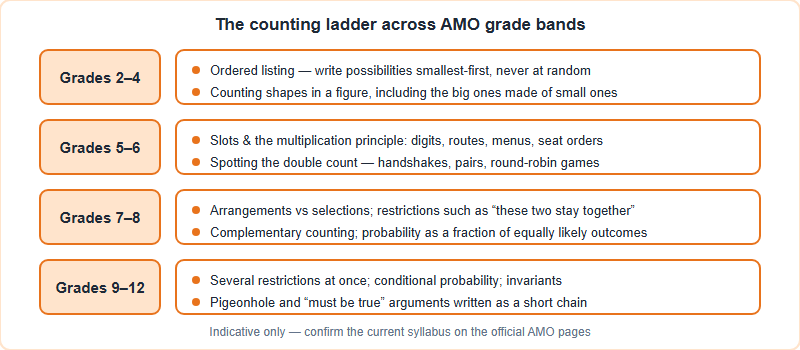
AMO runs across Grades 2 to 12 and the same idea reappears in harder clothing as the bands rise. Knowing which version belongs to your band stops two opposite mistakes: drilling material years above your paper, and assuming a topic will not appear because it sounds advanced. If you are unsure which level your child sits, read AMO grade levels explained, and confirm the current level structure on the official AMO pages.
| Band | How counting usually appears | What to drill |
|---|---|---|
| Grades 2–4 | Counting shapes inside a figure; simple lists; small arrangements of three or four objects; “how many different ways” with concrete items | Ordered listing; counting triangles and rectangles inside a grid without missing the large ones |
| Grades 5–6 | Slot problems (digits, outfits, menus); routes on a grid; handshake and round-robin situations; first taste of casework | Multiplication principle; recognising when the same item is being counted twice |
| Grades 7–8 | Arrangements vs selections stated explicitly; restrictions (“two people must sit together”); probability as a fraction of equally likely outcomes | Complementary counting; treating a fixed pair as a single block; clean casework |
| Grades 9–12 | Counting with several restrictions; probability with conditions; pigeonhole arguments; “must be true” reasoning | Justifying that cases are exhaustive and non-overlapping; writing a short deduction chain |
Probability is counting, done twice
Once a student can count, probability is close to free: the numerator is a count and the denominator is a count. What derails students is not the fraction — it is the assumption hiding underneath it.
A probability fraction is only valid when the outcomes you are counting are equally likely. Take two ordinary dice and ask for the probability that the total is 5. A student who reasons “the totals run from 2 to 12, that is eleven totals, so the answer is one eleventh” has counted honestly and answered wrongly, because a total of 7 is far more likely than a total of 2. Counting the thirty-six ordered pairs instead gives four favourable pairs — 1 and 4, 2 and 3, 3 and 2, 4 and 1 — and the fraction 4/36, which simplifies to 1/9.
So the discipline is: decide your unit of counting first, check that every unit is equally likely, and only then build the fraction. Write the denominator before the numerator. Students who write the numerator first tend to reverse-engineer a denominator that agrees with it.
Logic, pigeonhole and “must be true” questions
The upper bands add questions where nothing is calculated at all. You are told a set of conditions and asked what must follow. Two families appear often enough to prepare deliberately.
Grid logic. Four people, four sports, a handful of clues. The method is mechanical: draw a grid, mark impossibilities as they are ruled out rather than only marking confirmations, and re-read every clue after each new deduction. Most students lose these not through faulty logic but by using a clue once and forgetting it becomes more powerful later.
Pigeonhole. If you place more objects than containers, some container holds at least two. It sounds too obvious to be a technique, yet it answers questions such as “what is the smallest number of socks you must take from a dark drawer to be certain of a matching pair?” The move students miss is the worst-case framing: assume the most unhelpful draw possible, then take one more. Write the sentence “in the worst case…” explicitly — it converts a guess into an argument.
For these, the quality of your written chain matters even when only a final answer is recorded. A student who can write three linked sentences — therefore, therefore, therefore — almost never mis-records the answer, because the last sentence names exactly what was asked.
Four traps, and how to practise out of them
- The order trap. Counting a committee as though it were a line-up. Symptom: your answer is an exact multiple of the correct one. Fix: after every count, ask “would swapping two of these give a genuinely different outcome?”
- The inclusive trap. How many numbers from 7 to 19? It is 13, not 12. Subtract and add one whenever both endpoints belong. This single off-by-one accounts for a remarkable share of otherwise perfect solutions.
- The overlap trap. Adding cases that share members. If a question involves “or”, check whether something can satisfy both branches, and subtract the overlap once.
- The wrong-question trap. The question asked for the probability; you wrote the number of ways. Or it asked how many students, and you gave how many pairs. Underline the final noun in the question before you start.
A workable practice pattern is narrow and repetitive rather than broad. Take one tool a week — listing, slots, casework, complementary counting — and work only questions that use it, including the ones that look like they belong to another topic. Then spend one session a week mixing all four with no labels, because in the real paper nothing tells you which tool applies. In the questions families send us as an authorised AMO registration partner in China, the single most frequent request is for “harder problems”, when the more useful step is almost always a slower, more honest review of the counting questions already attempted and marked wrong for the second time.
Frequently asked questions
Do I need permutation and combination formulas for AMO?
Not for the lower bands. Slots, ordered listing and dividing out duplicate orders handle most questions. Formulas help in the senior bands as shorthand.
How much counting appears on an AMO paper?
The organiser sets the syllabus balance and the paper structure, and these can change between years. Confirm the current details on the official AMO pages.
Should my child guess a counting question they cannot finish?
A considered answer is better than a blank if the paper carries no penalty for a wrong answer. Confirm the current marking rules on the official AMO pages before relying on this.
Is this the same counting syllabus as the AMC?
No. AMO is run by SIMCC in Singapore with SIU for Grades 2–12. The AMC is a separate competition run by the MAA in the United States.
This site is operated by Hanlin Education as an authorized AMO registration partner for China. AMO (American Mathematics Olympiad) is run by SIMCC (Singapore International Mastery Contests Centre) together with Southern Illinois University; we are not the organiser. Registration windows, eligibility, paper structure, syllabus and award criteria are set by the organiser — please confirm all details on the official SIMCC / AMO pages. Factual corrections are made within 7 working days.