
For families preparing for the American Mathematics Olympiad (AMO), particularly in grades where number theory concepts begin to appear, AMO Remainder Word Problems represent a specific cognitive hurdle. Unlike straightforward division calculations, these problems require students to interpret textual constraints—such as “when divided by X, the remainder is Y”—and synthesize them to find a specific value, often the smallest positive integer that satisfies all conditions.
This article addresses the narrow but critical skill of translating word-based modular arithmetic into solvable equations. It distinguishes itself from broader preparation guides by focusing exclusively on the logical deduction required when multiple remainder conditions are present. For a general overview of AMO structure and scoring, please refer to our existing guide on AMO Results: Choosing Your Next Maths Competition and Preparation Step.
The Core Challenge: Interpreting Constraints
In an AMO context, a remainder problem rarely asks for a simple calculation. Instead, it presents a scenario where a quantity must satisfy several divisibility rules simultaneously. The difficulty lies not in the arithmetic itself, but in organizing the information. Students often attempt to guess numbers randomly or apply a single rule without checking against others.
The effective strategy involves two steps:
- Identify the modulus: Determine what numbers are dividing the unknown quantity.
- Establish the residue: Note exactly what remains after each division.
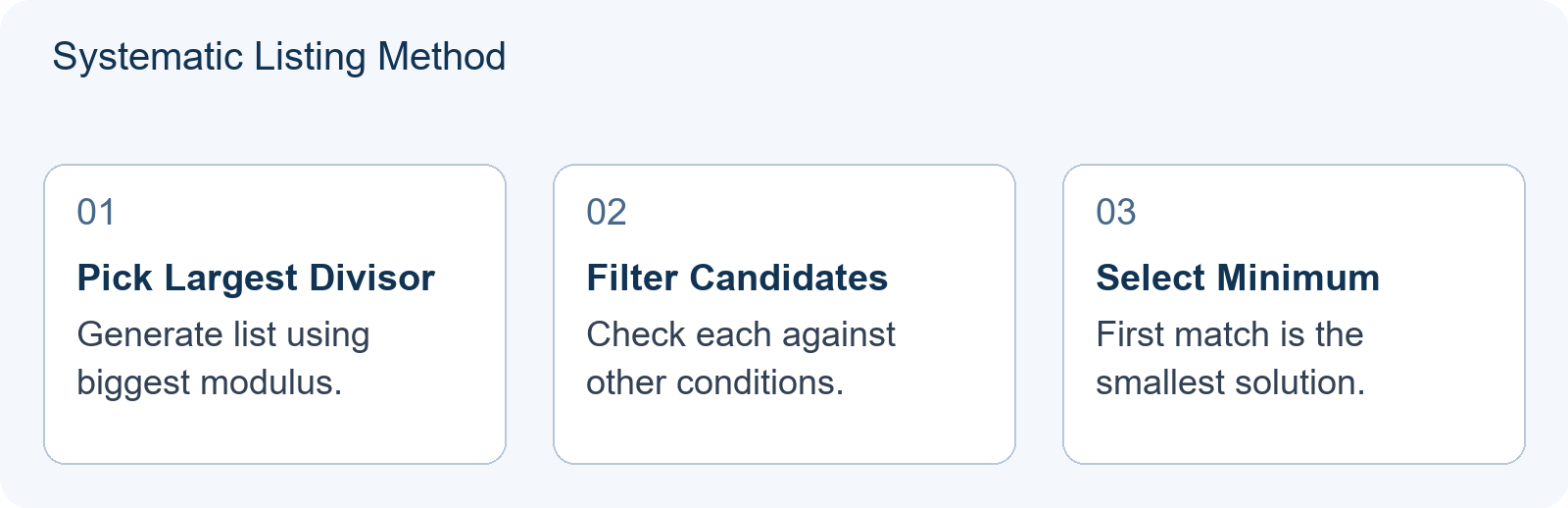
When multiple conditions exist, the solution space narrows rapidly. The goal is usually to find the smallest positive integer, which implies starting from zero or one and incrementing based on the largest modulus first to reduce trial iterations.
Worked Example 1: Single Constraint with Context
Consider a hypothetical AMO-style question suitable for upper elementary or middle school levels:
“A teacher has a bag of candies. When she divides them equally among 5 students, there are 3 left over. If she divides them among 7 students, there are also 3 left over. What is the smallest number of candies she could have?”
Step-by-Step Deduction:
- Analyze Condition A: . This means can be written as for some integer .
- Analyze Condition B: . This means can be written as for some integer .
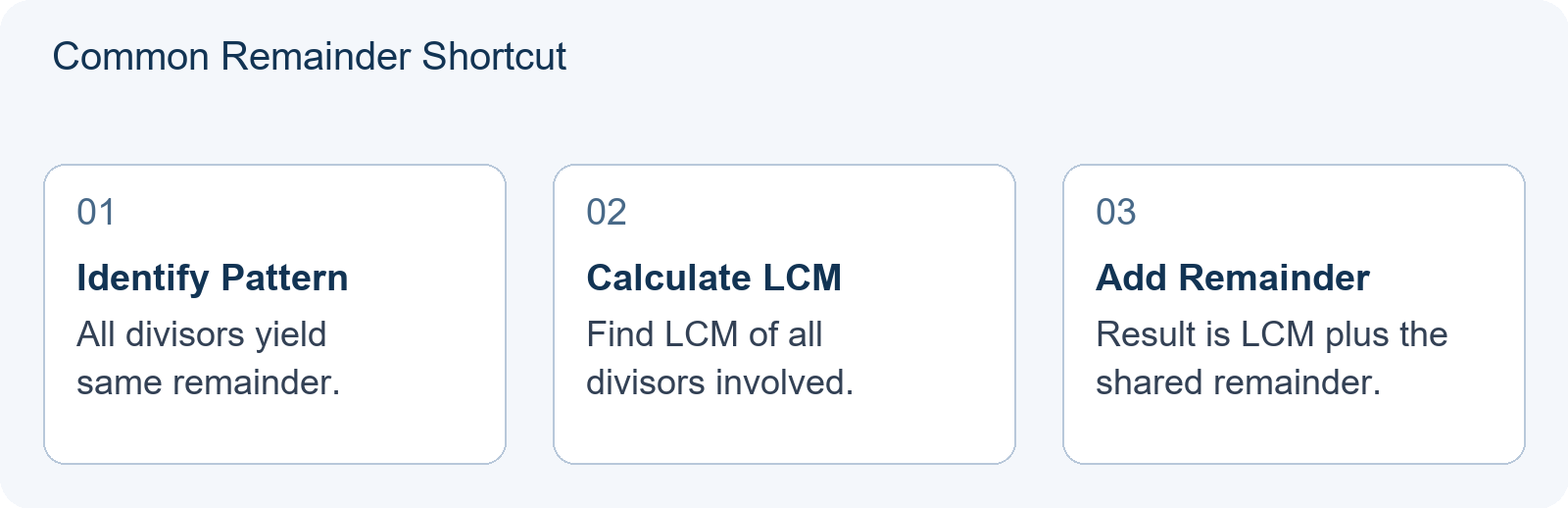
- Synthesize: Since both conditions result in a remainder of 3, we can subtract 3 from to get a number divisible by both 5 and 7. Let . Then is a common multiple of 5 and 7.
- Find Least Common Multiple (LCM): The LCM of 5 and 7 is 35. Therefore, the smallest positive is 35.
- Recover N: .
This example illustrates the “common remainder” shortcut. When remainders are identical, the number minus the remainder is divisible by the least common multiple of the divisors. The general form is: if and , then for some non-negative integer , and the smallest positive solution is when .
Worked Example 2: Different Remainders Require Systematic Listing
A more complex scenario arises when remainders differ. This is where many students fail because they try to apply the previous shortcut incorrectly.
“Find the smallest positive integer that leaves a remainder of 2 when divided by 3, and a remainder of 4 when divided by 5.”
The Common Pitfall:
Students might notice superficial patterns like and , then guess numbers without verification. Others might attempt to force the common-remainder shortcut by manipulating signs, which leads to errors. The correct approach recognizes that no simple subtraction shortcut exists when remainders differ.
Rigorous Method (Systematic Listing):
- Start with the larger divisor: Numbers satisfying are: 4, 9, 14, 19, 24, 29…
- Test against the smaller divisor condition ():
- Check 4: remainder . (Fails: need remainder 2)
- Check 9: remainder . (Fails: need remainder 2)
- Check 14: remainder . (Satisfies both conditions)
- Conclusion: Since we tested candidates in ascending order starting from the smallest non-negative value, 14 is the smallest positive integer satisfying both conditions.
Generalizing the Solution: Once the base solution 14 is found, all other solutions follow the pattern for non-negative integers . The next solution is , which verifies as remainder and remainder .
Why this matters for AMO: In timed competitions, listing candidates based on the largest modulus is faster than algebraic substitution for small integers. It reduces cognitive load and minimizes calculation errors. The key discipline is testing candidates in strict ascending order and stopping immediately at the first valid match—this guarantees minimality by construction.
Diagnostic Table: Identifying Your Strategy
Use this table to determine the best approach for a given remainder problem during practice sessions.
| Problem Feature | Recommended Strategy | Reasoning |
|---|---|---|
| Same remainder for all divisors | Subtract remainder, find LCM | Reduces problem to finding common multiples directly. |
| Different remainders, small divisors (<10) | Systematic Listing | Faster than Chinese Remainder Theorem formulas for mental math. |
| Different remainders, large divisors | Modular Arithmetic Substitution | Listing becomes too slow; algebraic isolation is necessary. |
| “Smallest number greater than X” | Find base solution, add multiples of LCM | General solution is . Solve for smallest giving value above threshold. |
Targeted Practice Sequence
To build proficiency in AMO Remainder Word Problems, learners should follow a graduated sequence rather than random drilling. This structured progression helps build confidence regardless of whether your child sits the exam online or on paper; see our comparison of AMO Online vs Paper: Which Test Format Should Your Child Take? for logistical differences.
- Phase 1: Verification Drills. Give students a number and ask them to verify if it fits three different remainder conditions. This builds confidence in checking work and catches sign errors early.
- Phase 2: Single Constraint Search. Ask for the smallest number satisfying one condition within a range (e.g., between 50 and 60). This practices modular thinking without overwhelming cognitive load.
- Phase 3: Two-Constraint Intersection. Introduce two divisors with different remainders. Use the systematic listing method described above, always starting from the larger divisor’s sequence.
- Phase 4: Three-Constraint Complexity. Add a third divisor. This requires careful tracking of the LCM cycle and tests whether students recognize when to switch from listing to algebraic methods.
For parents of younger students encountering their first word problems, see our introductory guide AMO Grade 2: What a First-Year Parent Should Know Before Signing Up.
Conclusion: Demonstrating Mastery
A learner has mastered this topic when they can instantly recognize whether a “common remainder” shortcut applies or if systematic listing is safer. They should be able to explain why adding the Least Common Multiple generates subsequent valid solutions, and why the first valid candidate in an ordered search is necessarily the smallest. This conceptual clarity prevents rote memorization failures when problem parameters change slightly—a common tactic in AMO questions designed to test adaptability rather than pattern matching.
Frequently Asked Questions
Is the Chinese Remainder Theorem required for AMO?
No, formal CRT proofs are generally not required for lower-grade AMO levels. Systematic listing and logical deduction are sufficient and faster for competition time limits.
What if the remainders are negative?
In standard AMO contexts, remainders are non-negative integers less than the divisor. If a problem implies ‘shortage’, convert it to a positive remainder by adding the divisor to the negative value.
How do I know if I found the smallest number?
Ensure you started your search from the lowest possible positive integer (usually 1 or the remainder itself) and stopped at the first valid candidate. Adding the LCM gives the next valid number, not the smallest.