
Signing your child up for their first math competition can feel overwhelming. If you are considering the AMO grade 2 level, you are likely looking for a way to challenge your child’s logical thinking without crushing their love for learning. The American Mathematics Olympiad (AMO) is distinct from other contests like the AMC or SASMO, offering a structured path for young minds. Here is what you need to know before hitting the register button.
Understanding the AMO Format for Young Learners
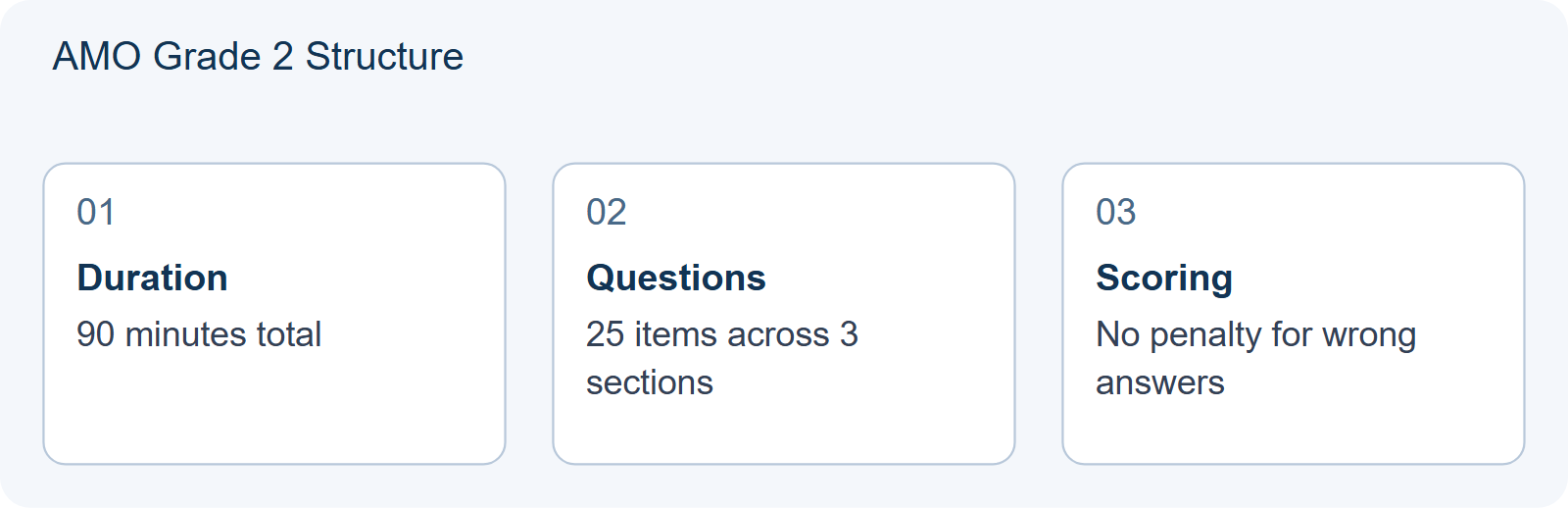
The AMO is designed to be accessible yet challenging. For Grade 2 students, the contest typically lasts 90 minutes and consists of 25 questions. These are divided into three sections: multiple-choice questions, short-answer open questions, and longer open-response problems. There is no penalty for wrong answers, which encourages students to attempt every question rather than leaving blanks out of fear.
It is crucial to distinguish this from the American Mathematics Competitions (AMC). While names sound similar, they are different organizations with different styles. The AMO often emphasizes creative problem-solving and visual logic, which suits younger children who may not yet have advanced algebraic skills. Understanding this difference helps you choose the right preparation materials.
Common Pitfalls for First-Time Parents
Many parents make the mistake of over-preparing. For a Grade 2 student, the goal should be familiarity with the test format, not mastering complex theorems. A common error is using resources meant for older grades. This leads to frustration and anxiety. Instead, focus on building confidence through manageable challenges.
Another pitfall is ignoring the English language component. Since the AMO is an international contest, questions are presented in English. Even if your child is fluent, mathematical terminology can be tricky. Terms like “perimeter,” “sequence,” or “remainder” might be new. Spending time on vocabulary ensures that language barriers do not hinder mathematical reasoning.
If you are unsure where to start, consider reviewing how to select appropriate practice material. Not all books are created equal, and some may be too dry or difficult for a seven-year-old. You can find guidance on choosing the right resources in our article on Prepping With the Wrong Book: How to Choose AMO Practice Material (2026).
Strategic Preparation Without Burnout
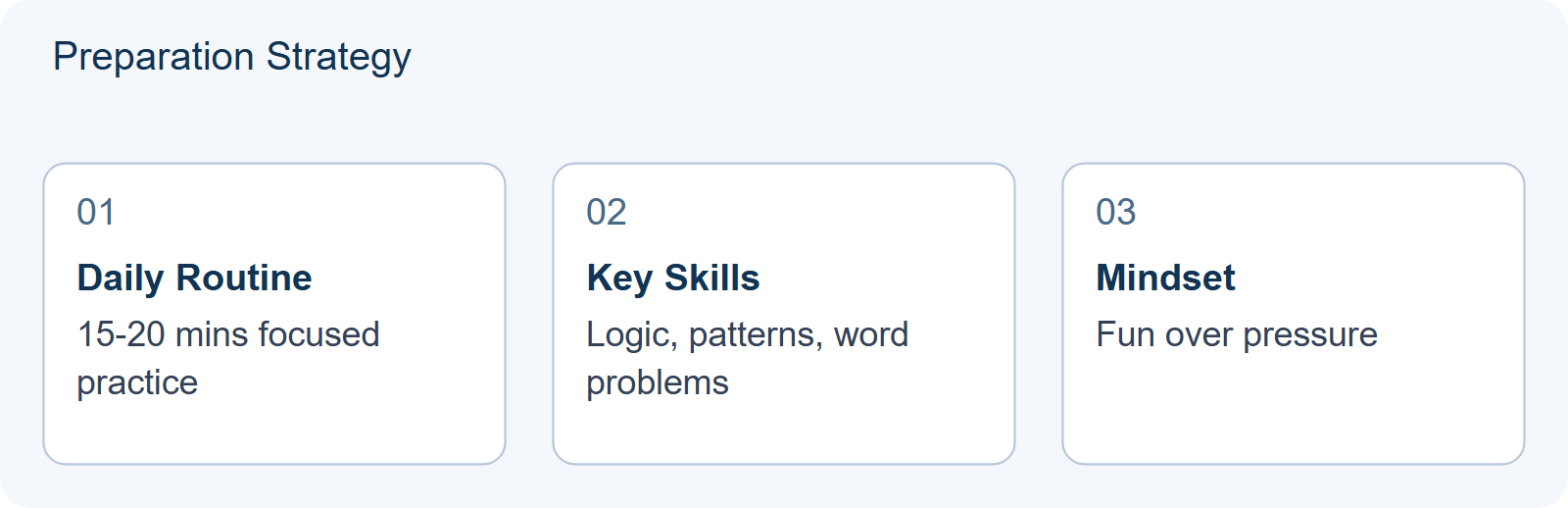
Effective preparation for AMO grade 2 is about consistency, not intensity. Short, daily sessions of 15–20 minutes are more effective than weekend marathons. Use games and puzzles to keep engagement high. Logic grids, pattern recognition, and simple word problems are excellent tools.
Focus on foundational skills such as number sense, basic geometry, and early arithmetic operations. Word problems are particularly important because they require translating text into mathematical actions. Many students struggle here not because they cannot calculate, but because they misinterpret the question. Practicing reading comprehension alongside math skills is vital.
To help your child navigate these types of questions, look at specific strategies for word problems. Our guide on The Assumption Method for AMO Word Problems: Heads and Legs, Two Prices and Excess-and-Shortage (2026) breaks down how to approach these classic puzzle types in a kid-friendly way.
What Happens After the Contest?
Once the exam is done, manage expectations carefully. Medals are awarded based on percentile rankings, meaning only a portion of participants receive Gold, Silver, or Bronze. It is possible for a strong student to miss a medal simply because the cohort was competitive that year. This is normal and does not reflect poorly on your child’s ability.
Use the experience as a data point for future growth. Did your child run out of time? Did they misunderstand instructions? These insights are valuable for next year. Remember that participation itself builds resilience and exposure to higher-level thinking.
If you are planning for subsequent years, understanding how performance bands shift is helpful. Read more about why scores vary between cohorts in our analysis of AMO Year Two: Why a Better Student Can Land the Same Medal – and What Actually Moves the Band (2026).
Final Checklist for Registration
- Verify Eligibility: Ensure your child is currently in Grade 2 during the contest period.
- Check Dates: Confirm the exact testing window with the official registration channel, as dates can shift slightly by region.
- Prepare Materials: Have pencils, erasers, and a clear water bottle ready. No calculators are allowed.
- Practice Timing: Do one full mock test under timed conditions to build stamina.
- Stay Calm: Your attitude sets the tone. Keep it fun and low-pressure.
By focusing on process rather than outcome, you give your child the best chance to enjoy the AMO grade 2 experience. It is a journey of discovery, not just a test score.
HYPOTHETICAL/ILLUSTRATIVE: Choosing Between Speed Drills and Deep-Dive Puzzles
Let’s imagine a specific preparation dilemma many first-year parents face. Suppose your child, Leo, enjoys math but gets frustrated when he cannot solve a problem within two minutes. You have thirty minutes available each evening for practice. Two plausible approaches emerge: Option A involves timed multiple-choice drills to boost speed and familiarity with the AMO Grade 2 format. Option B involves one or two open-response logic puzzles per session, allowing Leo to struggle, sketch diagrams, and discuss his reasoning without a clock ticking.
The decision hinges on identifying the root cause of Leo’s frustration. If you choose Option A, you are prioritizing test stamina and quick recognition of standard patterns. This might help him finish the 90-minute contest comfortably. However, if his anxiety stems from feeling “stuck,” this approach could reinforce the belief that math is about fast answers rather than deep thinking. He might learn to guess quickly but fail to develop the resilience needed for the harder open-response sections.
Conversely, Option B focuses on conceptual depth. By working through a single complex visual logic puzzle, Leo learns to break down information, use trial-and-error constructively, and articulate why an answer works. This aligns with the AMO’s emphasis on creative problem-solving. The risk here is time management; if he spends too long on one idea during the actual contest, he may leave easier questions unanswered. Yet, for a seven-year-old, building confidence in tackling hard problems often yields better long-term engagement than sheer speed.
What changes the decision? Observe how Leo reacts to failure. If he quits immediately after a wrong answer, Option B (with heavy parental support) is better because it reframes mistakes as part of the process. If he rushes and makes careless errors despite knowing the concepts, Option A helps build discipline. In our hypothetical scenario, let’s say Leo loves drawing pictures to solve problems but hates being rushed. The best choice is a hybrid: spend 15 minutes on a deep-dive puzzle (Option B) and 5 minutes reviewing simple pattern recognition cards (a light version of Option A).
This example illustrates that there is no universal “best” method. The right preparation mirrors your child’s current emotional relationship with challenge. For AMO Grade 2, where the goal is fostering logical curiosity, protecting their willingness to attempt difficult questions is more valuable than maximizing raw speed.
| Self-Check Question | Indicates Option A (Speed/Format) | Indicates Option B (Depth/Logic) |
|---|---|---|
| How does your child react to a blank page? | They panic and want immediate instructions. | They start sketching or guessing freely. |
| Where do they lose points in mock tests? | Running out of time on easy questions. | Leaving hard questions blank due to fear. |
| What is their primary motivation? | Winning or finishing first. | Solving the mystery or making a cool picture. |
Frequently Asked Questions
Is AMO the same as AMC?
No. AMO stands for American Mathematics Olympiad, while AMC refers to American Mathematics Competitions. They are organized by different bodies with different formats.
Can my child use a calculator?
No, calculators are generally not permitted in the AMO. Students must rely on mental math and written calculation skills.
How many medals are awarded?
Medals are given based on percentiles. Typically, the top 8% get Gold, next 12% Silver, and next 20% Bronze, though this can vary by year.