
A second AMO sitting is not a rerun of the first. It is a harder paper, taken against a field that also spent a year improving, scored against bands that move. That combination means a student can answer more questions, make fewer mistakes and think better — and still receive the same award colour. Reading that outcome as “no progress” is the most common mistake returning families make, and it usually leads to the wrong plan for year three.
Three things change between sitting one and sitting two
Families tend to model the second attempt as a single variable: my child is better, so the result should improve. Three variables actually move, and two of them move against you.
- The paper gets harder. AMO levels track school grade across the grades 2 to 12 range, so in an ordinary year-on-year progression the second sitting is at a higher level than the first. You are not retaking a paper; you are meeting a new one. Our AMO grade levels explained guide sets out how grades map onto levels, and level rules are set by the organiser, so confirm the current mapping on the official AMO pages.
- The field ages with you. Everyone in the new level also had a year of school mathematics. Your child improved; so did the comparison group. Improvement only shows up in a ranked result if it is faster than the field's.
- The bands are percentile-based, and the cut-offs float. Per the organiser's published scheme, awards are distributed by percentile — broadly Gold to around the top 8 per cent, Silver to the next 12 per cent and Bronze to the next 20 per cent, so roughly the top 40 per cent of the field receives an award. There is no fixed “Gold equals 90 marks” line; the threshold is wherever the field puts it that season. Our guide to how AMO scoring works explains the mechanics, and the current scheme should be confirmed on the official pages before you plan around it.
Put those together and the shape of the problem becomes clear. It is an escalator: your child is walking up while the steps move. Standing still means falling; genuine improvement is often what it takes to hold position; a band change requires improving faster than a whole cohort.
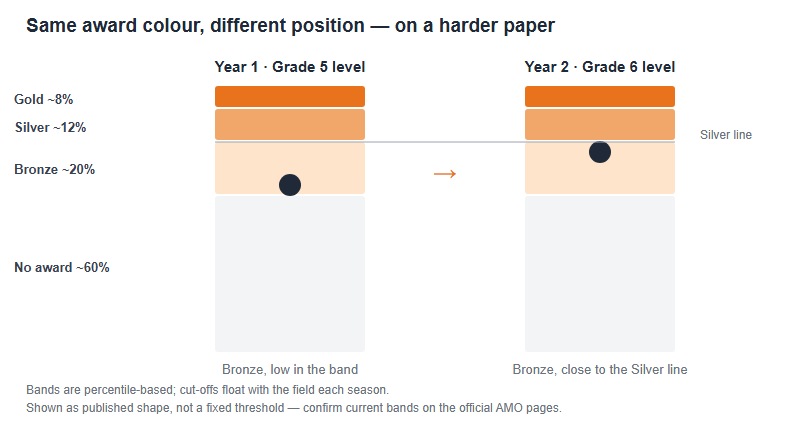
What “the same medal” can conceal
Because the award colour is a band rather than a number, it is a low-resolution instrument. Two very different years can produce identical certificates. The table below is an illustrative model built to show the arithmetic — it is not published AMO data and not any individual student's result.
| What you can measure | Year 1 (Grade 5 level) | Year 2 (Grade 6 level) | What it actually tells you |
|---|---|---|---|
| Share of available marks | 62% | 71% | Nine points of accuracy gained on a harder paper |
| Answer boxes left blank | 6 | 1 | Time management and the no-blank habit have landed |
| Hardest-tier items solved | 0 | 2 | The ceiling moved — the biggest signal in the table |
| Careless losses on secured material | 4 | 3 | Barely moved; this is next year's target |
| Award band | Bronze | Bronze | Unchanged — and the least informative row here |
Read from the bottom row alone, that is a flat year. Read from the rest of the table, it is a strong one: a level harder, nine points more accurate, five fewer blanks and the first successful attacks on the hardest tier. The single row that did not move — careless losses — is the one that tells you what to work on. This is why we ask returning families to write down four or five measurements before results day, rather than waiting to be told a colour.
The reverse case matters just as much. A student can move up a band while doing nothing better, because a particular season's field was weaker or the paper suited them. A band improvement built on nothing repeatable will not repeat.
Where the next band actually comes from
If you do want to move a band, it helps to know where the marks live. Split any paper your child sits into three tiers by how they performed, not by how the paper is organised.
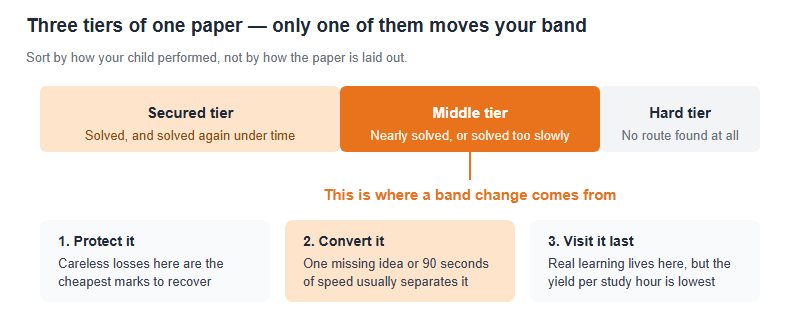
Most returning families spend year two on the hard tier, because those are the questions that hurt. It is the wrong allocation. The hard tier is where a student learns the most per problem and gains the least per hour; the middle tier is where a year of work turns into position. Concretely, that means:
- Recover blanks first. Where the marking scheme for your sitting carries no penalty for a wrong answer, an empty box is strictly worse than a bounded, reasoned attempt — confirm the current marking rules for your sitting on the official AMO pages, since scoring conventions differ across contests in the same family. Reducing blanks costs no mathematics at all, only a rehearsed final sweep.
- Then fix the repeat errors. Losses on material your child genuinely knows are the cheapest marks in the paper, and they persist unless they are logged and classified rather than simply corrected.
- Then convert near-misses. For each middle-tier question, decide honestly whether the gap was a missing idea or missing speed. Those need different treatment, and treating one as the other is why a whole term can produce no movement.
- Keep a small hard-tier habit. One genuinely difficult problem a week, worked without a time limit, is what raises the ceiling over two or three seasons. It just should not be the main course.
The four-question year-two review
When the result arrives, run this review before making any decision about the next season. Each question has an action attached, which is the point — a review that ends in a feeling rather than a plan was not a review.
- Did the ceiling move? Did the student solve anything this year that would have been out of reach last year? If yes, the programme is working even if the colour did not change.
- Did the floor hold? Were losses on secure material flat or worse? If flat, accuracy work is the priority, not new topics.
- Did the clock stop costing marks? Blanks and rushed final questions are a pacing problem inside a timed paper, and they respond to rehearsal rather than to more content.
- Is the student still willing? A child who is bored or discouraged will not gain a band, whatever the plan says. This one overrides the other three.
Two structural notes to finish. First, progression beyond the paper depends on award tier — the onward routes to SIMOC and IJMO are open to award winners, but which tiers qualify is set by SIMCC each season, so confirm the current route on the official AMO pages. If a specific onward route is your goal, that changes the calculation about which year to push hard. Second, a reminder that matters when families compare notes: AMO is the American Mathematics Olympiad run by SIMCC in Singapore with Southern Illinois University for grades 2 to 12, and it is not the AMC run by the MAA in the United States. Advice about “second-year strategy” written for one does not transfer to the other. Our introduction to AMO covers the distinction.
When to skip a season instead
Not every child should sit every year, and a deliberate gap is a legitimate plan rather than a retreat. From our teaching experience, and results vary by student, the cases where skipping usually serves the student better are consistent:
- The term is already full. A season that collides with school examinations or a second competition tends to produce a half-prepared sitting, which teaches very little and can dent confidence.
- The floor is unstable. If careless losses on secure material are still large, a year of accuracy work inside ordinary schoolwork is worth more than another contest paper.
- Motivation has thinned. A child who has stopped finding the problems interesting needs a change of diet, not another entry.
Conversely, the strongest case for entering again is the least glamorous one: the student finished last season's paper wanting more time rather than wanting to leave, and the diagnostic review named a specific, fixable weakness. That combination — appetite plus a target — is what turns a second sitting into a genuine step rather than a repeat performance. The colour on the certificate will do what the field decides. Everything worth measuring is inside the paper.
Frequently asked questions
Why did my child improve but receive the same AMO medal?
Awards are percentile bands with floating cut-offs, and a second sitting is usually at a higher level against an older field.
Is it worth entering AMO a second time?
Usually yes if the student wanted more time rather than an early exit, and your review named a specific fixable weakness.
What should we work on to move up a band?
Eliminate blanks, then repeat errors on secure material, then convert near-misses. The hardest questions teach most but yield least per study hour.
Do AMO award thresholds stay the same each year?
No. Bands are percentile-based, so the mark needed floats with the field each season. Confirm the current scheme on the official AMO pages.
This site is operated by Hanlin Education as an authorized AMO registration partner for China; we are not the organiser. AMO is run by SIMCC (Singapore International Math Contest Centre) with Southern Illinois University, and is not the American AMC run by the MAA. Award bands, level rules, marking conventions and progression routes are set by the organiser and change between seasons, so confirm all details on the official SIMCC / AMO pages. The year-on-year figures above are an illustrative model prepared by our editorial desk to show the arithmetic, not published AMO data or any individual result, and outcomes vary by student. Corrections made within 7 working days of notice.