
The assumption method solves any word problem built from two kinds of item and two known totals — heads and legs, adult and child tickets, bicycles and tricycles. Pretend every item is the same kind, measure how far that pretend total misses the real one, and divide the gap by what a single swap changes. The answer counts the kind you did not assume, and excess-and-shortage questions yield to the same gap-over-change idea.
Spotting a two-kinds problem before you calculate anything
Every question in this family has the same skeleton: two kinds of thing, each with a fixed value (legs per animal, yuan per ticket), a known total count, a known total value, and a question about how many of one kind there are. Recognising the skeleton is half the work, because English stories hide it behind phrases such as “some of them”, “the rest” and “a total of”.
The puzzle is also very old. The Sunzi Suanjing, a Chinese mathematical text dated to between the third and fifth centuries CE, asks about pheasants and rabbits sharing one cage, with 35 heads above and 94 feet below. The same puzzle later travelled to Japan as the crane-and-turtle calculation. Families in China usually know it as chickens and rabbits in the same cage (ji tu tong long), and Singapore-style problem-solving materials often call the key move “making suppositions”. The names change; the skeleton does not.
| Story | The two kinds | Count total | Value total | One swap changes the value total by |
|---|---|---|---|---|
| Animals in a pen | Chickens (2 legs), rabbits (4 legs) | Heads | Legs | 2 legs |
| Bike rack | Bicycles (2 wheels), tricycles (3 wheels) | Vehicles | Wheels | 1 wheel |
| School trip | Child tickets (18 yuan), adult tickets (30 yuan) | Tickets | Cost | 12 yuan |
| Coin jar | Coins worth 2 and coins worth 5 | Coins | Value | 3 |
| Courier pay | On-time parcels (+8 yuan), late parcels (−4 yuan) | Parcels | Pay | 12 yuan, not 4 |
Why does this family suit primary competition papers? In the US Common Core — the framework Southern Illinois University describes AMO as aligned with — a problem leading to two linear equations in two unknowns sits in Grade 8, under standard 8.EE.C.8.c. The assumption method reaches the same answer with multiplication, subtraction and one division. A question with a Grade 8 structure and an upper-primary toolkit is exactly what “non-routine” means. Which topics appear at a given AMO level is the organiser's decision; our guide to what AMO is explains who sets the papers.
The four steps, worked on the oldest version of the puzzle
Take the Sunzi Suanjing numbers: 35 heads and 94 feet, with pheasants on two feet and rabbits on four.
- Assume everything is one kind. Pretend all 35 animals are pheasants. That makes 35 × 2 = 70 feet.
- Measure the gap. The real total is 94, so 94 − 70 = 24 feet are unaccounted for.
- Price one swap. Turn one pheasant into one rabbit. The head count stays at 35 and the foot count rises by 4 − 2 = 2.
- Divide. 24 ÷ 2 = 12 swaps, so there are 12 rabbits and 35 − 12 = 23 pheasants. Check: 23 × 2 + 12 × 4 = 46 + 48 = 94.
Step 3 hides a condition: the swap must leave the count total unchanged — one head out, one head in. A swap that changes the number of heads is the wrong swap, and the division will produce nonsense.
Now run it the other way. Assume all 35 are rabbits: 35 × 4 = 140 feet, which is 140 − 94 = 46 too many. Each swap from rabbit to pheasant removes 2 feet, so 46 ÷ 2 = 23 — and 23 is the number of pheasants. The division always counts the kind you did not assume. Reporting the wrong kind is the quickest way to lose a mark on a question you actually solved, and running both directions is a free check: the two quotients must add back to the count total, 12 + 23 = 35.
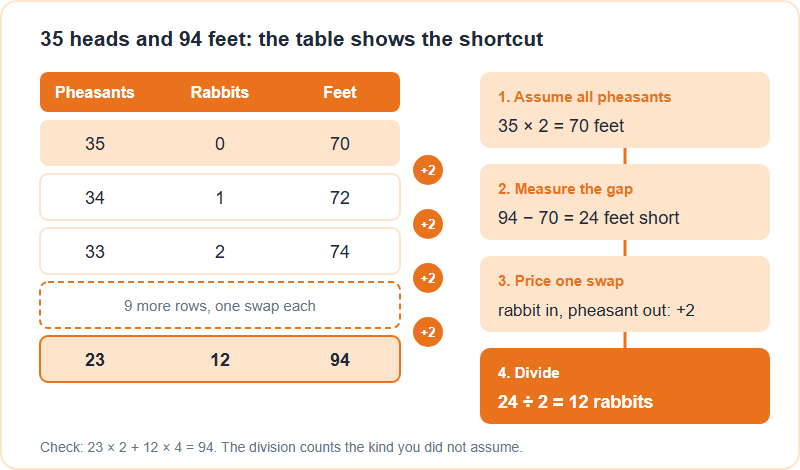
For younger students, build the table first: start at 35 pheasants and 0 rabbits, swap one animal per row and write down the feet. After three rows the pattern is plain — every row adds 2 — and the question becomes “how many rows until 94?” The four-step method is that table with the middle rows skipped. That is why it can be taught before any algebra, and why a child who has built the table a few times sees the shortcut as skipping rows rather than as a rule to memorise.
Three variations that change what one swap is worth
Two prices. A class buys 40 trip tickets for 1,020 yuan. Child tickets cost 18 yuan and adult tickets cost 30 yuan. How many adult tickets were bought? Assume all 40 are child tickets: 40 × 18 = 720 yuan. The gap is 1,020 − 720 = 300 yuan. Swapping one child ticket for an adult ticket adds 30 − 18 = 12 yuan, so 300 ÷ 12 = 25 adult tickets and 15 child tickets. Check: 25 × 30 + 15 × 18 = 750 + 270 = 1,020.
A gain and a loss. A courier is paid 8 yuan for each parcel delivered on time, and 4 yuan is deducted for each late parcel. After 50 parcels she has earned 280 yuan. How many parcels were late? Assume all 50 were on time: 400 yuan, which is 120 yuan more than she earned. Here the swap is where students go wrong. Changing one parcel from on time to late does not cost 4 yuan; she loses the 8 she would have earned and has 4 taken away, so the total falls by 12. That gives 120 ÷ 12 = 10 late parcels and 40 on time. Check: 40 × 8 − 10 × 4 = 320 − 40 = 280. Dividing by 4 would claim 30 late parcels, which pays only 40 yuan.
Three kinds, one extra condition. A car park holds bicycles, tricycles and cars: 30 vehicles and 96 wheels, with exactly as many bicycles as tricycles. Three unknowns need a third fact, and the trick is to use it to glue two kinds together. Treat one bicycle plus one tricycle as a single pair worth 2 vehicles and 5 wheels. If all 30 vehicles came in pairs there would be 15 pairs and 75 wheels, which is 21 short. Swapping one pair for two cars keeps 2 vehicles and adds 8 − 5 = 3 wheels, so 21 ÷ 3 = 7 swaps. That means 14 cars and 15 − 7 = 8 pairs: 8 bicycles, 8 tricycles and 14 cars. Check: 16 + 24 + 56 = 96 wheels, and 8 + 8 + 14 = 30 vehicles.
The steps never changed; only the value of one fair swap did — a price difference, a gain plus a loss, or the gain from trading a bundle. Write that value on its own line before dividing, every time.
Excess and shortage: the same gap, measured between two plans
A second family looks different but runs on the same idea. Children share a box of stickers under two plans, and you are told what is left over or missing under each; Chinese extension classes often call these surplus-and-deficit problems (ying kui wenti). The supply is the same under both plans and only each child's share changes, so the difference between the two outcomes, divided by the change in one share, gives the number of children.
Worked example: if each child gets 5 stickers, 8 are left over; if each child gets 7, the teacher is 4 stickers short. Moving from the first plan to the second uses up the 8 spare stickers and then needs 4 more, so total demand rises by 8 + 4 = 12. Each child's share rises by 7 − 5 = 2. That makes 12 ÷ 2 = 6 children, and the box holds 6 × 5 + 8 = 38 stickers. Check: 6 × 7 = 42, which is exactly 4 more than 38.
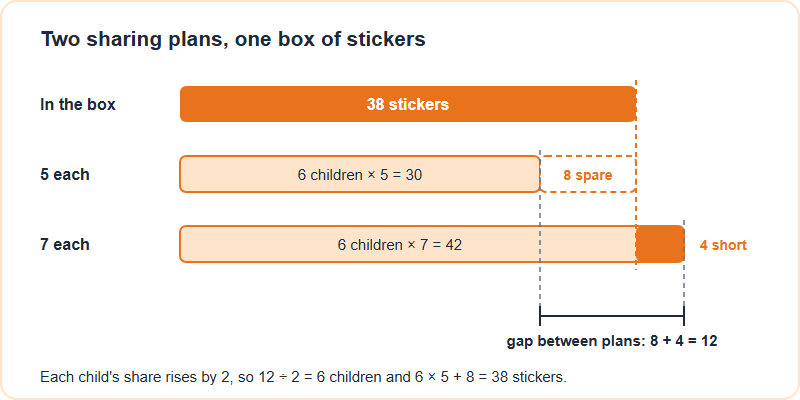
The only real decision is whether to add or subtract the two outcomes. The table covers every case, but drawing both plans against one supply bar is sturdier than memorising four rules.
| First plan | Second plan | Gap between the plans | Our example | Result |
|---|---|---|---|---|
| Some left over | Some short | Add the two amounts | 5 each: 8 left over; 7 each: 4 short | 12 ÷ 2 = 6 children, 38 stickers |
| Some left over | Fewer left over | Subtract | 4 each: 20 left over; 6 each: 4 left over | 16 ÷ 2 = 8 children, 52 stickers |
| Some short | Less short | Subtract | 9 each: 12 short; 7 each: 2 short | 10 ÷ 2 = 5 children, 33 stickers |
| Exactly enough | Some left over or short | The other amount on its own | 6 each: exactly enough; 4 each: 10 left over | 10 ÷ 2 = 5 children, 30 stickers |
Assumption, table or two equations? Choosing by stage
No tool replaces the others; each suits a different stage, and strong students keep two available so that one can check the other. The bands below are our own preparation grouping, not an organiser structure: match practice to the level your child will sit with our AMO grade levels guide, and confirm scope on the official SIMCC / AMO pages.
| Stage | First tool | Why it fits | Check with |
|---|---|---|---|
| Around Grades 3–4 | A table of cases, one swap per row | Shows the constant change per swap | Recount both totals in the final row |
| Around Grades 4–6 | The four-step assumption method | Fast, three written lines, no unknowns to name | Assume the other kind; the two answers must add to the count total |
| Around Grades 7–8 | Two equations, with assumption kept for small numbers | Common Core places two-equation problems in Grade 8; awkward numbers suit algebra | Solve by assumption in your head and compare |
| Grade 9 and up | Equations, plus bundling for three or more kinds | Extra conditions become extra equations, or glue two kinds into one | Substitute back into every total |
A four-week routine builds the family without taking over the timetable — two or three questions a session, with the swap value written out every time:
- Week 1: heads and legs only, solved in both directions, with the two quotients added back as a check.
- Week 2: prices and coins, including questions that ask for the kind you would not naturally assume.
- Week 3: gain-and-loss and three-kinds questions, where the value of a swap is the trap.
- Week 4: excess and shortage, then a mixed set with no labels, so the student must recognise each family unaided.
One naming note, because it affects which practice material you trust. AMO, the American Mathematics Olympiad, is run by SIMCC in Singapore together with Southern Illinois University for Grades 2 to 12. It is not the AMC of the Mathematical Association of America in the United States, and material written for one does not follow the other's design. Before planning time per question, read how AMO scoring works and confirm the current format on the official pages.
Frequently asked questions
What is the assumption method in word problems?
Pretend every item is one kind, find how far that total misses the real one, then divide the gap by what one swap changes.
Which answer does the division give me?
The kind you did not assume. Assume all chickens and the quotient counts rabbits; assume all rabbits and it counts chickens.
Should older students use two equations instead?
They can. Equations cope with awkward numbers, but the assumption method is quicker for small ones and gives an independent check.
How are excess-and-shortage questions related?
Both divide a gap by a change per unit. Compare the two sharing plans against one supply, then divide by the change in each share.
This site is operated by Hanlin Education as an authorized AMO registration partner for China. AMO (the American Mathematics Olympiad) is run by SIMCC in Singapore together with Southern Illinois University (SIU); it is not the MAA's AMC. We are not the organiser. Topic coverage, paper format, marking and dates are set by the organiser and can change, so confirm details on the official SIMCC / AMO pages. The worked examples are our own, apart from the historical Sunzi Suanjing puzzle. Any factual error will be corrected within 7 working days.