
Work-rate problems ask how long a job takes when people or machines share it, take turns or work against each other. The dependable method is to give the whole job a convenient size — a common multiple of the individual times — so every rate becomes a whole number per minute or hour. Add the rates of helpers, subtract the rates of opponents such as a leak, then divide. Never add or average the times.
Why adding the times feels right and is always wrong
An aunt can paint a fence in 6 hours; her nephew can paint it in 3. How long do they take together? The two instinctive answers are 9 hours, from adding, and 4.5 hours, from averaging. Both fail a test that needs no arithmetic at all: help cannot slow you down. With both painting, the job must take less time than the nephew needs on his own, because he alone would finish in 3 hours. Nine and 4.5 are both slower than the nephew by himself, so both are impossible.
The right move is to count how much of the job each person does in one hour. The aunt paints one sixth of the fence; the nephew paints one third, which is two sixths. Together they paint three sixths, or half the fence, every hour, so the whole fence takes 2 hours. Times do not combine; rates do. It is the same principle as closing speed in journey problems, where two travellers heading towards each other add their speeds rather than their journey times.
That observation gives a check worth running on every answer. When two workers help each other, the joint time must be shorter than the faster worker's time alone, and it can never be shorter than half of it — half is what you would get if the slower worker were as quick as the faster one. For the fence, the window runs from 1.5 hours to just under 3 hours, and 2 hours sits inside it.
Where does this sit in a school syllabus? The US Common Core — the framework Southern Illinois University describes AMO as aligned with — introduces unit rates in Grade 6, in standards 6.RP.A.2 and 6.RP.A.3.b, and adding fractions with unlike denominators in Grade 5, in standard 5.NF.A.1. The fraction route to work problems leans on both. The whole-job method below replaces the fractions with whole numbers, which puts the same questions within reach before rates have been formally taught.
The whole-job method in four steps
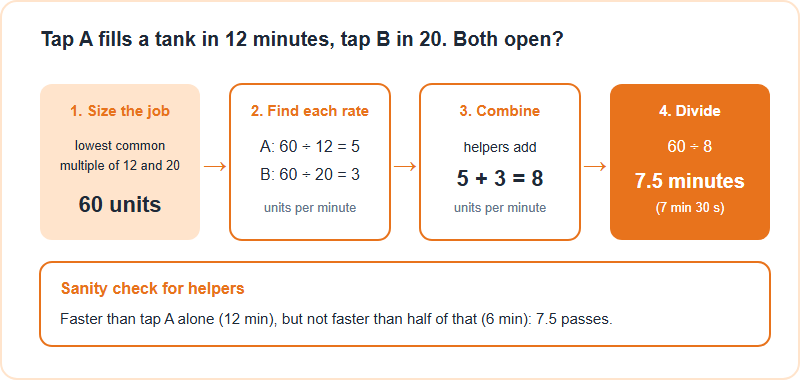
Worked example: tap A fills a tank in 12 minutes and tap B fills it in 20 minutes. With both taps open, how long does the empty tank take to fill?
- Size the job. Choose a tank size that both times divide into. The lowest common multiple of 12 and 20 is 60, so call the tank 60 units.
- Find each rate. Tap A delivers 60 ÷ 12 = 5 units a minute; tap B delivers 60 ÷ 20 = 3 units a minute.
- Combine. Helpers add: 5 + 3 = 8 units a minute. An opponent, such as a leak, would be subtracted at this step instead.
- Divide. 60 ÷ 8 = 7.5 minutes, which is 7 minutes 30 seconds.
Run the check: 7.5 minutes is quicker than tap A's 12 minutes and not quicker than half of that, 6 minutes. It passes. Any common multiple would work — a 120-unit tank gives rates of 10 and 6 and the same 7.5 minutes — but the lowest one keeps the numbers small, and small numbers are where careful students stop making slips.
The method earns its keep by postponing fractions. Every rate is a whole number, the combining step is ordinary addition or subtraction, and a fraction appears only in the final division, if at all. For a student who is secure with whole numbers but still slow with unlike denominators, that single change turns a question they would skip into one they can finish.
Five shapes of work problem, all solved the same way
Once the job has a size, most variations reduce to the same four steps. The examples below are our own.
| Shape | Example | Job size | Rates | Answer |
|---|---|---|---|---|
| Working together | Tap A fills a tank in 12 minutes, tap B in 20 | 60 units | 5 + 3 = 8 a minute | 7.5 minutes |
| One starts, the other joins | Same taps; A runs alone for 4 minutes, then B is opened too | 60 units | A alone fills 20; the other 40 fill at 8 a minute | 4 + 5 = 9 minutes |
| Filling against a leak | A tap fills an empty tank in 10 minutes; a leak empties a full tank in 15; both run | 30 units | 3 − 2 = 1 a minute | 30 minutes |
| Finding a missing worker | Two painters together take 6 days; one alone takes 10. How long for the other alone? | 30 units | Together 5 a day, the first painter 3, so the second does 2 | 15 days |
| More workers at the same pace | 4 painters take 9 days; how long do 6 painters take? | 36 painter-days | 6 painter-days each day | 6 days |
Two details deserve a second look. In the leak row the answer is slower than the tap alone, as it must be — the check reverses when something works against you. And if a leak is at least as fast as the tap, the combined rate is zero or negative and the tank never fills. “Never” is a legitimate answer to watch for, and so is the difference between a tank that starts empty and one that starts full, which the wording decides rather than the arithmetic.
The last row is a different flavour. When every worker keeps the same pace, the job size is simply workers multiplied by days: four painters for 9 days is 36 painter-days of work, so 6 painters need 36 ÷ 6 = 6 days. The trap is scaling the wrong way. More painters must mean fewer days, never more.
Taking turns: where the averaging trap comes back
Worked example: Ana can finish a jigsaw alone in 4 hours, and Ben can finish it alone in 6 hours. They take turns of one hour each, starting with Ana. How long does the jigsaw take?
Size the job at 12 units, the lowest common multiple of 4 and 6. Ana manages 3 units an hour and Ben 2, so every two-hour cycle completes 5 units. After two full cycles — 4 hours — 10 units are done and 2 remain. The fifth hour is Ana's, and she needs only 2 ÷ 3 of an hour, which is 40 minutes. The jigsaw takes 4 hours 40 minutes.
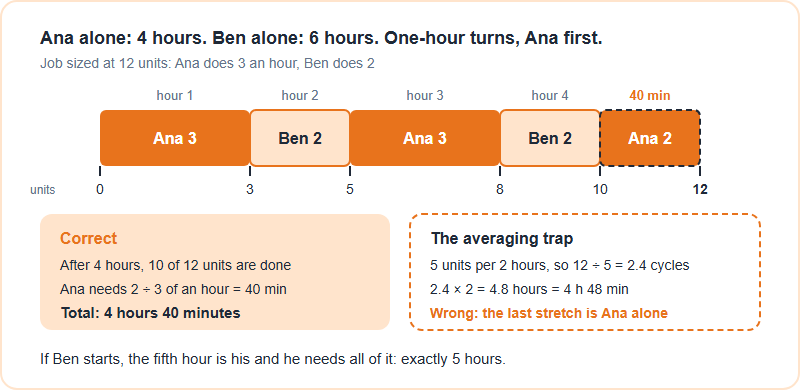
The tempting shortcut says the pair averages 5 units every 2 hours, so 12 units take 12 ÷ 5 = 2.4 cycles, or 4.8 hours — 4 hours 48 minutes. It is wrong by 8 minutes, because the final stretch is not worked at the pair's average rate. It is worked by Ana alone, at her own rate of 3 units an hour. Whenever a question involves turns, stop at the last complete cycle, then play out the remaining turns one at a time, each at the rate of whoever holds it, until the job is done.
Order matters too. If Ben starts instead, the same two cycles still leave 2 units after 4 hours, but the fifth hour is now Ben's and he needs all of it: the jigsaw takes exactly 5 hours. Same people, same jigsaw, and a 20-minute difference decided by who goes first — a detail that is easy to miss when a question is read quickly.
A harder variant, and a three-week drill
Older students meet a version in which the job grows while it is being done. A field's grass feeds 10 goats for 20 days, or 15 goats for 10 days, and the grass keeps growing at a steady rate. How long would it feed 25 goats? Measure everything in goat-days, the amount one goat eats in a day. Ten goats for 20 days eat 200 goat-days of grass; fifteen goats for 10 days eat 150. The first grazing lasted 10 days longer and used 50 more, so the field grows 50 ÷ 10 = 5 goat-days a day. The starting grass is therefore 200 − 20 × 5 = 100 goat-days. Twenty-five goats eat 25 a day while the field regrows 5, a net loss of 20 a day, so the grass lasts 100 ÷ 20 = 5 days.
Growth behaves exactly like a tap refilling what the goats remove, so this is the leak row of the table running in reverse. Chinese extension classes often call the family cows eating grass (niu chi cao). A quick check confirms the model: fifteen goats lose a net 10 goat-days a day, and 100 ÷ 10 = 10 days, matching the question.
A three-week routine builds the whole family. Keep sessions short, and make the half-to-full time check a written line under every answer where workers help each other.
- Week 1: working together and missing-worker questions, always sizing the job as a common multiple before any other step.
- Week 2: late joiners and leaks, including at least one question whose honest answer is that the tank never fills.
- Week 3: taking turns, same-pace workers and one growth question, then a mixed set with no labels, converting every fractional hour into minutes.
One last orientation note. AMO, the American Mathematics Olympiad, is run by SIMCC in Singapore together with Southern Illinois University for Grades 2 to 12, as our guide to what AMO is explains, and it is not the AMC of the Mathematical Association of America. Which topics appear at a particular AMO level is the organiser's call, so aim practice at the right level with our AMO grade levels guide, read how AMO scoring works, and confirm current details on the official SIMCC / AMO pages.
Frequently asked questions
Why can't I add the times in a work problem?
Times do not combine; rates do. Working together must beat the faster worker alone, so an added time can never be right.
What size should I give the whole job?
A common multiple of the individual times, ideally the lowest. Every rate becomes a whole number and fractions wait until the end.
How do I handle a leak or a drain?
Treat it as a negative rate and subtract it from the tap. If the drain is at least as fast as the tap, the tank never fills.
Does it matter who starts when workers take turns?
Often, yes. The final part-turn runs at one person's rate, so a different starter can change the finishing time.
This site is operated by Hanlin Education as an authorized AMO registration partner for China. AMO (the American Mathematics Olympiad) is run by SIMCC in Singapore together with Southern Illinois University (SIU); it is not the MAA's AMC. We are not the organiser. Topic coverage, paper format, marking and dates are set by the organiser and can change, so confirm details on the official SIMCC / AMO pages. All worked examples in this article were written for this guide; the grass-growth question keeps the numbers of a classic Chinese textbook problem. Any factual error will be corrected within 7 working days.