
The fastest way to lose a term of AMO preparation is not idleness. It is working hard on material built for a different competition. AMO is organised from Singapore by SIMCC with Southern Illinois University, spans grades 2 to 12 and rests on a US Common Core spine — so a workbook written for the MAA's American Mathematics Competitions quietly trains the wrong reflexes. Five tests sort the shelf out.
The most expensive mistake is the one that looks most sensible
A parent searches for "American Mathematics Olympiad practice", finds a thick, well-reviewed American competition workbook, and buys it. It is a reasonable-looking decision that costs a term, because the two contests share only a country adjective. AMO is run by SIMCC in Singapore with Southern Illinois University. The AMC is run by the Mathematical Association of America in the United States. Different organisations, different papers, different entry routes, different award mechanics.
Three things go wrong when AMC material becomes an AMO spine. First, the grade span is different: AMO runs from grade 2 upward, so a book pitched at an American middle-school contest audience is simply out of band for a large share of AMO entrants. Second, the emphasis differs, because AMO's content reference point is US Common Core rather than a contest-specific canon. Third, and most damaging, the two papers reward different habits under time, so a student trained on one paper's rhythm can arrive at the other with good mathematics and bad pacing.
The award mechanics differ too. AMO recognition is percentile-based within each grade level worldwide: broadly, Gold is around the top 8 percent, Silver the next 12 percent and Bronze the next 20 percent, so roughly the top 40 percent are medal-recognised, with any further recognition bands set by the organiser. That structure changes what "good practice" even means, because you are not chasing a fixed pass mark. If that is new, read how AMO scoring works before choosing anything, and confirm the current bands on the official SIMCC / AMO pages.
Five tests any resource must pass
Our coaching team applies the same five checks to every book, app, PDF pack and problem bank a family brings us. A resource that fails two of them is not a bad book; it is a book for someone else.
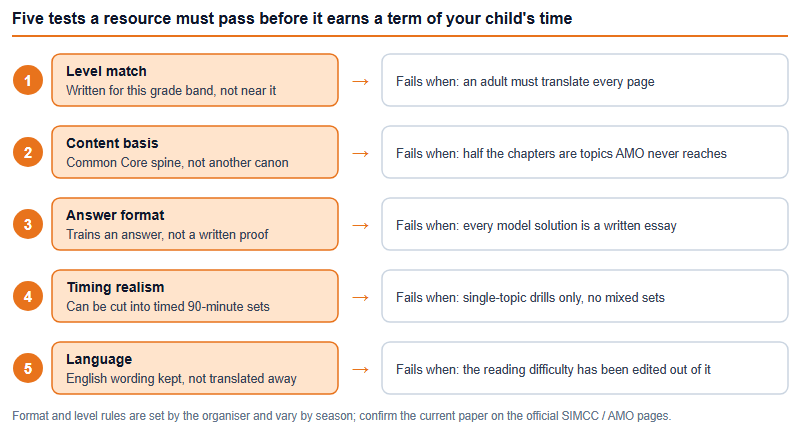
Two of the five deserve unpacking. Answer format matters because AMO is answered as answers: the paper asks a student to produce a result, not to construct and write out a formal proof. A book whose entire model-solution style is extended written argument is training a different output, however good the mathematics inside it is. The exact section make-up of the paper does vary, so check the current format on the official pages rather than assuming last season's shape.
Language is the test families skip most often. A translated edition removes precisely the load the real paper contains: the child meets the concept in their strongest language, answers correctly, and nobody discovers that the English words for "remainder", "consecutive" or "at most" were never a problem in practice but will be on the day. Translation is a fine teaching aid. It is a poor rehearsal.
What each common source is actually good for
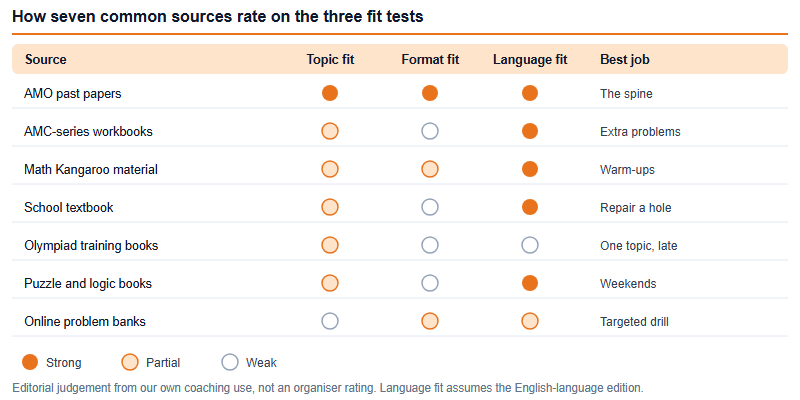
No resource on this list is worthless. Each is useful for something specific and misleading for something else, and the trouble starts when a family gives one of them the wrong job.
| Source | Genuinely good for | Where it misleads | Sensible job |
|---|---|---|---|
| AMO past and practice papers | Wording, pacing, question style, level calibration | Nothing — but supply is finite, so families burn through it | The spine of the plan |
| AMC-series workbooks | Extra non-routine problems for older, stronger students | Different organiser, band and paper rhythm; treated as a syllabus it distorts everything | Optional extra problems only |
| Math Kangaroo material | Friendly, well-graded non-routine practice at the junior end | A separate contest with its own paper; the style is not AMO's style | Warm-up and variety |
| School textbook or workbook | Fixing a genuine content hole once the error log names it | Routine, single-method questions build speed on the wrong kind of item | Targeted repair, not the weekly diet |
| National olympiad training books | Depth in one topic; genuine reasoning stretch | Depth-first where AMO rewards breadth; often proof-shaped and in another language | One topic at a time, late in a cycle |
| General puzzle and logic books | Enjoyment, persistence, willingness to sit with a hard problem | No level calibration at all; a child can be busy and untested | Weekends and holidays |
| Online problem banks | Volume, instant marking, weak-topic filtering | Mixed provenance; level tags are frequently wrong | Drill only, after the topic is chosen |
Why there is suddenly more junior material to sift through
Families are not imagining the flood. An industry briefing dated 24 August 2026 that reached us reports that Math Kangaroo registrations passed 380,000 this season, a record, with the strongest growth in the youngest age bands. Publishers and tutoring platforms follow entry numbers, so the primary-age end of the shelf is filling up fast.
Two things follow. The first is a clarification that matters more the more crowded the shelf gets: Math Kangaroo is a different competition from AMO, with its own organiser, its own paper and its own entry route. Material written for it is not AMO material, whatever the cover suggests. The second is practical: a growing share of new junior books are marketed with generic wording such as "maths olympiad" or "international maths challenge" without naming a contest at all. That generic labelling is exactly what the five-test filter exists for. If a book will not tell you which paper it was written for, treat it as a general non-routine problem source and give it a general non-routine job.
A shelf that works, by grade band
The right mix shifts with age, mostly because reading load and topic breadth grow faster than mathematical difficulty does. Choose the band by the level the student will actually sit, not by ambition — the grade level guide is the place to settle that first, since ranking happens within each level.
- Grades 2–4. Papers at level, read aloud together at first, plus one gentle non-routine source for enjoyment. No topic drills yet; at this age a child who enjoys the problems keeps going, and that is the whole strategy.
- Grades 5–6. Papers at level, plus targeted drills on the two topics the error log keeps naming. This is the band where English wording starts to cost real marks, so keep everything in English from here on.
- Grades 7–9. Papers plus one topic book at a time, worked in blocks of two to three weeks. Add timed mixed sets, because breadth under a clock is now the binding constraint rather than any single topic.
- Grades 10–12. Papers plus selected harder non-routine problems from any credible source, including American competition workbooks used strictly as extra problems. At this level the risk is no longer wrong material but no timed practice at all.
As a rule of thumb our coaching team aims for roughly three-fifths of practice time on AMO's own papers and variants of them, about three-tenths on drills aimed at named weaknesses, and the remainder on exploratory problems chosen for interest. That is a working ratio from teaching, not an organiser recommendation, and it should bend around the individual student.
The check that outranks all five
Before any of this, confirm the current season's eligibility, level structure, format and dates on the official SIMCC / AMO channels. Two habits are worth building. First, treat format as a per-season fact rather than a permanent one; a resource that matched the paper three years ago may not match it now, and a plan built on an outdated shape is a slow, invisible failure. Second, be careful where you read those facts: third-party summaries drift, and lookalike or expired domains that once carried competition information can end up in other hands entirely. Verify on the organiser's own channels, and where a fee, date or level rule is concerned, take nothing from a blog — including this one — as final.
Frequently asked questions
Can we use AMC 8 books to prepare for AMO?
Only as extra problems. AMO is a different contest run by SIMCC in Singapore, with its own grade span and format.
Is a translated maths olympiad book fine?
It removes the English reading load that the real paper contains, so pair it with English-language practice.
How much of our practice should be AMO past papers?
Our coaching team aims for most of it early on, then adds topic drills once the weak areas are clear.
Where do we confirm the current format and levels?
Only on the official SIMCC and AMO channels. Third-party pages and lookalike domains go out of date fast.
This site is operated by Hanlin Education as an authorized AMO registration partner for China. AMO is run by the Singapore International Mastery Contests Centre (SIMCC) together with Southern Illinois University; we are not the organiser, and AMO is not the American Mathematics Competitions (AMC) run by the MAA in the United States. Resource judgements above are our own editorial and coaching opinion, not organiser endorsements; eligibility, level structure, format, dates, fees and award bands are set by the organiser — always confirm current details on the official SIMCC / AMO pages before registering. If you spot an error in this article, tell us and we will correct it within 7 working days.