
Your AMO results arrived. Whether the paper shows a top score or a mid-pack finish, the report itself is a diagnostic tool. The most productive next step is to treat it as a map of what you have mastered and where to focus next, rather than as a final verdict on ability. This article shows how to read an AMO score report section by section, spot error patterns, and turn those patterns into a week-by-week improvement plan.
What Your AMO Score Report Actually Shows
SIMCC describes the American Mathematics Olympiad as a competition for students in Grades 2 through 12, with a framework based on US Common Core Standards (SIMCC, retrieved 2026-11-23). The test is divided into sections that assess different skills: typically a multiple-choice portion and open-response portions that require written reasoning.
A score report from a completed season usually contains:
- Total score and section breakdown
- Correct, incorrect, and omitted items by topic area
- Time spent or time remaining indicators (for online formats)
The value is in the breakdown, not the total. Two students with the same total score may have opposite strengths: one fast and accurate on arithmetic but weak on written explanations, another strong on reasoning but slow on computation. The study plans for these two students should differ.
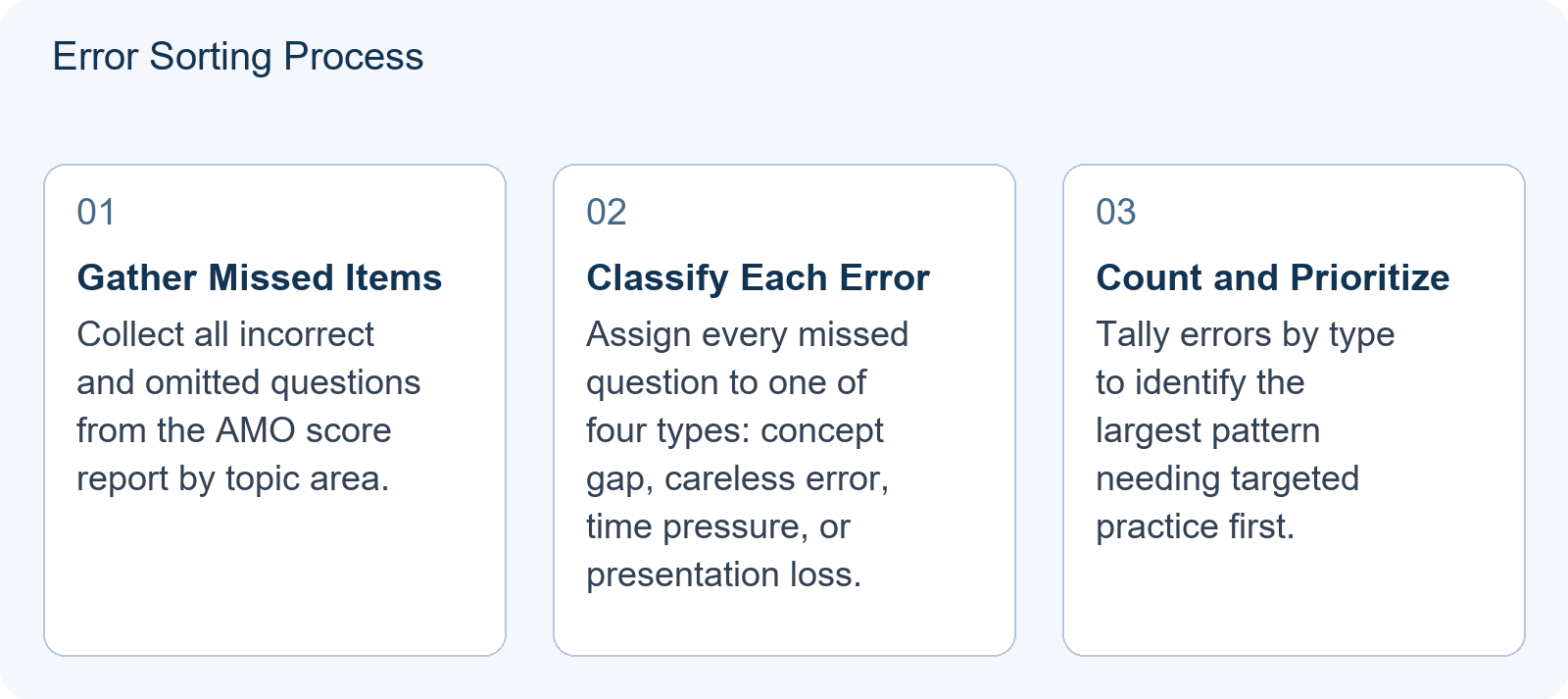
Step 1: Sort Errors Into Four Buckets
Before writing any plan, classify every missed question. Teaching illustration: consider a student who sat the 2025 AMO Grade 6 paper and missed eight questions. Here is how the errors might sort:
| Error Type | What It Looks Like | Typical Fix |
|---|---|---|
| Concept gap | Wrong method chosen; formula misapplied | Reteach the concept with visual models |
| Careless error | Correct method, arithmetic slip or misread | Structured checking routine; slow down |
| Time pressure | Blank or rushed at end of section | Timed practice; skip-and-return strategy |
| Presentation loss | Correct idea, but marks lost in open response | Learn scoring rubric; practice writing steps |
Teaching illustration: our hypothetical Grade 6 student found that three errors were concept gaps (probability, area of compound shapes, algebraic substitution), two were careless sign errors, two came from unfinished questions in the final ten minutes, and one was a presentation loss in Section B where the correct answer appeared without shown working. This 3-2-2-1 split immediately tells us where the first month of study should go.
Step 2: Map Topics to AMO’s Common Core Framework
Because AMO bases its framework on US Common Core Standards, missed topics cluster into predictable domains. After reviewing several past papers, these domains appear consistently:
- Operations and Algebraic Thinking: word problems, patterns, equations
- Number and Operations in Base Ten / Fractions: computation, comparison, estimation
- Measurement and Data: charts, units, perimeter, area, volume
- Geometry: angles, symmetry, coordinate grids, nets
- Statistics and Probability: mean/median/mode, simple probability, interpreting tables
Match each missed question to one domain. If a student missed four questions in Measurement and Data but none in Geometry, the priority is clear. Do not assume weakness in one domain predicts weakness in another.
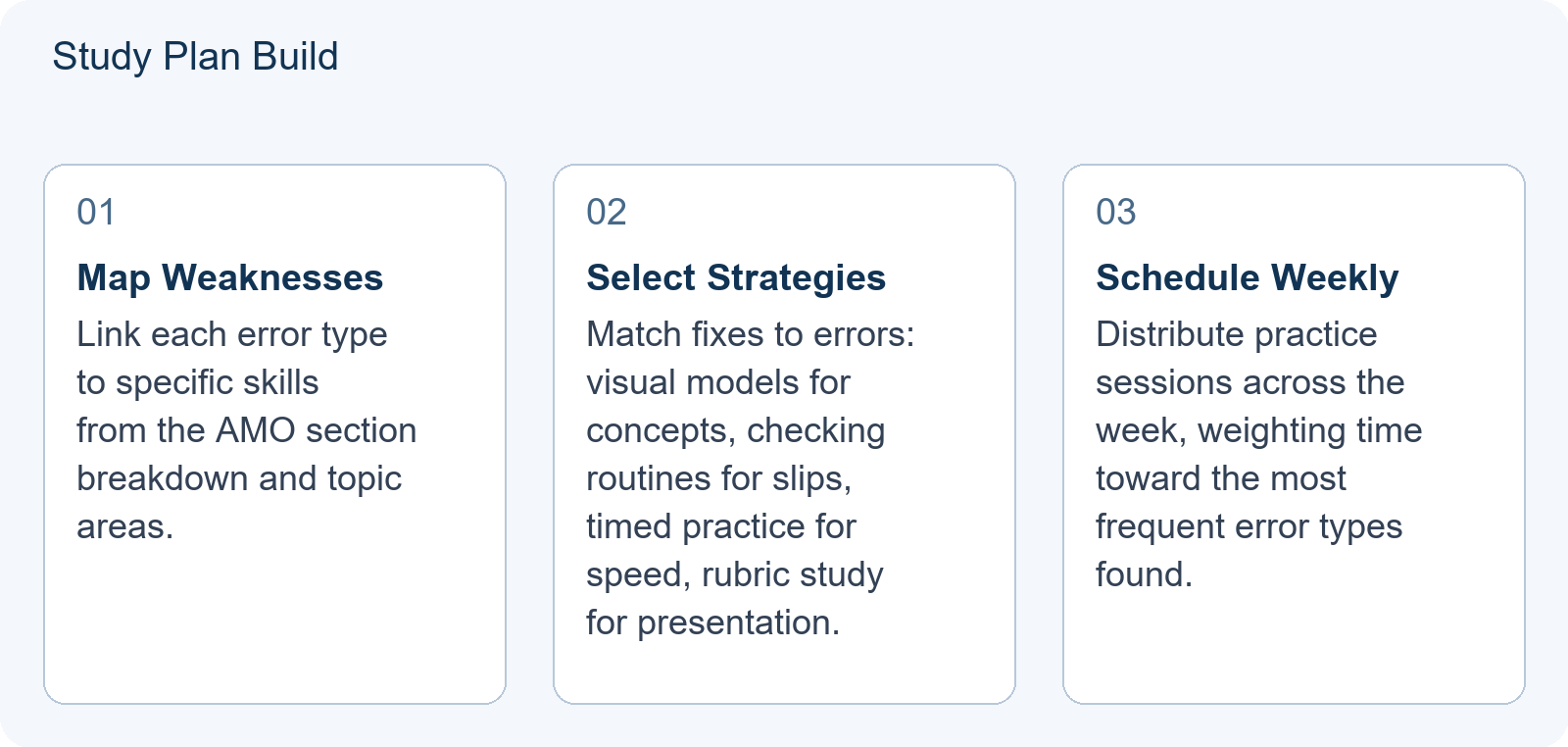
Step 3: Build a Topic-Focused Study Plan
Once buckets and domains are identified, allocate study time. A balanced weekly plan for a student with multiple concept gaps might look like this:
| Day | Activity | Duration |
|---|---|---|
| Monday | Concept gap 1: taught lesson + worked example | 45 min |
| Tuesday | Concept gap 2: taught lesson + practice set | 45 min |
| Wednesday | Careful computation drill: speed with accuracy | 30 min |
| Thursday | Timed section practice: simulate exam conditions | 45 min |
| Friday | Open-response writing: show full reasoning | 45 min |
| Saturday | Mixed review: questions from prior weeks | 60 min |
Adjust the split based on your error analysis. A student with mostly time-pressure errors should reduce concept lessons and increase timed practice. A student with mostly presentation losses should increase open-response writing practice.
Worked Example: From Error to Correct Approach
Teaching illustration: a Grade 5 student missed this type of problem: “A rectangular garden has length 12 m and width 8 m. A path of width 2 m is built around it. Find the area of the path.” The student calculated 12 × 8 = 96 and stopped, missing the outer dimensions entirely.
Error classification: concept gap in Measurement and Data, specifically compound area. The fix is not “try harder” but a specific reteaching:
Step-by-step correction:
- Draw the inner rectangle: 12 m by 8 m. Label it.
- Recognize the path adds 2 m on all sides, so add 2 + 2 = 4 m to each dimension.
- Outer dimensions: (12 + 4) = 16 m and (8 + 4) = 12 m.
- Outer area: 16 × 12 = 192 square metres.
- Inner area: 12 × 8 = 96 square metres.
- Path area: 192 − 96 = 96 square metres.
The teaching point: when a path surrounds a shape, always sketch the larger containing shape and subtract. This generalizes to frames, borders, and margins.
Using Past Papers Strategically
Past papers are most useful after error analysis, not before. Here is a disciplined approach:
Phase 1: Untimed diagnostic (Week 1). Complete one full paper without time pressure. Grade thoroughly. Sort errors into the four buckets above.
Phase 2: Targeted remediation (Weeks 2-4). For each concept gap, find three similar problems from the same domain in other past papers. Work them with full written reasoning.
Phase 3: Timed replication (Week 5). Retake the original diagnostic paper under timed conditions. Compare scores and error patterns. If the same concept gap reappears, the teaching method needs adjustment, not just more practice.
For students seeking structured practice in specific AMO topics, our clinics cover common problem types with worked solutions. AMO Magic Squares: Use the Centre and Line Sum Before You Guess (Grades 4-7) demonstrates how a systematic approach beats guessing. AMO Probability Without Replacement: The Shrinking-Denominator Clinic (Grades 6-9) shows how to track changing denominums step by step. For open-response practice, AMO Section C: How to Write Open-Ended Solutions That Show Your Reasoning offers a framework for presentation that matches what graders expect.
When Results Disappoint: A Rational Response
A lower-than-hoped score is information, not a prediction. The appropriate response depends on what the error analysis reveals:
- Mostly careless errors: This is the easiest fix. Implement a checking routine: after each question, verify the question asked, re-estimate the answer, and check one calculation.
- Mostly unfinished questions: Practice skip-and-return. Mark uncertain questions, move on, and return with remaining time. Many students lose points stubbornly on one hard question while leaving three easier ones blank.
- Mostly concept gaps: This indicates the curriculum coverage is incomplete. Identify the specific topics and address them before next season’s registration opens.
Teaching illustration: a Grade 7 student scored below expectations on the 2025 AMO. Error analysis showed five of seven errors were in probability and combinatorics, topics not yet covered in school. The study plan focused on these two domains using our probability clinics and systematic counting methods. By the next season, the student’s accuracy in these topics matched their strength in algebra.
Tracking Progress Without Comparing to Others
Score reports invite comparison, but effective study planning requires individual tracking. Create a simple log:
| Date | Topic | Questions Attempted | Correct | Error Type |
|---|---|---|---|---|
| 2026-11-15 | Probability without replacement | 5 | 3 | 1 concept, 1 careless |
| 2026-11-18 | Compound area | 4 | 4 | None |
| 2026-11-22 | Open-response writing | 3 | 2 | 1 presentation loss |
This log reveals patterns invisible in a single score. The student above is improving in compound area but still dropping presentation marks. That specific insight shapes the next week’s focus.
Preparing for the Next Season
As of November 2026, the 2026 AMO windows (Singapore private, Singapore school, and international) have concluded. No registration dates for a future season are established by current evidence. Preparation should therefore be skill-based rather than deadline-driven.
A productive off-season plan:
- Consolidate fundamentals: Ensure fluency in arithmetic, fractions, and basic algebra appropriate to grade level.
- Extend into next-grade topics: AMO’s Common Core framework means questions often draw on material slightly ahead of typical school pace.
- Practice written reasoning: The open-response sections reward clear logical structure. This skill transfers to school mathematics and future competitions.
- Build stamina: The 90-minute format requires sustained concentration. Gradually increase practice session length.
For simulation practice, AMO Online Test: Simulating the 90-Minute Exam at Home offers guidance on creating realistic conditions.
Common Pitfalls in Post-Result Review
Avoid these unproductive patterns:
- Attributing failure to “not being a math person”: Errors are specific and fixable.
- Repeating the same practice without diagnosis: More of what did not work is not a plan.
- Ignoring presentation losses: In open-response sections, communication is part of the mathematics.
- Comparing raw scores across grades: AMO spans Grades 2-12; a Grade 5 score and a Grade 8 score are not comparable.
How to Diagnose a “Known Concept, Wrong Execution” Error
Not every missed question signals a gap in understanding. A common and costly pattern is the student who recognizes the topic, sets up the correct approach, but still arrives at a wrong answer. These errors hide inside otherwise strong sections and are easy to dismiss as “just careless.” Treating them that way wastes time and hides a fixable flaw in working memory or number handling.
Teaching illustration: a Grade 6 student correctly identifies that a problem requires finding the area of a path around a rectangle. She draws the outer rectangle, computes the new dimensions as 16 m and 12 m, then writes 16 × 12 = 182. The correct product is 192; she has dropped a ten. Because her method is sound, she labels this a careless error and moves on. But the pattern repeats on three later papers: correct setup, wrong arithmetic, always in the final multiplication step.
Diagnostic check: ask the student to solve the same problem verbally while you record the steps. If she states 16 × 12 = 192 aloud but writes 182, the issue is transcription, not concept. If she hesitates at 16 × 12, the issue is retrieval fluency. The fix differs. For transcription errors, the immediate next practice task is to write each intermediate result before computing the next, forcing a pause between speaking and writing. For retrieval gaps, drill specific facts (here, the 12-times table) until automaticity returns.
Concrete next practice task: take the original compound-area problem and change only the numbers: length 14 m, width 9 m, path width 2 m. The student should predict the outer dimensions (18 m and 13 m), compute 18 × 13, and state the product aloud before writing it. Repeat with five variations, recording whether the error occurs in prediction, oral computation, or written transcription. This isolates the exact failure point and turns a vague “careless” label into a targeted intervention.
General event background is available at Event background.
Frequently Asked Questions
How soon after receiving results should we start a study plan?
Within one week. Memory of specific difficulties fades quickly. Review the paper while the experience is fresh.
Can a student improve significantly between seasons?
Yes, with targeted work on identified gaps. Improvement is fastest when the error analysis is specific and the practice matches it.
Should we focus on speed or accuracy first?
Accuracy first. Speed builds naturally on accurate methods. Rushing through unmastered content reinforces errors.