
Choosing the AMO Online option offers flexibility, but it introduces a specific logistical challenge: replicating the exam environment at home. Unlike an at-school paper test, where the venue manages the start, stop, quiet, and separation from distractions, the online format requires families to self-regulate many of those conditions. The core of this preparation is not just solving problems. It is rehearsing the pacing and structure of the verified 90-minute, 25-question paper so that the format feels ordinary before test day.
Online option vs at-school paper: what changes for practice
The source facts say AMO can be taken online or as an at-school paper test. That single sentence should shape the whole rehearsal plan. In an at-school paper sitting, the school controls the clock, seating, and invigilation. In an online sitting at home, the family must stage those elements. The mathematics does not become a different subject, but the child has to manage device, desk, quiet, and timing without a venue doing it for them.
This distinction matters because home rehearsal can easily drift into the wrong activity. It should not become a portal-troubleshooting session. The available format facts do not provide platform-specific rules, so this routine does not invent them. Instead, it focuses on what is verified: 90 minutes, 25 questions, three scored sections, 100 points, and no negative marking. If a family wants rehearsal to be useful, it should train the child to move through those verified constraints with calm decisions.
The fixed target: 25 questions, 100 points, 90 minutes
The AMO paper structure is specific. There are 15 multiple-choice questions worth 3 points each, 5 open-response questions worth 5 points each, and 5 open-response questions worth 6 points each. The arithmetic is simple but important: 15 x 3 = 45; 5 x 5 = 25; 5 x 6 = 30; 45 + 25 + 30 = 100. There is no negative marking.
That point distribution changes how a student should practise. The first 15 questions account for 45 points. The last 10 questions account for 55 points. In other words, the final 10 questions carry more than half the total score while representing 40 percent of the question count. A student who spends too long on early multiple-choice questions can lose access to the highest-value section. A student who rushes the open questions without clear written thinking may also lose points they could have earned with a calmer approach.
Because there is no negative marking, a blank multiple-choice question and a wrong multiple-choice question both score zero. That means a reasoned guess after eliminating impossible options can be better than leaving the answer blank. This does not mean random guessing should become the strategy. It means the rehearsal should include a decision rule for the final minute: if an MCQ remains unsolved but options can be narrowed, choose the best remaining option rather than leave a zero on the page.
Setting up a distraction-light home rehearsal
Before the timer starts, set up the same conditions you intend to use again. Choose one device, one desk, and one time of day. Prepare pencils, erasers, scratch paper, water, and any permitted tools. Close other tabs, silence notifications, and put the phone in another room. If the child is working on a computer, position the screen so only the rehearsal material is visible. A parent can act as a silent invigilator who records checkpoint times but does not help with the mathematics.
One caution: do not simulate platform features that are not in the verified format notes. The notes do not list calculator policy, typing requirements, flagging tools, or portal behaviour. If calculator use matters for your sitting, verify it separately through the current official instructions and rehearse only with the tools allowed there. Do not assume a calculator is permitted. The rehearsal routine should train timing, accuracy, and independence, not guesswork about an interface.
For a full rehearsal, arrange 25 questions in the same section pattern: 15 MCQ, then 5 open-response questions, then 5 more open-response questions. If you do not have a complete official set, you can build a mixed practice set from your own materials. Label that set as a teaching illustration, not as an official past paper. The point is not to predict exact questions. The point is to make the child practise moving from MCQ selection to written reasoning under a single 90-minute clock.
The 90-minute rehearsal clock: checkpoints for a 25-question paper
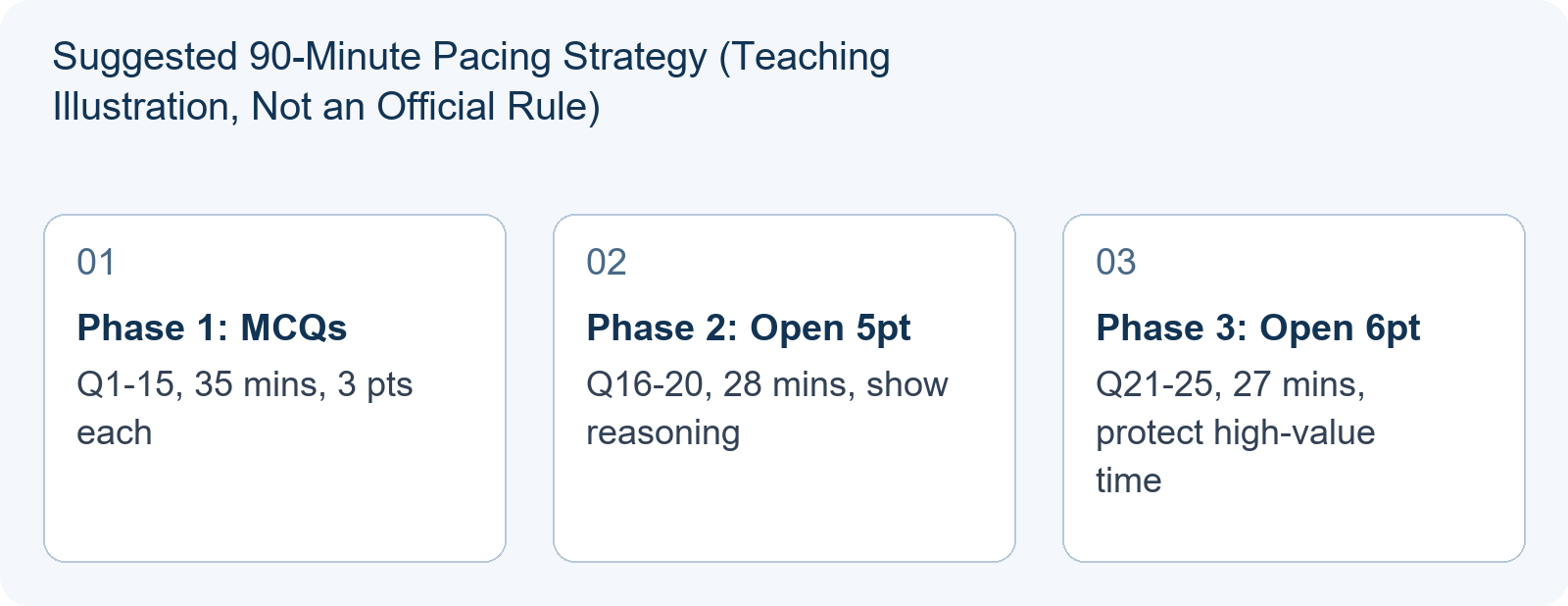
The following timing is a teaching illustration, not an official AMO rule. It gives the child a concrete plan to rehearse, and it can be adjusted after several rehearsals. One workable split is 35 minutes for Questions 1-15, 28 minutes for Questions 16-20, and 27 minutes for Questions 21-25. That totals 90 minutes. The checkpoint is more important than the exact minutes: the child should learn when to leave a question and when to protect the highest-value questions.
- Checkpoint 1 at 35 minutes: finish or leave Questions 1-15. These 15 MCQs are worth 45 points. Aim for steady progress rather than perfect certainty on every question. If a question takes more than about three minutes, mark it and move on. If the child finishes early, use the extra time only to check marked questions, then start the open-response section rather than sitting idle.
- Checkpoint 2 at 63 minutes: finish or leave Questions 16-20. These five open questions are worth 5 points each. They require structured reasoning. Allocate roughly five to six minutes per question in this teaching illustration. If a child is behind, capture the setup and move forward; do not spend the remaining time on one 5-point question when two 6-point questions remain.
- Finish at 90 minutes: stop and record the paper. Do not give extra time. After the timer stops, note which questions were blank, guessed, or incomplete. This record is the raw material for diagnosis. A rehearsal without a record becomes just another practice paper; a rehearsal with checkpoint notes becomes a training tool.
After one bad rehearsal, do not redesign the whole plan. Use three rehearsals to see whether a pattern is real. A child who is strong in geometry may need more time in the final section if geometry appears there. A child who is strong in arithmetic may clear the MCQs faster. The purpose of the checkpoint is to force conscious decisions, not to impose a permanent rule.
Section-by-section practice: MCQ speed and open-question write-ups
MCQ speed and accuracy
Practise the first 15 questions in short sets. Use elimination: test the options, estimate, check parity, watch units, and look for digit patterns. Because there is no negative marking, a final-minute reasoned guess is better than a blank answer. But in rehearsal, mark every guessed answer so the error log can separate a knowledge gap from a timing guess. Keep scratch work organised enough that the child can trace a mistake afterwards.
Open-response questions worth 5 points
These questions require a written answer. Rehearse a clear sequence: what is given, what is required, the steps used, and the final answer. The verified format notes do not describe a grader preference, so the aim is not to imitate an unknown marking scheme. The aim is to make the child’s reasoning reviewable. If the child types, practise typing mathematical notation. If the child writes by hand, practise legible steps. Choose the medium that the sitting instructions permit.
Open-response questions worth 6 points
These are the highest-value questions. In rehearsal, they should receive protected time. If the child gets stuck, write down the setup and any intermediate result before moving on. That helps the child return later and helps the parent see where the reasoning stopped. Do not claim partial credit unless the current official rules say so; instead, treat written work as a diagnostic record. After the rehearsal, study the missing concept and re-attempt the question under time.
Diagnostic: where home rehearsals break down
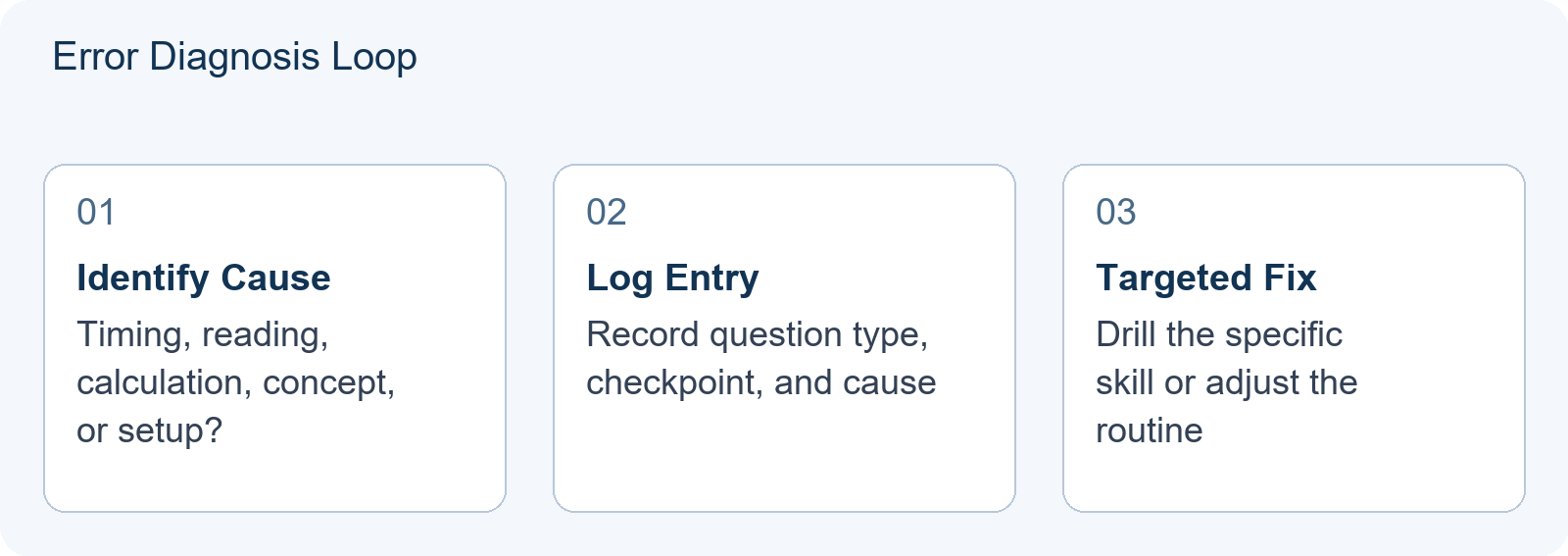
After each full rehearsal, score the paper. Then go beyond the score. For every wrong or blank question, write one line: what happened, when it happened, and what to do next. A simple cause system works well. Use categories such as timing, reading, calculation, concept, and setup.
- Timing: Did the child run out of time for Questions 21-25? If yes, check how long Questions 1-15 took. The problem may be early overrun rather than slow work on the hardest questions.
- Reading: Did the child misinterpret a condition? Rehearse careful reading under pressure. Short passages can be paraphrased before calculation begins.
- Calculation: Did simple arithmetic slip under time pressure? Add a short verification habit, such as checking units, parity, or reasonableness before writing the answer.
- Concept: Did the child fail several questions in one topic? That is a study signal. Schedule targeted topic work rather than another full paper immediately. Our guide on The AMO Error Log: A Four-Cause System That Turns Lost Marks Into Points (2026) provides a systematic way to categorise recurring mistakes.
- Setup: Was the child distracted by the device, desk, or room? Fix the rehearsal environment before assuming the mathematics is the problem.
The diagnostic loop is the most valuable part of the routine. A score tells you what happened on one day. A cause log tells you what to change before the next rehearsal. If the same cause appears three times, change the practice plan. If causes are scattered, keep the routine stable and collect more evidence.
Using rehearsal results to adjust practice volume
If a child consistently finishes Questions 1-15 in about 30 minutes with high accuracy, the MCQ pacing is probably safe. Keep the full rehearsal but spend more time on the final open questions. If Questions 21-25 are often untouched, reduce the number of full papers and increase timed single-topic sets so the child learns to enter and leave difficult problems more efficiently.
If accuracy is strong for 45 minutes and then falls sharply, build stamina with half-length rehearsals before returning to 90 minutes. If open-response writing is the weak point, practise three-step written solutions daily. If MCQs are the weak point, use short elimination drills and review why the chosen option was wrong. The volume of practice should follow the diagnosis, not a fixed number of papers per week.
Also remember that an online sitting can feel different from paper because the child may be scrolling, clicking, or navigating rather than turning pages. The verified notes do not define those interface details, so rehearse the physical actions of your chosen setup without claiming they are official. If the child will write on paper and submit later, rehearse that process. If the child will enter answers directly, rehearse the accuracy of entry. The goal is to reduce avoidable friction on test day.
For final preparation and tapering, see The Last 14 Days Before AMO: A Taper Plan That Protects Your Accuracy (2026). For a direct comparison of the online and paper options, see AMO Online vs Paper: Which Test Format Should Your Child Take?.
Conclusion: from rehearsal to readiness
Preparing for the AMO Online option is not about guessing platform rules. It is about making the verified structure feel familiar. The child should know that there are 25 questions, that the first 15 MCQs are worth 45 points, that the final 10 open questions are worth 55 points, and that the whole paper lasts 90 minutes with no negative marking. A home rehearsal routine turns those numbers into decisions: when to move on, when to protect high-value questions, and how to review mistakes without panic.
Used consistently, the 90-minute rehearsal does more than build speed. It builds independence. The child learns to manage a clock, write clear reasoning, and recover from difficult questions. The parent learns where the real breakdowns occur. That is a more useful preparation goal than trying to predict exact questions or invent unofficial portal details. Rehearse the verified format, diagnose the causes, adjust the practice volume, and let the final test day feel like a routine the child has already practised.
Frequently Asked Questions
Does AMO Online use a different number of questions from the paper test?
The verified format facts describe AMO as 90 minutes and 25 questions: 15 MCQ worth 3 points, 5 open worth 5 points, 5 open worth 6 points, total 100, with no negative marking. The notes also say AMO can be taken online or as an at-school paper test. They do not describe a different question count for the online option.
Should my child guess on MCQs if time runs out?
Because there is no negative marking, a blank MCQ and a wrong MCQ both score zero. A reasoned guess after eliminating options can therefore be better than leaving it blank. In rehearsal, mark guesses so you can separate timing guesses from real understanding.
Can we use a calculator during rehearsal?
The verified format notes do not state calculator rules. Check the current official instructions for your sitting and rehearse only with the tools allowed there. Do not assume a calculator is permitted.