
For Grade 12 students, AMO 12 planning is less about adding another competition to a crowded senior year and more about matching practice to the actual paper. The verified AMO format is compact: 90 minutes, 25 questions, three sections, 100 points, and no negative marking. That single fact changes the senior-year strategy. You are not preparing for an open-ended research project or a multi-hour olympiad. You are preparing to read quickly, choose when to move on, and leave a clear answer for the questions that carry more weight.
AMO covers Grade 2-12 and is organized by SIMCC and SIU. For a Grade 12 student, the relevant question is not whether the competition is prestigious, but whether a realistic practice plan can be built around the verified paper structure. This article gives that plan. It assumes limited time, treats AMO as one commitment among many, and avoids claims about admissions rankings or guaranteed benefits.
What the verified AMO paper actually asks of a Grade 12 student
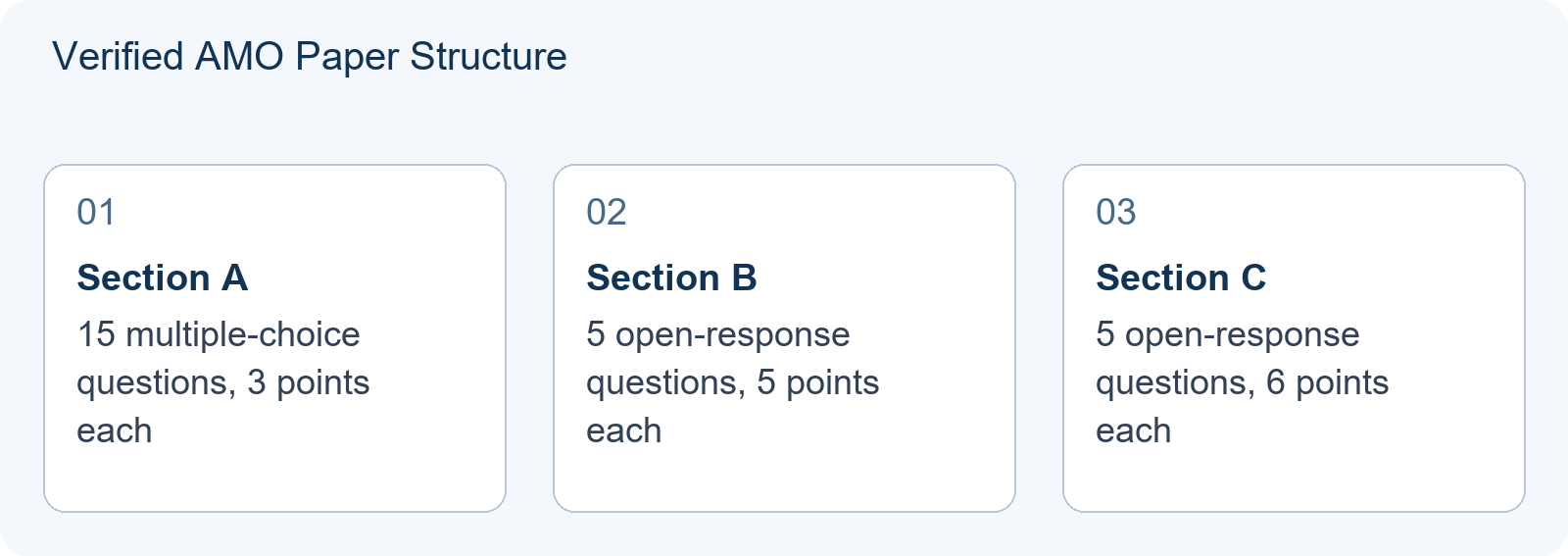
The verified structure is specific. Section A has 15 multiple-choice questions worth 3 points each, so those 15 questions carry 45 points. Section B has 5 open-response questions worth 5 points each, carrying 25 points. Section C has 5 open-response questions worth 6 points each, carrying 30 points. The total is 45 + 25 + 30 = 100 points. There is no negative marking.
At 90 minutes for 25 questions, the average is 3.6 minutes per question. That average is not a target. Some questions will be faster; others will demand more reading and checking. The useful senior-year skill is deciding, in the first minute, whether a question is worth your next five minutes. Because no negative marking is verified, leaving an MCQ blank gives you no protection. If you can eliminate even one option, a considered guess is usually better than a blank. For open-response questions, write the final answer and the steps you can justify; do not invent official partial-credit rules that the paper has not published.
The verified format gives a total time limit. Treat any section-by-section minute plan as your own practice tool, not as an official rule. This matters for senior students because many arrive from school tests where each section has a fixed time. In AMO, you manage your own time across the paper.
A 20-minute diagnostic: Section A, B and C accuracy vs speed
Before committing to weeks of preparation, run a short diagnostic. This is a teaching illustration, not an official AMO sample or scoring guide. Set aside 20 minutes and use five mixed questions: three multiple-choice questions, one open-response question at the 5-point level, and one open-response question at the 6-point level. If you do not have suitable questions, use three quick calculation or algebra MCQs and two short multi-step problems from a school extension book.
Record two numbers: how many you answered correctly, and how long you took. If you finish all five with full accuracy inside 18 minutes, your foundation is probably strong enough for a maintenance plan. If you run over 20 minutes, or if you lose more than one question, diagnose the cause. A conceptual gap shows up when you cannot start. A pacing gap shows up when you start well but spend too long checking. A reading gap shows up when you misread signs, units, or the final request. The diagnostic is deliberately small. It is not a prediction of your AMO medal. It is a cheap way to decide where practice time should go.
Building a four-week practice block around 90-minute sets
If the diagnostic reveals room for improvement, a four-week block is a manageable commitment for many seniors. The plan below is a teaching suggestion. It is not official AMO guidance, and it should be adjusted to your school calendar.
- Week 1: Familiarisation and pacing. Complete one full 90-minute set. Use a quiet room, a timer, and no pauses. The goal is to finish the paper, not to prove you are already fast. Afterward, mark every question and note whether your errors were caused by reading, method, or time pressure.
- Week 2: Section-specific drills. Split practice into two shorter sessions. In the first, do a block of multiple-choice questions and aim to improve your first-minute decision-making: solve, mark for review, or move on. In the second, practise open-response questions and write complete final answers with enough working that your method can be followed. Keep the sessions short enough that quality does not collapse.
- Week 3: Error analysis and refinement. Take another full 90-minute set. Then spend at least as much time reviewing as you spent doing it. Categorise mistakes into calculation error, misread question, concept gap, and time-management error. Fix only the categories that appear more than once. Senior year is not the time to rebuild every topic from zero.
- Week 4: Simulation and confidence. One final full set under exam-like conditions. Do not add new material in the last few days. Review your error log, your timing decisions, and your standard opening steps for common question types. The aim is a calm, repeatable routine.
If a full 90-minute set is impossible in one sitting, split it across two days, but keep at least one full simulation before the paper. Split practice is useful for learning; full practice is useful for pacing. Grade 12 students often need both.
What to do when senior-year time shrinks: the minimum effective week
Senior year is unpredictable. University applications, internal assessments, revision tests, and family commitments can derail even a good four-week block. When that happens, do not abandon preparation entirely and do not attempt to compensate with late-night cramming. Switch to a minimum effective week.
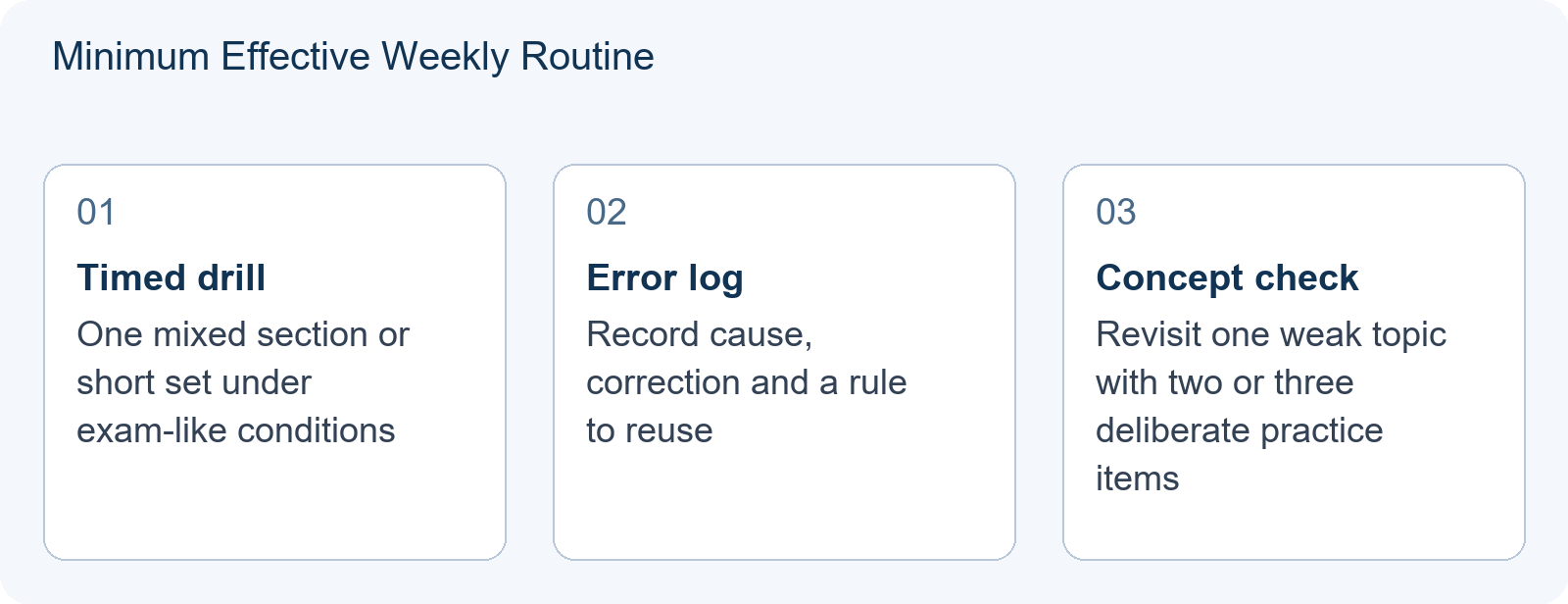
The minimum effective week takes two to three hours. Use one hour for a timed drill: either a set of multiple-choice questions or a small set of open-response questions. Use the next one to one-and-a-half hours for error analysis. Write down the exact cause of each mistake and the rule or method you will use next time. If a concept is weak, spend twenty minutes on two or three carefully chosen practice items. Stop there. The purpose is to keep your mathematical decision-making active, not to exhaust yourself.
This reduced plan works because the verified paper rewards accuracy and time control as much as deep topic knowledge. A student who can solve five questions carefully, record errors, and return next week is usually in a better position than one who does twenty questions without review. That is a coaching principle, not an official scoring rule, but it fits the no-negative-marking format and the senior-year reality.
Practice sequence: mixed sets, error log, and Section B and C write-ups
Effective preparation for the AMO format relies on three habits. They are especially useful for Grade 12 students because they can be done in short blocks.
Mixed sets. Avoid practising one topic for an entire week unless you have a diagnosed weakness. The paper places different kinds of questions in one sitting, so your practice should also ask you to switch contexts. Use past papers where available, or combine problems from algebra, number theory, geometry, combinatorics, and data handling. The goal is not random practice; it is deliberate switching. After each mixed set, note which switch cost you time.
Error log. Keep a simple log with four columns: question source, what I did, what I should have done, and the rule to reuse. Review the log weekly. A senior student who has limited time should not re-solve problems they already know. They should re-solve the problems that produced a recorded error. This turns a small amount of practice into targeted revision.
Section B and C write-ups. The open-response sections carry the larger individual point values. Practise writing a final answer clearly and supporting it with a compact, checkable method. The verified format gives point values. The available information does not specify a required proof length or a single accepted write-up style; train to be understandable: define variables, show the key equation or diagram, and state the final result. If you use model solutions, use them to compare clarity and structure, not as an official marking scheme.
For many seniors, the fastest gain comes from Section A accuracy. Fifteen questions worth 3 points each means that careless MCQ errors can erase the advantage gained from one hard Section C question. Build a habit of checking units, signs, and the exact question asked before you fill the answer. Then use the remaining time for Sections B and C without panicking.
Decision rule: when AMO fits a Grade 12 load – and when to reduce volume
Decide with evidence, not anxiety. If your 20-minute diagnostic is stable, if one full 90-minute set does not wreck your week, and if your core schoolwork is holding steady, then a four-week block or a maintenance plan is reasonable. If practice consistently pushes sleep down or causes predicted grades to slip, reduce to the minimum effective week. If even that is too much, it is acceptable to stop. AMO is one competition, not a requirement for a successful senior year.
A practical rule is to check two signals each week: sleep and schoolwork. If either is deteriorating, cut practice volume before cutting sleep. If both are stable and the math itself feels engaging, keep the routine. This is not an admissions argument. It is a workload argument. The AMO is organized by SIMCC and SIU. This guide is an independent resource and an authorized AMO registration partner, not the organizer. We do not promise a result or an admissions outcome.
For a wider planning view, see our guide to The Multi-Year AMO Roadmap: Planning Grades 2 to 12 Without Burnout. If you are strong in school maths but find AMO questions unfamiliar, read Top of the Class but Stuck in AMO? The Non-Routine Gap, Explained (2026). In the final fortnight, use The Last 14 Days Before AMO: A Taper Plan That Protects Your Accuracy (2026).
Frequently Asked Questions
Is there negative marking in the AMO?
No, the verified AMO format states there is no negative marking. Students should attempt all questions.
How long is the AMO exam?
The AMO exam lasts 90 minutes and consists of 25 questions divided into three sections.
Can I prepare for AMO in less than four weeks?
Yes. A minimum effective week of two to three hours, focused on timed drills and error analysis, can maintain proficiency when senior-year time is limited.