
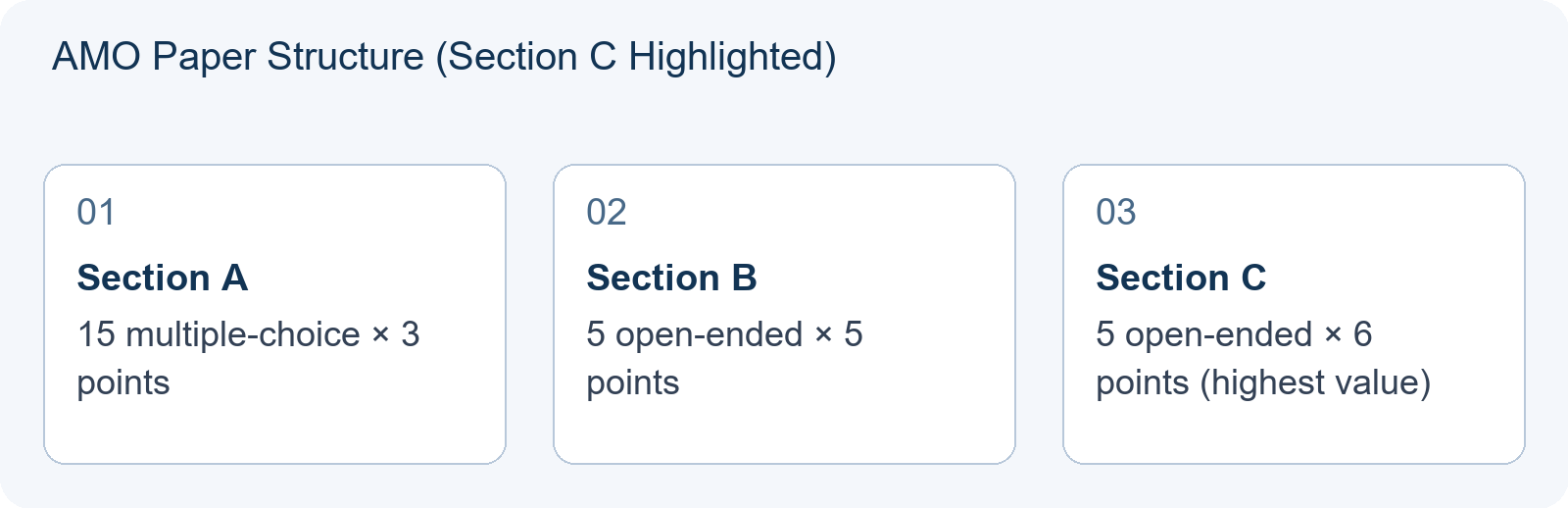
For many students preparing for the American Mathematics Olympiad (AMO), the jump from multiple-choice recognition to open-ended written reasoning is the biggest scoring difference of the whole paper. The AMO paper runs for 90 minutes and contains 25 questions in three bands: 15 multiple-choice questions worth 3 points each, then two open-ended sections — 5 questions worth 5 points each, followed by 5 questions worth 6 points each — for a total of 100 points. There is no negative marking. Section C is that final band: five open-ended questions at the highest single-question value in the paper.
This article is specifically about AMO Section C. The whole-paper timing picture is a separate topic; the focus here is narrower and more practical: how to practise the write-up itself, so that whatever a marker sees in your script is easy to follow. We do not claim to know the official internal partial-credit rubric for AMO — the supplied facts confirm the point values, the 90-minute limit, and the absence of negative marking, but they do not publish a per-line marking scheme. Everything below is therefore framed as a teaching routine, not as official marking guidance.
Why Section C Rewards a Different Skill
Section A is a recognition-and-speed section. Fifteen questions at 3 points each, inside a 90-minute paper, means the multiple-choice band is designed to be moved through quickly. Section B rarely surprises a student who has done past papers: five open questions at 5 points each tend to sit at the boundary between routine application and a short piece of reasoning. Section C is different. Five 6-point open questions sit at the top of the difficulty ramp, and because they are open-ended, the answer itself is only half the deliverable.
A useful way to think about the difference: in Section A the answer is the product; in Section C the answer is the conclusion of an argument. If the argument is missing, a marker — even a fair-minded one — has nothing to grade except the final number. That matters when the final number is wrong. It also matters when the final number is right, because a correct answer with no visible reasoning cannot demonstrate to a reader whether the method was sound or lucky.
A Diagnostic: Answer-Only vs Reasoning-Visible Solutions
Before adopting any routine, run a quick self-diagnostic. Take one Section C-style problem you have already solved. Now try to reconstruct your own solution in writing as if a stranger had to follow it. Two things usually happen: either you can rebuild it cleanly, or you find a gap you did not notice while solving it mentally.
Compare two hypothetical responses to the same problem. A student who writes only the final integer, or who writes “by counting, the answer is 47,” gives a marker no leverage. If 47 is correct, fine. If it is not, there is no second path to credit. A student who writes the constraint, the count, and the reasoning has produced something a marker can follow line by line. Even if the final number is wrong because of a small arithmetic slip, the visible method shows the intent.
This diagnostic is not only about earning potential partial credit. It is also about catching your own mistakes. Mental arithmetic hides errors; written arithmetic exposes them. If you routinely write every step of a Section C solution, you will find that many “careless errors” were actually process errors that a written check would have flagged before you boxed the answer.
The Write-Up Routine: Three Checkpoints
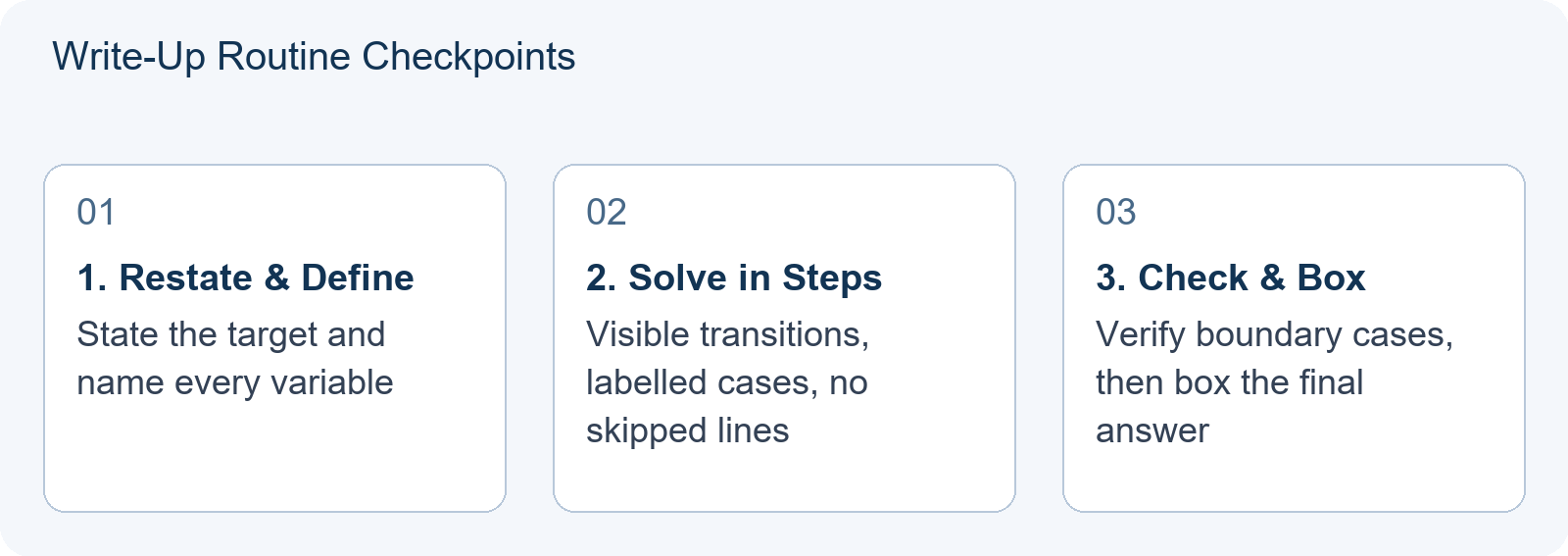
We propose a three-checkpoint routine for every Section C question. This is a teaching illustration, not an official AMO format, but it structures the writing process so that nothing essential is left invisible.
Checkpoint 1: Restate the Goal and Define the Objects
Start with one sentence that states what is being found — “Find the smallest positive integer n such that …” — and then a short line that defines every symbol you will use. If the problem involves a rectangle, name its sides. If it involves a sequence, define its first term and rule. If it involves a set, state whether it is finite or infinite. This checkpoint takes about thirty seconds, but it prevents the two most common writing failures: losing track of the target halfway through, and using a symbol twice for two different quantities.
Checkpoint 2: Solve in Visible Steps
Proceed linearly. Each line should follow from the previous one, and each transition should be labelled with the reason: “Substitute,” “Apply the Pythagorean identity,” “Sum the arithmetic series.” Avoid long blocks of prose. A short label plus an equation is clearer than a paragraph of explanation. If a step is long, break it into two lines. If a case split is needed, label the cases Case 1, Case 2. If the solution uses a symmetry shortcut, state the symmetry before using it — a marker cannot credit a shortcut you never mentioned.
Checkpoint 3: Check and Conclude
Before you box the answer, verify units, signs, and boundary values. Does the answer behave correctly in a small case? Is it positive? Does it satisfy the original condition? Then box the answer clearly, in the form the question asked for. If the question asked for a number of arrangements, give an integer. If it asked for a probability, give a fraction or decimal consistently. A clearly boxed, correctly formatted answer lets the marker locate the result quickly, and a marker who can find the answer quickly can evaluate the surrounding work fairly.
Labelled Teaching Illustration: A Hypothetical 6-Point Question
Note: The following is a fabricated example for instructional purposes only. It is not an AMO past-paper question, and the point value is used only as a scenario for practising the routine.
Hypothetical problem. A rectangle has integer side lengths and a perimeter of 20 cm. What is the maximum possible area, and what dimensions achieve it?
Applying the routine.
Checkpoint 1 — Restate and define. We want to maximise the area A of a rectangle whose sides l and w are positive integers and whose perimeter is 20 cm. Area A = l·w, perimeter 2(l + w) = 20, so l + w = 10.
Checkpoint 2 — Solve in visible steps. From l + w = 10, every admissible pair has the sum fixed at 10, so write w = 10 − l with l a positive integer between 1 and 9. Then A(l) = l(10 − l). To find the maximum, we can argue directly: the product of two positive numbers with a fixed sum is maximised when the numbers are as close as possible, which here means l = w = 5. Verifying the full integer table: (1, 9) gives 9; (2, 8) gives 16; (3, 7) gives 21; (4, 6) gives 24; (5, 5) gives 25. The maximum is 25.
Checkpoint 3 — Check and conclude. The sides 5 cm and 5 cm give perimeter 2(5 + 5) = 20 cm, matching the given condition, and both sides are positive integers. The area is 5 × 5 = 25 cm². This is the largest value in the table, and no pair of positive integers with sum 10 can exceed it because l and w are bounded by the constraint. Boxed answer: 25 cm², achieved by a 5 cm × 5 cm square.
The point of the illustration is not the arithmetic. It is that the three checkpoints together produce a solution a reader can follow from statement to boxed answer, using only the written lines. A student who arrived at 25 by intuition would have produced the same number, but with no trace of the argument.
Common Section C Traps and Corrections
Four traps catch students on Section C more often than content gaps do.
Trap 1: The magic jump. A student writes “clearly, the number of arrangements is 6,” skipping the casework that produced it. Fix: if a step feels obvious, that is the step most worth writing. Obviousness is subjective; readers cannot fill gaps you did not mark.
Trap 2: Ignored edge cases. Counting problems often hide small cases — zero, one, repeated elements, degenerate shapes. If a problem constrains variables with an inequality, check the boundary. If it counts objects, check whether the empty selection is allowed. Fix: after the main solution, write one line — “small cases: n = 0, n = 1 give …” — so boundary behaviour is visible.
Trap 3: Unit and notation mismatches. A problem quoted in metres, answered in centimetres, is wrong even if the arithmetic is right. A problem using x, then reusing x for a different quantity on the next line, is unreadable. Fix: convert units at the start and rename symbols whenever their meaning changes.
Trap 4: Solo final answer. A student who writes only the boxed number has produced a fragment of a solution. Fix: the final line should contain, at minimum, the answer and the conditions under which it holds. That single sentence is often the first thing a marker reads.
Practice Drill: Rewriting a Rushed Solution
Pick one practice problem you solved quickly, ideally from a timed session. Set a fifteen-minute timer and rewrite the solution using the three checkpoints. Then compare the two versions side by side and answer three questions: did the rewrite expose any steps you had skipped? Did it reveal an assumption you had not stated? Did it change the final answer?
Repeat this drill once a week for four weeks. The goal is not to slow down your normal solving; it is to install a writing reflex so that, under exam pressure, the checkpoints happen automatically. The routine is meant to be internalised, not consulted.
Students who want additional targeted practice can look at our articles on the Top of the Class but Stuck in AMO? The Non-Routine Gap, Explained (2026), You Have Finished the Past Papers: How to Turn One AMO Problem Into Ten (2026), and the The AMO Error Log: A Four-Cause System That Turns Lost Marks Into Points (2026). Each addresses a different part of the same problem: thinking style, practice volume, and mistake diagnosis.
Frequently Asked Questions
Does AMO give partial credit for Section C?
The supplied facts confirm there is no negative marking and list the point values, but they do not specify official partial-credit rules for open-ended questions. Our routine focuses on clarity so that any available credit is captured.
How much time should I spend on each Section C question?
With 20 earlier questions covering 70 of the 100 points in a 90-minute paper, the open-ended Section C questions should absorb roughly 20–30 minutes total, or about 4–6 minutes each. Adjust based on difficulty and how quickly you move through Sections A and B.
Is this routine applicable to other maths contests?
Yes. The restate-and-define, solve, and check habit is a general approach for any open-ended maths contest, including competitions with different point values such as the AMC or other olympiad-style papers.