
Direct Answer: What AMO Section A Rewards
AMO Section A is the critical opening block of the American Mathematics Olympiad paper. For students preparing for this competition, understanding the specific mechanics of this section is the first step toward maximizing score efficiency. Verified competition facts for the current AMO format are: Grade 2–12; 90 minutes total duration; 25 questions divided into three sections. Specifically, Section A consists of 15 multiple-choice questions worth 3 points each; Section B has 5 open-response questions worth 5 points each; and Section C has 5 open-response questions worth 6 points each. The total possible score is 100 points. Crucially, there is no penalty for wrong answers.
This structure creates a unique strategic environment. Section A alone offers 45 of the 100 available points, meaning nearly half the exam’s value is concentrated in the shortest, most rapid-fire questions. Because all 15 items carry equal weight, the rational default strategy is to answer every single Section A question. Leaving a blank guarantees zero points, whereas guessing—even with limited information—offers a chance at 3 points. However, the strategic challenge is not merely “Can I solve this?” but rather “What is the fastest reliable route to the correct option?” Many students fall into the trap of treating Section A like Section B or C, attempting rigorous, full derivations for simple multiple-choice items. This article provides a coaching clinic designed to shift that mindset. It is important to note that this is a teaching framework based on competitive mathematics pedagogy, not an official scoring rule issued by the organizers.
The Three-Question Decision Rule for Every MCQ
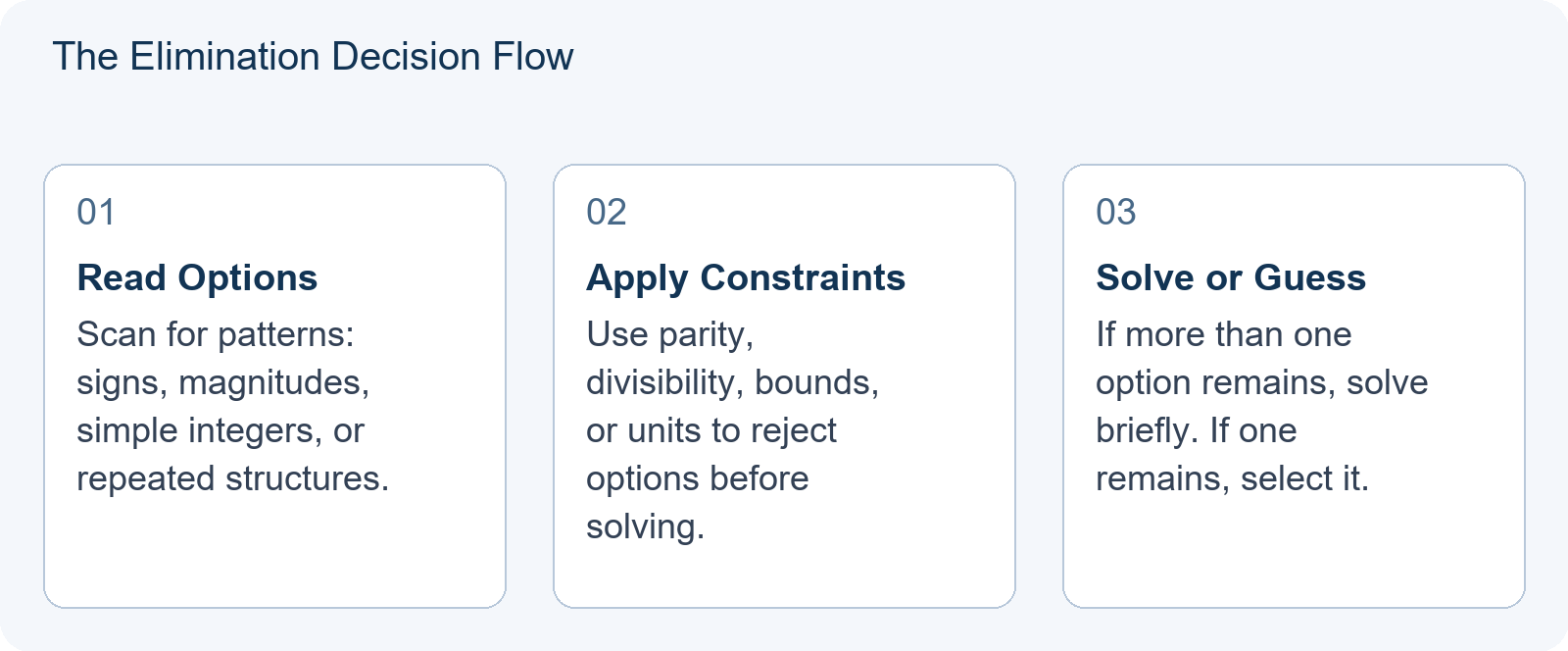
To prevent over-solving, we recommend applying a strict three-question filter before committing to any calculation. This mental checklist helps you decide whether to dive into algebra or stay on the surface level of logic and estimation.
- Is the answer space small or structured? Look at the options immediately. Are they simple integers? Small fractions? Values that are easy to plug back into the problem statement? If the options are discrete and manageable, direct option testing is often faster than setting up and solving an equation. For example, if the question asks for a number between 1 and 10, testing the four given options takes seconds, whereas deriving the formula might take minutes.
- Can structural constraints reject options? Before calculating, ask what properties the answer must have. Does it need to be an integer? Is it positive? Is it even or odd? Does it fit within a specific range? Mathematical structures often impose rigid constraints. A length cannot be negative. A count of people must be a whole number. A probability must lie between 0 and 1. If two options violate these basic physical or logical constraints, you can eliminate them instantly without doing any real math.
- Can estimation separate the field? If exact computation looks messy or time-consuming, approximate first. Round numbers to the nearest ten or hundred. Perform the calculation mentally. If your estimate is 48 and the options are 12, 24, 48, and 96, you have likely found the answer. Save precise, step-by-step calculation only for cases where two or more options survive your initial estimation filter.
A useful coaching rule of thumb for pacing: if you have spent about 90 seconds on a Section A question and have not eliminated at least one option, you are likely over-solving. With 15 questions in Section A, a practical time allocation is roughly 30–36 minutes for this entire section. This leaves ample time for the higher-value open-response sections. If you allocate 36 minutes, the average pace is about 2.4 minutes per question. This is a suggested pacing choice for optimal performance, not an official AMO requirement.
Common Trap Patterns in AMO-Style MCQs
Multiple-choice distractors in mathematics competitions are rarely random. They are carefully engineered to catch common student errors. Recognizing these patterns allows you to anticipate the trap and avoid it. The table below describes four frequent patterns that appear in AMO-style Section A practice questions.
| Trap Type | Description | Elimination Cue & Strategy |
|---|---|---|
| Off-by-One | Options differ by exactly 1 or -1 (e.g., 24, 25, 26). | Check boundary conditions. Does the problem say ‘at least’, ‘greater than’, or ‘inclusive’? Test the smallest or largest valid integer explicitly. Often, the trap is forgetting to add or subtract 1 in counting problems. |
| Sign Error | Options include both positive and negative versions of the same magnitude (e.g., 5 and -5). | Determine the sign logically before calculating. Lengths, counts, areas, and probabilities cannot be negative. If the context implies a physical quantity, eliminate negative options immediately. |
| Scale Mismatch | Options look similar but imply different units or scales (e.g., cm vs m, or % vs decimal). | Check conversion factors. If the input is in centimetres and the output asks for metres, reject options that ignore the factor of 100. Always verify the unit requested in the final answer line. |
| Partial Solution | An option represents an intermediate step rather than the final answer. | Ask: did I finish the operation? If the problem asks for the sum of squares, reject an option that is only the square of the sum. Re-read the final sentence of the question to ensure you are answering what was actually asked. |
For example, consider a counting problem offering options 24, 25, 26, and 27. The consecutive nature of these values strongly suggests an inclusion-exclusion boundary trap. Instead of recounting every possibility from scratch, verify whether endpoints are included or excluded. This targeted check is often significantly faster than a full recount and directly addresses the likely source of error.
Worked Teaching Illustration: Bounds and the Impossible Option
Teaching illustration: this is a hypothetical problem created for this article to demonstrate the method. It is not an actual past AMO question.
Problem: Which of the following cannot be written as n^2 + n for a positive integer n?
A) 12
B) 20
C) 28
D) 42
Elimination-first route: Factor the expression as n(n+1). For a positive integer n, the product n(n+1) lies strictly between n^2 and (n+1)^2. Now, compare each option with known square gaps.
- Option A (12): Lies between 3^2 = 9 and 4^2 = 16. Testing n = 3 gives 3 × 4 = 12. Possible.
- Option B (20): Lies between 4^2 = 16 and 5^2 = 25. Testing n = 4 gives 4 × 5 = 20. Possible.
- Option D (42): Lies between 6^2 = 36 and 7^2 = 49. Testing n = 6 gives 6 × 7 = 42. Possible.
- Option C (28): Lies between 5^2 = 25 and 6^2 = 36. The only positive integer n such that n^2 < 28 < (n+1)^2 is n = 5. However, 5 × 6 = 30, which is not 28. Therefore, 28 cannot be written as n^2 + n for a positive integer n.
A full quadratic route would require solving n^2 + n – 28 = 0, calculating the discriminant 1 + 4(28) = 113, and recognizing that 113 is not a perfect square. While valid, this takes longer. The bounds check and one product test take far less time. This illustrates the clinic’s core goal: use structural properties to reject options before engaging in heavy calculation.
Diagnostic: Section A Decision Errors, Not General Errors
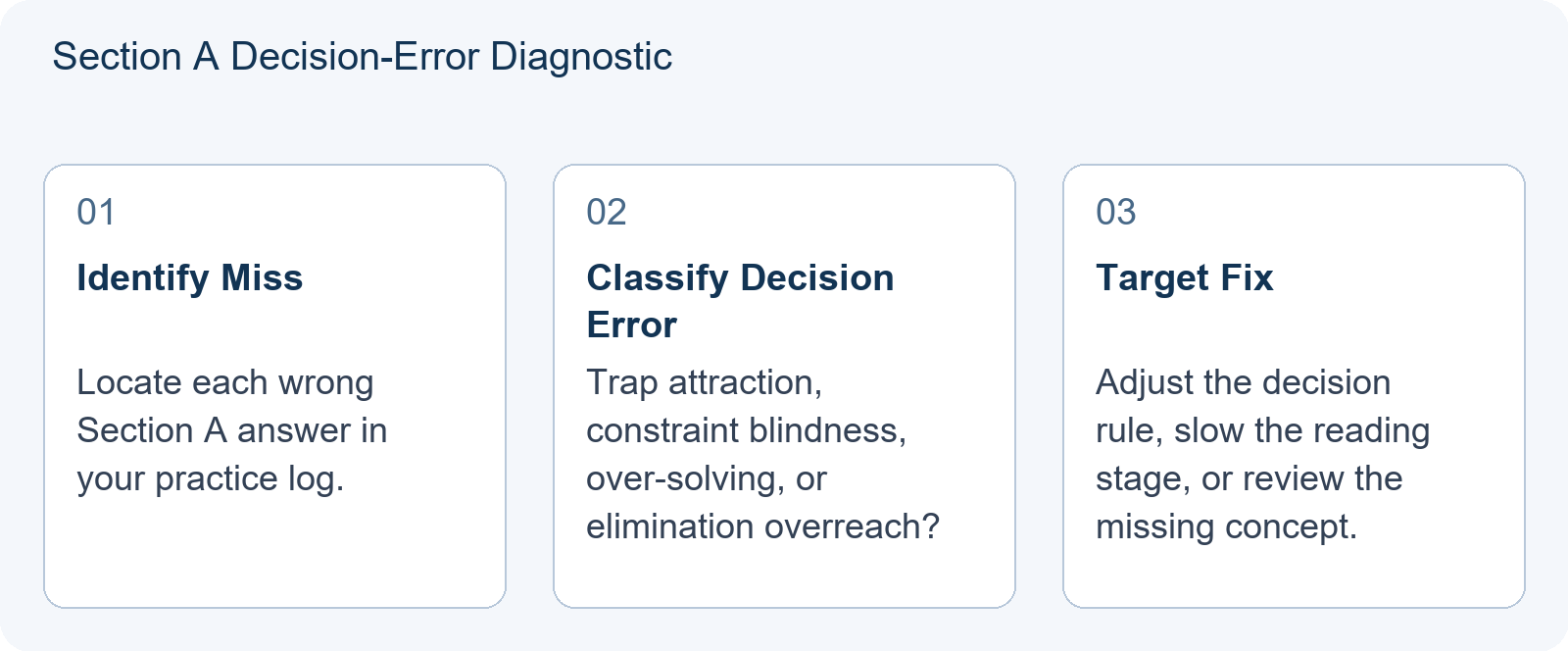
Reviewing practice tests generically is inefficient. To improve specifically in Section A, classify each miss by the decision error that caused it. This approach differs from broader error logs; for a comprehensive view of tracking mistakes, see our article on The AMO Error Log: A Four-Cause System That Turns Lost Marks Into Points (2026).
- Cause 1: Trap attraction. You selected a distractor that matched a partial calculation or a common mistake. Fix: Before selecting an answer, pause and ask: “Which operation does the problem actually ask for?” Verify that you haven’t stopped halfway through the required steps.
- Cause 2: Constraint blindness. You ignored a key condition such as ‘positive integer’, ‘at least’, ‘distinct’, or ‘non-zero’. Fix: Underline every constraint in the question text. Our guide on Reading AMO Questions in English: The Sentence Patterns That Cost Marks (2026) covers specific sentence patterns that hide these constraints.
- Cause 3: Over-solving. You completed a long, complex derivation when simple option testing or bounds checking would have sufficed. Fix: Practise the Three-Question Decision Rule on timed sets. Force yourself to look at the options before starting the math.
- Cause 4: Elimination overreach. You rejected the correct option using an invalid cue, such as assuming a value must be odd without checking the rule, or misapplying a divisibility test. Fix: When eliminating, state the exact mathematical rule that justifies the rejection. If you can’t name the rule, don’t eliminate.
If Cause 3 appears often, your issue is strategic rather than mathematical—you know the math but lack the speed technique. If Cause 1 or Cause 2 dominates, you need to slow down at the read-and-decode stage. If Cause 4 dominates, practise justifying every elimination logically before trusting it.
Practice Routine: Ten Minutes of Elimination Drills
To build intuition for this style of thinking, dedicate ten minutes daily to ‘No-Solve’ drills. Take five multiple-choice questions from your own practice set or past-paper collection. Set a timer for 60 seconds per question. Your task is not to find the correct answer, but to eliminate at least two incorrect options using logic, bounds, parity, or units.
After the drill, compare your eliminations with the actual solutions. Did your logic hold? If you eliminated the correct answer, analyse which cue was invalid. Was your assumption about parity wrong? Did you misread the scale? This trains you to spot structural features quickly and accurately. For students preparing for higher grades, this habit can be integrated into weekly practice sessions before attempting full timed mock exams. It shifts the focus from “getting the right answer” to “understanding why the other answers are wrong,” which is a powerful learning tool.
How Elimination Fits Into the 90-Minute Paper
Section A is the gateway to the rest of the paper. Spending too long here leaves insufficient time for Sections B and C, which contain the highest-value questions. Section B and C questions are worth 5 and 6 points respectively, compared to Section A’s 3 points. Although Section A has more total points because it has 15 items, the individual stakes are lower. A balanced plan reduces the chance that later open-ended questions are rushed or left blank due to time pressure.
The ideal flow is to secure quick wins through elimination, then allocate remaining time to harder calculations. Because there is no penalty for wrong answers, never leave a Section A question blank. If stuck, make an educated guess based on partial elimination and move on immediately. Dwelling on a difficult Section A question is a poor investment of time compared to tackling a Section B problem. For more on managing time and writing clear reasoning for the open-ended sections, see our guide to AMO Section C: How to Write Open-Ended Solutions That Show Your Reasoning.
Elimination-first does not mean guessing blindly. It means asking, before every full solve, whether the options and constraints already tell you enough to decide. In Section A, that habit can protect both accuracy and time, allowing you to enter the more demanding sections with confidence and energy.
General event background is available at Event background.
Frequently Asked Questions
Is there a penalty for wrong answers in AMO Section A?
No. Verified competition facts state there is no penalty for incorrect answers. That means students should attempt every question and use elimination to narrow choices rather than leaving blanks.
How many points is each Section A question worth?
Each of the 15 multiple-choice questions in Section A is worth 3 points. Section A therefore contributes 45 points to the 100-point paper.
Should I always eliminate options before solving?
Not always. Use the Three-Question Decision Rule. If options are complex or structural constraints are clear, eliminate first. If the problem is straightforward and fast to solve, calculate directly. The aim is to balance speed and accuracy.