
In our experience, marks lost to “careless reading” in AMO are often neither carelessness nor vocabulary. They are a small set of English sentence patterns — comparisons, quantifiers, order-reversing phrases — that quietly change what a question asks. There are about nine of them, they recur across word problems of this kind, and a bilingual student can be trained to spot them with a few weeks of focused work.
Why a misread is usually a grammar problem, not a maths problem
A student who sits the paper in English at an international school in China typically has plenty of mathematical vocabulary. They know perimeter, remainder, consecutive. What catches them is not the technical noun; it is the ordinary English wrapped around it. “Five less than twice a number” contains no difficult words at all, and a large share of students convert it into the wrong expression.
The diagnostic signature is easy to recognise. The student's working is mathematically clean, the arithmetic is right, and the answer is confidently wrong — and when they see the solution they say “oh, I thought it meant…”. That is not a maths failure and more practice papers will not fix it, because they will keep making the same conversion. What fixes it is direct training on the patterns themselves.
Two things make this worth attacking early. First, it is the cheapest source of marks in the whole preparation: the student already has the mathematics. Second, it compounds — a mis-parsed first sentence sends the entire multi-step solution somewhere useless, so one grammar slip can cost a whole question rather than one line. (For orientation, see what AMO is. AMO is run by SIMCC in Singapore with Southern Illinois University Carbondale, for Grades 2 to 12 — it is not the AMC, which is a separate competition run by the MAA in the United States. Paper language, format and instructions are set by the organiser; confirm on the official AMO pages.)
This article deliberately does not cover mathematical vocabulary, which we handle separately. Everything below is about sentence structure — the words a student already “knows” and still misreads.
The nine patterns that reverse meaning
| Pattern | What it means precisely | The common misreading | Five-second test |
|---|---|---|---|
| at most / at least | at most 4 means 4 or fewer; at least 4 means 4 or more | Reading either as “exactly 4” | Say the boundary aloud: “could it be 4? could it be 9?” |
| how many more A than B | The difference, A − B | Writing down A, the larger amount | Circle the word “more” — it means subtract, not report |
| three times as many A as B | A = 3 × B, so B is the smaller one | Making B three times A — the order flips | Point at which noun is bigger before writing anything |
| 5 less than twice a number | 2n − 5 | 5 − 2n, or 2(n − 5) | “less than” reverses the order of what you just read |
| each / every / per | The amount applies once to every item, so multiply | Treating the number as a total already | Ask: is this a total, or one portion? |
| the rest / the remaining | Whatever is left after all previously mentioned parts | Subtracting only the most recent part | List the parts already used before computing the rest |
| respectively | Matches two lists in order, first to first | Matching by proximity or guessing the pairing | Draw two short columns and join them with lines |
| in 5 years / 5 years ago | The shift applies to every person in the problem | Ageing one person and leaving the other unchanged | Write a two-row table: now, and then |
| consecutive | In a row; consecutive even or odd numbers differ by 2, not 1 | Using a gap of 1 for even numbers | Write the first three examples before using them |
Three of these deserve extra attention because they cost the most. The comparison family (“three times as many…as”, “how many more…than”) accounts for a large share of the misreads we see in marked practice papers, because the two nouns arrive in the opposite order from the arithmetic. The order-reversing family (“less than”, “subtracted from”, “divided into”) is worse, because the sentence reads left to right while the expression must be built right to left. And the time-shift family in age problems is where a student who has understood everything else still loses the question, by moving one person through time and not the other.
One honest note on a phrase students ask about constantly. In careful mathematical English, “three times as many as X” means 3X. The looser phrase “three times more than X” is used by many writers to mean exactly the same thing, though read strictly it could mean 4X. If a question uses the looser wording, work with 3X and then check that your answer is consistent with every other condition in the question — the rest of the information almost always resolves it.
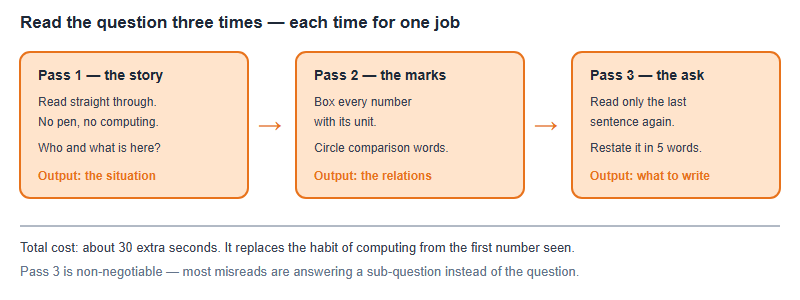
Annotate the stem in sixty seconds
Reading protocols only work if they leave a physical trace on the paper. A student who “reads carefully” without marking anything is relying on memory under time pressure, which is exactly when memory fails. Four marks are enough, and they should be identical every single time so they become automatic.
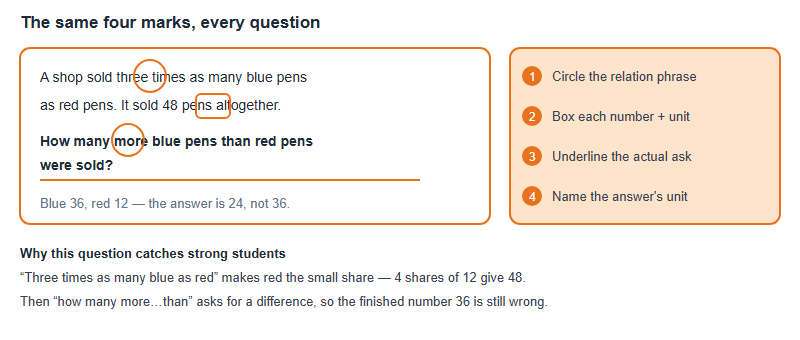
The fourth mark — naming the unit of the answer before solving — is the one students skip and the one that catches the most errors. Writing “answer = pens” or “answer = minutes” at the top of the working forces the student to decide what kind of thing they are looking for, which is exactly the decision a misread destroys.
Training it: three drills that work
- Paraphrase drill (five minutes, most days). Take five question stems — no solving. The student rewrites each in their own English in one short sentence beginning “Find…”. Then check the paraphrase against the original word by word. This isolates comprehension completely from mathematics, which is why it improves so quickly.
- Pattern hunt. Give a past paper and ask only for one thing: mark every instance of the nine patterns. No answers. Ten minutes. Students are usually surprised how many appear, and recognition is most of the battle.
- A misread log. Every misread goes in a notebook in three columns: the original phrase, what the student thought it meant, what it actually meant. Reread the log before each practice paper. Misreads are highly personal and highly repetitive — a student who mis-parses “less than” will do it again in three weeks unless it is on a page in front of them.
One trap to name explicitly, because it is common among bilingual students and rarely discussed: translating the question into Chinese in your head, solving, then translating back. It feels safer and it costs marks. Conditions get dropped in translation, particularly quantifier words such as each, at most and remaining, which do not map one-to-one and are easy to smooth over. It also doubles the time spent on every stem. The better target is to build a direct route from the English sentence to the mathematical relation, which is precisely what the paraphrase drill trains — and note that the paraphrase should be written in English, not in translation.
What this does not fix — and how to tell the difference
Reading training solves reading problems only. If a student parses a question perfectly, states the ask correctly, and still cannot find a route into it, the issue is problem-solving technique or a genuine content gap, and no amount of annotation will help. The two look similar on a results sheet and are easy to separate in practice: read the question aloud to the student and ask them to restate what is wanted. If they now solve it, it was reading. If they still cannot start, it was not.
It also does not change the level a student should sit. Reading load naturally rises with grade band, so a student who is comfortable mathematically but slow in English is not a candidate for moving up — see AMO grade levels explained and confirm the current arrangement officially. And it should not change what a family expects from a result: AMO awards are percentile-based and depend on the whole cohort in that season, so treat cleaner reading as a reliable gain in marks rather than a guarantee of a band (see how AMO scoring works).
Set against that, this is still the highest-return few weeks available to most bilingual competitors. The mathematics is already there. The work is only to stop the English quietly changing the question on the way in.
Frequently asked questions
Is my child losing marks because of English or because of maths?
Read the question aloud and ask them to restate the ask. If they then solve it, the problem is reading, not mathematics.
Should a bilingual student translate questions into Chinese first?
Better not to. Quantifiers such as each, at most and remaining are easily dropped in translation, and it doubles the time per question.
Does “how many more A than B” mean the total of A?
No. It asks for the difference, A minus B. Circling the word “more” while reading is the fastest habit to prevent this.
Is AMO the same as the AMC?
No. AMO is run by SIMCC in Singapore with SIU for Grades 2 to 12; the AMC is a separate competition run by the MAA in the United States.
This site is operated by Hanlin Education as an authorized AMO registration partner for China. AMO (American Mathematics Olympiad) is run by SIMCC (Singapore International Math Contest Centre) together with Southern Illinois University Carbondale; we are not the organiser and do not speak for it. Contest dates, eligibility, paper language and structure, and award arrangements are set by the organiser and can change between seasons — confirm all details on the official SIMCC / AMO pages or through your registration channel. Factual errors are corrected within 7 working days of being reported.