
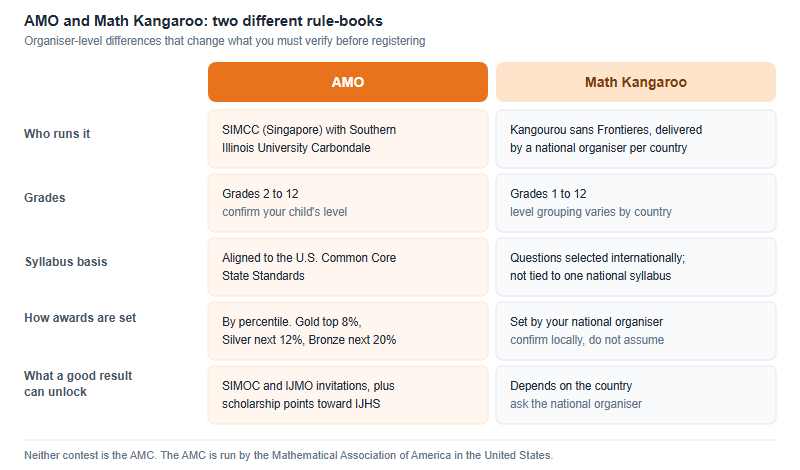
AMO and Math Kangaroo are both international maths competitions open to primary and secondary students, but they are run by different bodies under different rule-books. AMO is jointly organised by SIMCC in Singapore and Southern Illinois University for grades 2 to 12, and its papers are aligned to the US Common Core. Math Kangaroo runs through Kangourou sans Frontières and its national organisers, whose formats differ from country to country.
That single sentence explains most of the confusion families bring to us. Parents compare the two as if they were two versions of the same exam, then discover halfway through the term that the sitting dates, the marking rules and the onward routes are set by completely separate organisations. This guide sets out what is genuinely different, what you can verify today, and which questions actually decide the choice for a particular child.
First, the disambiguation that saves the most trouble
Before comparing anything, get the names straight, because three different contests get muddled in Chinese international-school parent groups every autumn.
- AMO — American Mathematics Olympiad. Jointly organised by the Singapore International Mastery Contests Centre (SIMCC) and Southern Illinois University Carbondale, whose STEM Education Research Center co-organises it. Open to grades 2 to 12. Papers are aligned to the U.S. Common Core State Standards. Despite the word "American" in the name, it is not the AMC: the contest is run out of Singapore by SIMCC together with SIU in Illinois. Our full introduction to AMO covers this in detail.
- AMC — American Mathematics Competitions. A separate contest run by the Mathematical Association of America in the United States, feeding AIME and USAMO. It is not AMO, does not share papers with AMO, and does not share an organiser with AMO.
- Math Kangaroo. The English name for the Kangourou sans Frontières contest, an international association founded after mathematicians from ten countries met in Strasbourg in 1994, with statutes registered in Paris in January 1995. Questions are selected internationally; the paper is then delivered by a national organiser in each participating country. It had over six million participants across 57 countries in 2014, and by 2022 counted 84 participating countries.
So the honest comparison is not "AMO vs Kangaroo, which is the real one". Both are real, established, and long-running. They are simply governed differently, and that governance difference is what generates every practical difference below.
What each paper measures — and the one rule you must never copy across
This is where the two contests genuinely diverge, and it matters more than any surface detail.
Math Kangaroo is built as a graded puzzle set. Its published design uses questions worth 3, 4 and 5 points according to difficulty, with the sections divided evenly. The consequence is that a Kangaroo paper is deliberately front-loaded with accessible items so that a nervous nine-year-old still finishes with a score they can be proud of, while the 5-point block at the end separates the strongest candidates. Papers in most countries run somewhere in the 50 to 75 minute range and contain roughly 24 to 30 problems, though the exact figure for your child's level is set nationally. The style rewards a flash of insight: seeing the trick quickly, spotting the symmetry, ruling out options.
AMO is built as a curriculum-anchored olympiad. Its framework is aligned to the U.S. Common Core State Standards, which is unusual among international olympiads and is the single most useful thing to know about it. A Common Core anchor means the topics your child meets on an AMO paper are, in principle, topics the school year is already meant to cover — taken to a non-routine depth. That is why AMO tends to suit students who have solid grade-level foundations and need to be stretched laterally, rather than students who need a whole new syllabus.
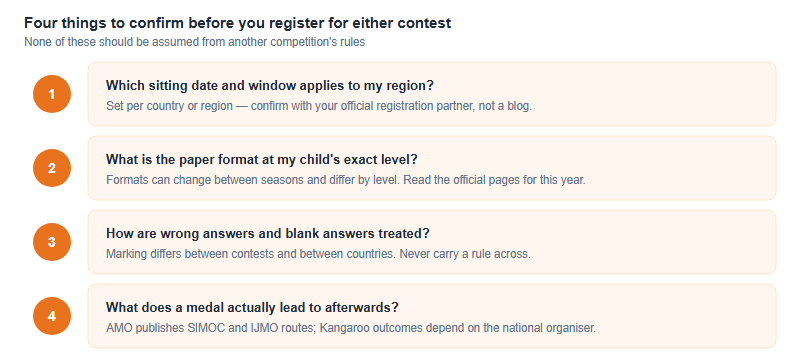
We deliberately do not publish a question count or timing for AMO here. Contest formats are revised between seasons and can differ by level, and a number copied from a coaching blog is exactly how families end up rehearsing the wrong pacing. Confirm the current format for your child's level on the official SIMCC / AMO pages, or with whoever registers you.
Which brings us to marking — the one place where borrowing a fact from the wrong competition costs real marks.
Kangaroo marking is set nationally, and it is not uniform. Some national implementations deduct for an incorrect answer while others do not penalise wrong answers at all — and skipping is treated differently again. A student who has been coached on "there is no penalty, so fill in every bubble" using one country's rules can walk into a sitting under a different country's rules and lose marks by guessing.
AMO uses a different system for the award itself: medals are decided by placement against the worldwide field rather than a fixed pass mark, which we unpack in how AMO scoring works. Confirm the current marking rules for your own sitting on the official pages before you build any guessing strategy on top of them.
The general rule for any competition household: marking rules are contest-specific and often country-specific. Verify them for the paper you are actually sitting, this year.
Side-by-side: the comparison that actually helps you decide
| Decision factor | AMO | Math Kangaroo |
|---|---|---|
| Governing body | SIMCC (Singapore) with Southern Illinois University Carbondale | Kangourou sans Frontières, delivered by a national organiser |
| Eligible grades | Grades 2 to 12 | Grades 1 to 12; how grades are grouped into levels varies by country |
| Content anchor | Aligned to the U.S. Common Core State Standards | Internationally selected questions, not tied to a single national curriculum |
| Question design | Confirm the current format for your level on the official pages | Multiple choice graded at 3, 4 and 5 points, sections divided evenly |
| Award basis | Percentile placement, not a fixed pass mark: top 40% are medalled — Gold top 8%, Silver next 12%, Bronze next 20% | Set by the national organiser; confirm locally |
| Published onward route | Gold and Silver invited to IJMO; Gold, Silver and Bronze invited to SIMOC the following year | Depends on the country; many national programmes end at the single paper |
| Recognition beyond the medal | Individual Scholarship Points for Bronze and above; four points bring free induction into the International Junior Honor Society | Varies; ask the national organiser |
| Best suited to | Students with secure grade-level foundations who need depth and a multi-year ladder | Students who enjoy short lateral puzzles and want a low-pressure first competition |
What a strong result leads to next
For families thinking past a single certificate, this is the most material difference and the one least discussed.
AMO publishes a defined ladder. The top 40% of participants receive a certificate and a medal, split as Gold for the top 8%, Silver for the next 12% and Bronze for the next 20%. Gold and Silver awardees are invited to compete in IJMO, the International Junior Math Olympiad; Gold, Silver and Bronze awardees are invited to the Singapore International Mathematics Olympiad Challenge (SIMOC) the following year. Separately, every Bronze or higher award earns Individual Scholarship Points, and four accumulated points bring free induction into the International Junior Honor Society. So one autumn paper can, in principle, put a student onto a multi-year track.
Kangaroo, by contrast, is in most countries a single celebrated paper. That is a design choice, not a weakness: a self-contained contest with no advancement pressure is exactly right for a seven-year-old, or for a student whose term is already full. But if the reason you are entering a competition is to build a documented progression across several years, the two contests are not interchangeable, and the published routes are worth reading before you commit. Our guide to AMO grade levels shows how the ladder maps onto a school career.
Three student profiles, three honest recommendations
Neither contest is better in the abstract. The right question is which one fits the student in front of you this year.
- Grade 2 to 4, first competition, anxious about tests. A short, self-contained, cheerfully-designed paper is the right introduction, and the graded 3/4/5-point structure means almost every child comes away having solved something. Kangaroo is a natural first step. AMO also runs from grade 2 and is entirely viable at this age; the deciding factor is usually whether you want a one-off experience or the start of a ladder.
- Grade 5 to 8, already strong at school maths, bored. This is the profile AMO was built for. A Common Core-aligned paper taken to olympiad depth exposes the gap between "can execute the method" and "can handle an unfamiliar problem" without requiring a separate curriculum first. If the student wants a multi-year target, the SIMOC and IJMO routes give the year a point.
- Grade 9 to 12, building a record. Read both carefully. Senior students often already have a maths competition on their calendar, and adding a second one has a real cost in preparation weeks. Choose the one whose published progression you would actually pursue, and enter it properly, rather than half-preparing for two.
One last piece of advice from our registration desk: the most reliable way to choose is not to read comparisons like this one, but to sit your child down with a past paper from each at their own grade, untimed, on a weekend morning. Fifteen minutes of watching which paper they lean into tells you more than any table. Neither contest guarantees any academic outcome, and no honest partner would suggest otherwise — the value is the thinking the preparation builds.
Frequently asked questions
Is AMO the same as the American Mathematics Competitions (AMC)?
No. AMO is run by SIMCC in Singapore with Southern Illinois University for grades 2 to 12. The AMC is a separate MAA contest in the United States.
Can my child sit both AMO and Math Kangaroo?
Usually yes: they are run by different organisations on separate calendars. Check both sitting dates and your term workload first.
Which competition is harder?
Neither is uniformly harder. They test different things at different levels. Compare past papers at your child's own grade before deciding.
How are AMO awards decided?
By percentile placement rather than a fixed pass mark. The top 40% receive a medal: Gold top 8%, Silver next 12%, Bronze next 20%. Confirm the current bands on the official AMO pages.
This site is operated by Hanlin Education as an authorized AMO registration partner for China. AMO (the American Mathematics Olympiad) is run by SIMCC together with Southern Illinois University — we are not the organiser, and we do not set papers or award medals. Details of format, marking, dates and awards can change by season and by region; always confirm current information on the official SIMCC / AMO pages, and confirm Math Kangaroo details with the relevant national organiser. We do not guarantee any result or admission outcome. Corrections are made within 7 working days.