
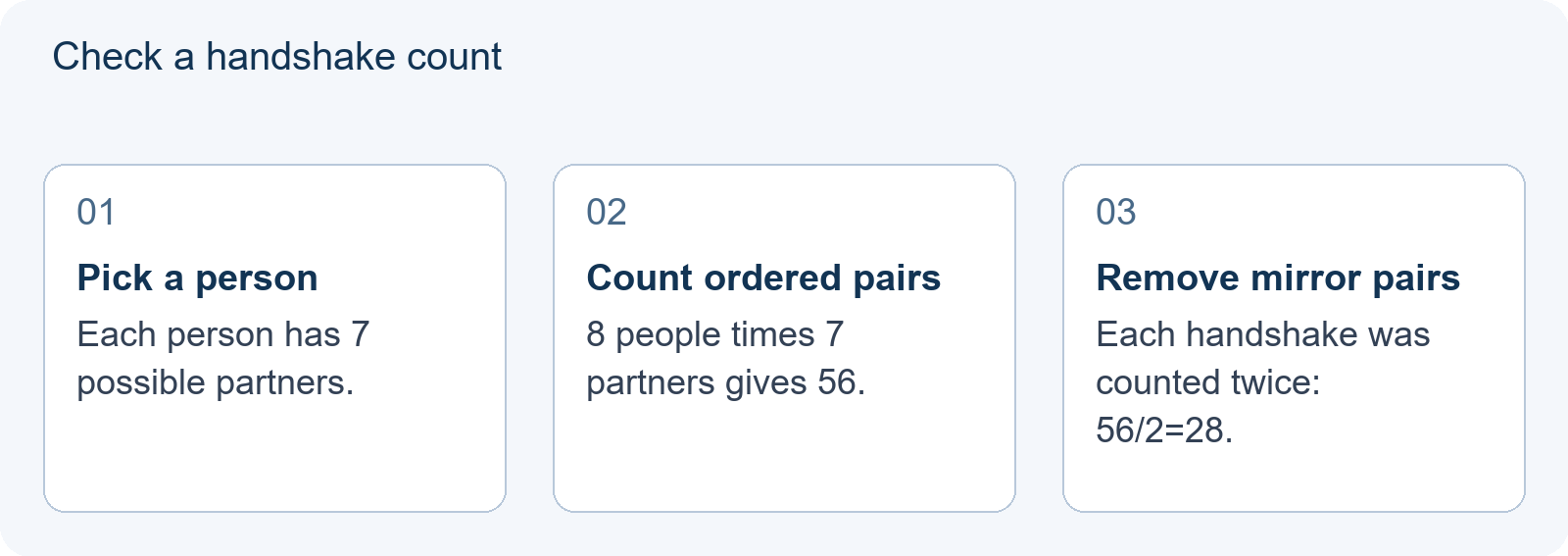
Short answer (teaching illustration, not an official contest problem): For eight people who each shake hands once with every other person, the total is 28, not 56. The product 8 × 7 = 56 counts each handshake twice: once when A is named first and once when B is named first. Because those two descriptions refer to the same handshake, divide by 2. That is the whole decision. In AMO handshake problems and other pair-counting questions, swap the two members of a pair. If the swap gives the same outcome, the pair is unordered and the ordered count must be halved. If the swap gives a different outcome, do not halve.
The AMO site notes used for this article (synced 14 July 2026) describe AMO (American Mathematics Olympiad) as a Grade 2–12 competition with a 90-minute, 25-question paper: 15 multiple-choice questions worth 3 points, five open questions worth 5 points and five open questions worth 6 points, for 100 points. The notes also say it can be taken online or as a paper test at school. Those are format facts, not a claim that every paper contains a handshake question. The method below is a teaching clinic for AMO-style practice, not a reproduction of a contest paper or official scoring guidance.
Why one division by 2 is enough — and when it is wrong
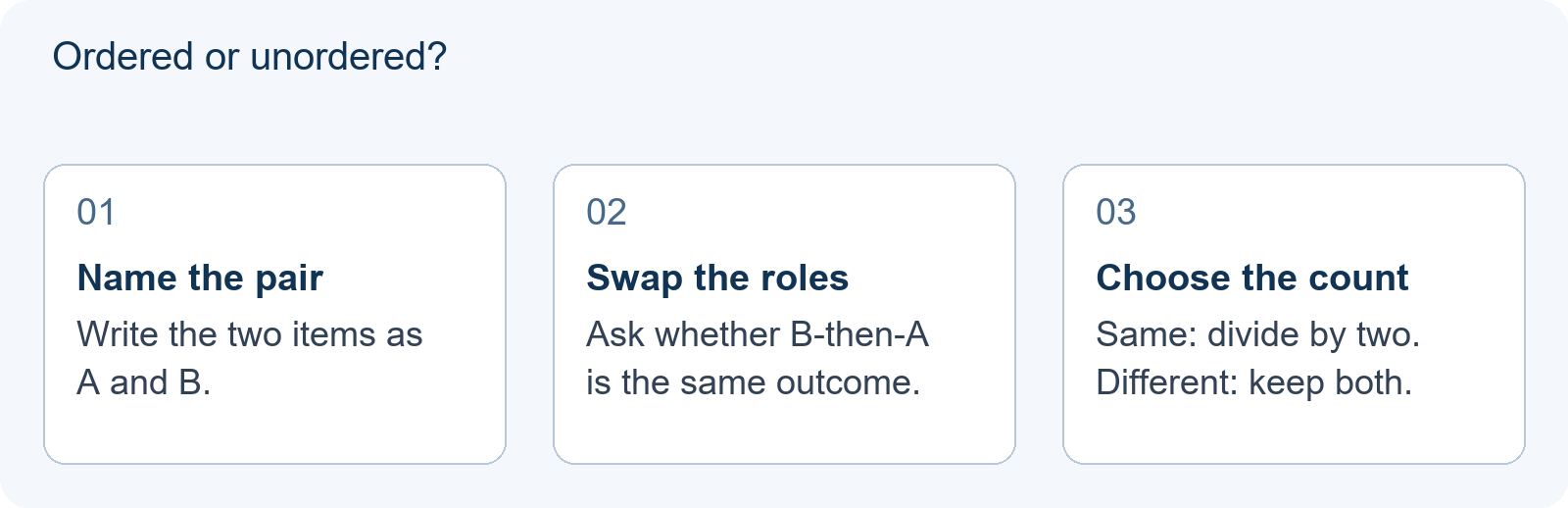
Ordered counting means the order of the two names matters. Unordered counting means the two names describe one outcome no matter which is written first. The safest test is not to stare at a formula but to compare two descriptions: A with B, and B with A.
- A handshake between A and B is the same event as a handshake between B and A. The two orders collapse into one handshake, so divide by 2.
- A captain and vice-captain pair changes when the roles swap. A as captain with B as vice-captain is not the same as B as captain with A as vice-captain, so do not divide.
- A home match hosted by A against B is not the same fixture as a home match hosted by B against A. If the league counts both, keep both and do not divide.
Division by 2 is therefore not a habit attached to the word ‘pair’. It is a correction for counting every unordered pair exactly twice. If your counting scheme has counted a pair four times, dividing by 2 leaves it counted twice; the fix is to change the scheme, not to divide again. If your scheme has counted each pair once in each direction, exactly two descriptions exist for each unordered pair, and division by 2 is justified.
For a different double-counting trap — choosing rectangle boundaries or path steps — see AMO Grid Counting: Avoiding Double Counts in Rectangles and Paths. The decision there is about which boundaries define a rectangle; the decision here is whether a pair has two interchangeable roles or two genuinely different roles.
Deriving n(n−1)/2 instead of memorising it
Start with n people. The first person can be paired with n−1 others. The second person can also be paired with n−1 others, but that would count some pairs in both directions. A cleaner ordered count is: choose the first name in n ways and the second name in n−1 ways, giving n(n−1) ordered pairs. A person cannot be paired with themselves, which is why the second choice has only n−1 options. Each unordered handshake then appears twice, so the number of handshakes is n(n−1)/2.
| People (n) | Ordered pairs n(n−1) | Handshakes n(n−1)/2 |
|---|---|---|
| 4 | 12 | 6 |
| 6 | 30 | 15 |
| 8 | 56 | 28 |
The table is a teaching illustration, not an official contest task, and it is not a substitute for the swap test. It is a check on a counting scheme that has already been identified as unordered. The formula assumes that every pair is wanted once, that no person is paired with themselves, and that the two roles are interchangeable. Remove any one of those assumptions and the division may no longer be correct.
Worked teaching illustration: six teams, one match or home and away
Teaching illustration, not an official contest problem. Suppose six teams enter a league. There are 6 × 5 = 30 ordered fixtures if we first choose a home team and then choose an away team. The meaning of ‘match’ decides what to do next.
| Fixture rule | Ordered count | Divide by 2? | Total |
|---|---|---|---|
| Each pair plays once | 6 × 5 = 30 | Yes | 15 |
| Each pair plays home and away | 6 × 5 = 30 | No | 30 |
In the first row, ‘A versus B’ and ‘B versus A’ name the same single fixture, so the ordered count has doubled the answer. In the second row, the two descriptions are different fixtures: one is played at A’s home and one at B’s home. The arithmetic did not change; the interpretation of a match changed. A student who divides automatically will get 15 in both rows and lose the second case.
Same test, different subtraction: polygon diagonals
A polygon is a useful teaching check: it also involves unordered pairs, but there is an extra subtraction. With n vertices, every pair of distinct vertices determines one segment. There are n(n−1)/2 such pairs. Of those segments, n are sides of the polygon. The diagonals are the remaining segments, so the number is n(n−1)/2 − n, which simplifies to n(n−3)/2. The formula is not a new magic rule; it is the handshake count with the sides removed.
The following polygon table is a teaching illustration, not an official contest problem.
| Polygon | All vertex pairs | Sides | Diagonals |
|---|---|---|---|
| 5 sides | 10 | 5 | 5 |
| 6 sides | 15 | 6 | 9 |
| 7 sides | 21 | 7 | 14 |
| 8 sides | 28 | 8 | 20 |
For a 7-sided polygon, 7 × 6 / 2 = 21 vertex pairs, and 7 of those pairs are sides, leaving 14 diagonals. The check 7 × 4 / 2 = 14 agrees. This example also shows why students should not divide by 2 and then subtract without checking units: the 21 is a count of vertex pairs, the 7 is a count of sides, and the final 14 is a count of diagonals.
A three-question diagnostic before you calculate
- Are the two roles interchangeable? If swapping A and B leaves the same outcome, treat the pair as unordered. If the swap changes the outcome, keep the orders separate.
- Does the wording say each pair once, or home and away? ‘Each pair once’ usually points to an unordered count. ‘Home and away’, ‘captain and vice-captain’ or ‘first and second’ point to ordered counting.
- Have I counted both directions of the same pair? If yes, and the two directions describe the same outcome, divide by 2. If no, do not divide merely because the word ‘pair’ appears.
These questions are deliberately about meaning before arithmetic. A student who reaches for n(n−1)/2 because a question contains people or teams has skipped the only step that can justify the formula. A student who asks the three questions may still make an arithmetic mistake, but the check is designed to catch setup errors before arithmetic begins.
How to write the reasoning in an open-response answer
A complete explanation should show the ordered count, the reason for dividing, and the final unit. For the eight-person handshake, one acceptable answer reads: ‘Each of the 8 people can choose one of the other 7, giving 8 × 7 = 56 ordered pairs. A handshake between A and B is the same as a handshake between B and A, so every handshake is counted twice. Therefore there are 56 ÷ 2 = 28 handshakes.’ The division is not presented as a rule; it is presented as a correction for a specific double count.
This is the same explanation style encouraged in AMO Section C: How to Write Open-Ended Solutions That Show Your Reasoning. For a home-and-away match question, the answer would instead say: ‘There are 6 × 5 = 30 ordered fixtures because the home team and away team are different roles. A match at A against B is not the same fixture as a match at B against A, so no division by 2 is made.’ The contrast between the two written answers makes the decision visible to a marker.
Preparing a useful lesson or resource request
If a child repeatedly divides when the roles are different, the error is conceptual rather than arithmetic. A useful lesson should diagnose the setup before drilling more formulas. Bring three things to a tutor or centre: the exact question wording, the child’s count before any division, and the child’s answer to the swap test. Ask for two contrasting cases — one unordered and one ordered — and listen for whether the explanation is about outcomes or about a memorised rule.
- Ask the tutor to show why division by 2 is allowed in the handshake case but not in the captain-and-vice-captain case.
- Ask for practice that mixes handshakes, single round-robin fixtures, home-and-away fixtures and polygon diagonals, so the decision is exercised.
- Ask the child to write the final unit every time: handshakes, matches, fixtures or diagonals. A correct number with the wrong unit is not a complete answer.
A four-cause error log, such as the one described in The AMO Error Log: A Four-Cause System That Turns Lost Marks Into Points (2026), can record whether the cause was ordered/unordered confusion, a missed subtraction or an arithmetic slip. That record makes the next lesson more specific. No method guarantees a particular score, but a visible decision rule gives the child a way to explain the choice, unlike a formula copied without its condition. These preparation questions apply to any tutor or centre; they are not a ranking of providers.
General event background is available at Event background.
Frequently Asked Questions
Why divide by 2 for handshakes but not for captain and vice-captain?
A handshake between A and B is the same event as one between B and A, so the two orders collapse. A captain-and-vice-captain pair changes when the roles swap: A captain with B vice is not the same as B captain with A vice. Use division only when swapping names leaves the outcome unchanged.
Does n(n−1)/2 count every pair exactly once?
Yes, when you start with n people, each paired with each other person, no self-pairs, and each unordered pair is wanted once. If each pair meets twice, as in home-and-away matches, the count is n(n−1), not n(n−1)/2.
For six teams, is the answer 15 or 30?
It depends on the fixture rule. If each pair plays once, 6 x 5 / 2 = 15 matches. If each pair plays once at each team’s home, there are 6 x 5 = 30 matches. The arithmetic is the same; the meaning of a match is different.