
Mixture and concentration questions are weighted-average problems in disguise. The two-component version is the family Grade 5–8 students meet while preparing for competitions such as AMO, so this clinic treats AMO mixture problems as a method family rather than as a claim about any particular paper. The rule is short: if two components have values a and b with a below b, and the target t lies strictly between them, the components combine in the ratio (b−t):(t−a), lower value to higher value. That result is a ratio of parts, not yet kilograms, litres or grams. Add the parts, divide the requested total by the part sum, then multiply each part. If t lies outside the interval between a and b, no mix using positive amounts of both components can reach it; if t equals a or b, only one component is present. The sections below prove the rule, work two checked illustrations, and isolate the errors that turn a correct ratio into a wrong final answer.
The 30-second decision aid
Before doing any arithmetic, place the target. The cross is reliable only when the target sits between the two component values. For Grades 5–8 the arithmetic is usually manageable; the difficulty is deciding whether the question wants a ratio, a total, or one component amount.
| Situation | What it means | What to do |
|---|---|---|
| a < t < b | Feasible with both components | Compute the ratio and scale if needed |
| t = a or t = b | Endpoint case | Only one component is used; the other amount is zero |
| t < a or t > b | Impossible for a positive two-component mix | Check the values and the target before continuing |
Two extra checks belong with the interval test. First, both component values and the target must be expressed in the same unit before you draw the cross; a price per kilogram and a concentration in percent cannot be mixed in one ratio. Second, the target must be a value the requested average can actually take, so a question asking for an average price below the cheaper coffee, or a concentration below the weaker solution, has no two-component answer at all.
The AMO paper itself is a Grade 2–12 competition: 90 minutes, 25 questions, 15 multiple-choice questions at 3 points, five open questions at 5 points and five open questions at 6 points, for 100 points, with no penalty for wrong answers (AMO site fact notes, source record dated 30 May 2026). That format does not change the mathematics above, but it explains why a compact and checkable setup matters: a clean ratio line plus a one-line weighted check is worth more than a page of prose.
Why the cross works
Let the lower component have value a and amount x, and let the higher component have value b and amount y. The target t is the weighted average:
t = (ax + by) ÷ (x + y).
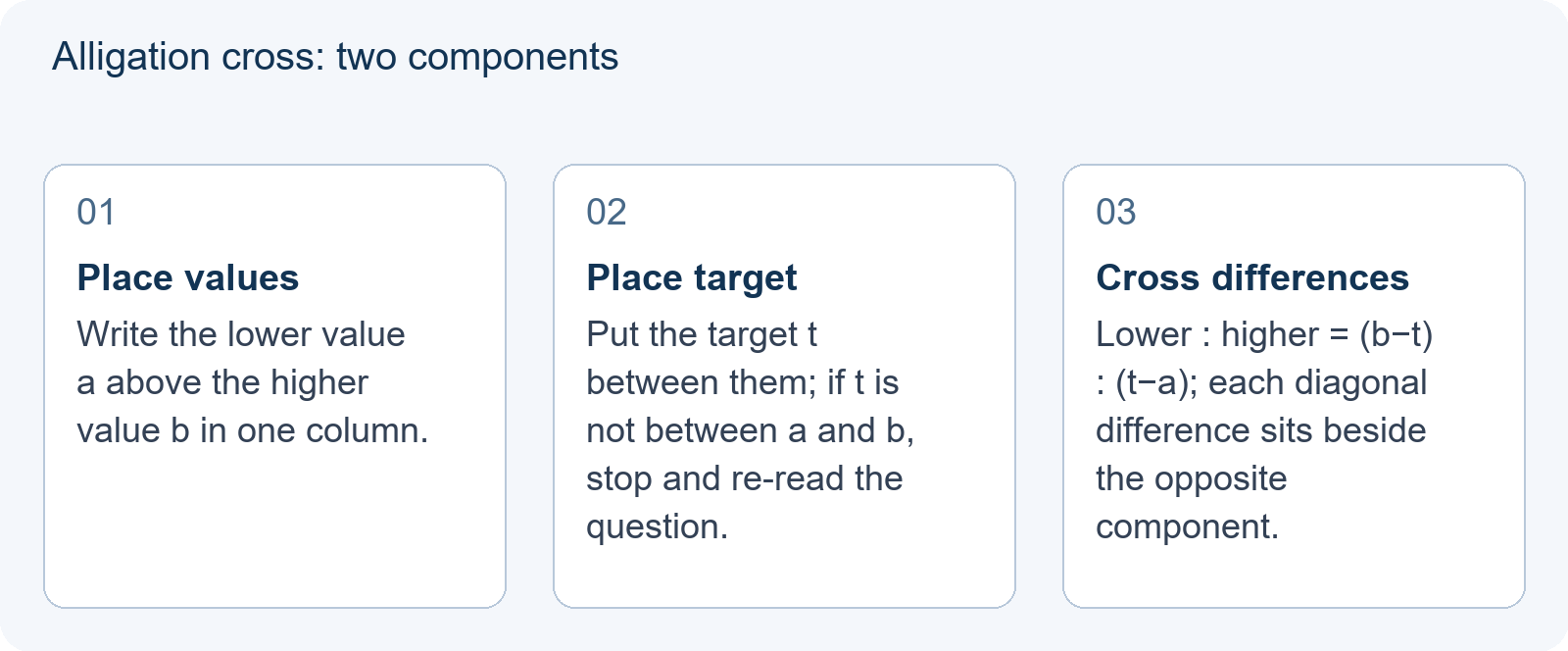
Multiply both sides by x + y: t(x + y) = ax + by. Expand: tx + ty = ax + by. Collect the x-terms on one side and the y-terms on the other: tx − ax = by − ty, so x(t − a) = y(b − t). Dividing gives x ÷ y = (b − t) ÷ (t − a). That is the alligation cross: the lower component takes the difference measured from the higher value, and the higher component takes the difference measured from the lower value. The differences are written diagonally, which is why the method is easy to remember and equally easy to reverse by mistake.
The pattern also supplies a sanity check. If the target is closer to the lower value, the lower component should take the larger share, because it must pull the average down. With values 8 and 12 and target 9, the lower share is (12 − 9) = 3 parts and the higher share is (9 − 8) = 1 part; the target is nearer 8, and the cheaper component really does take three-quarters of the mix. If your ratio says the opposite, you have attached a diagonal difference to the wrong component.
Teaching illustration 1: a coffee blend
Hypothetical teaching illustration, not an official AMO question. A shop blends coffee at $8 per kg with coffee at $12 per kg to make 10 kg worth $9 per kg. Check the target first: 8 < 9 < 12, so a two-component mix is possible. The differences are 12 − 9 = 3 beside the $8 coffee, and 9 − 8 = 1 beside the $12 coffee. The ratio is $8 coffee : $12 coffee = 3 : 1.
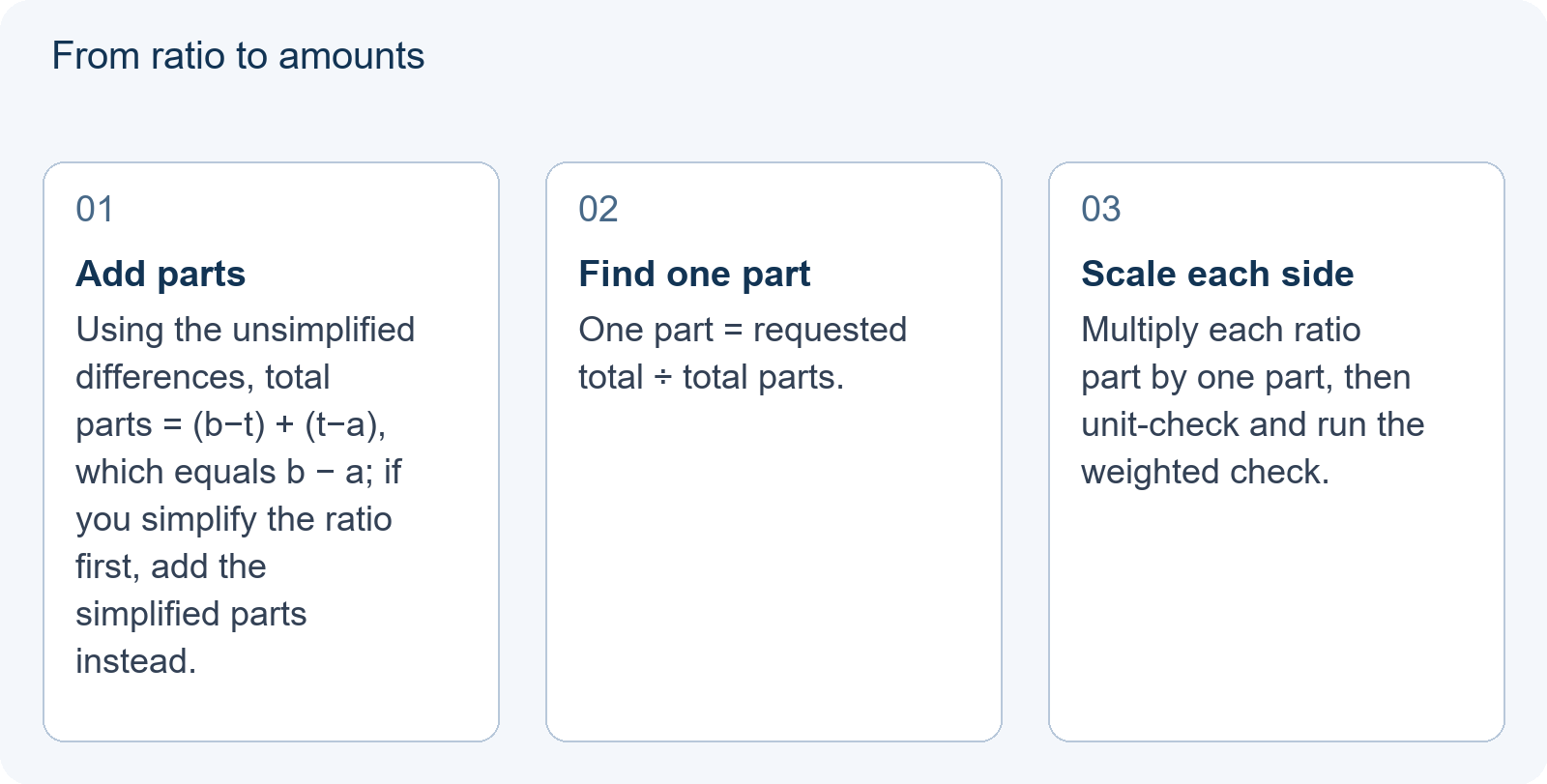
Now scale. The ratio has 3 + 1 = 4 parts. The requested total is 10 kg, so one part is 10 ÷ 4 = 2.5 kg. The $8 coffee is 3 × 2.5 = 7.5 kg, and the $12 coffee is 1 × 2.5 = 2.5 kg.
| Component | Value | Parts | Amount | Cost contribution |
|---|---|---|---|---|
| $8 coffee | 8 | 3 | 7.5 kg | $60 |
| $12 coffee | 12 | 1 | 2.5 kg | $30 |
| Total | 4 | 10 kg | $90 |
Check: $60 + $30 = $90, and $90 ÷ 10 kg = $9 per kg. The check uses the weighted total, never a direct average of 8 and 12. A direct average would give 10, which happens to be the correct target only when the two amounts are equal.
Teaching illustration 2: two solutions
Hypothetical teaching illustration, not an official AMO question. Assume volumes add and percentages are by volume. A student mixes a 20% solution with a 50% solution to obtain 60 litres of a 30% solution. The target 30 lies between 20 and 50. The lower-to-higher ratio is (50 − 30) : (30 − 20) = 20 : 10 = 2 : 1.
The ratio has 2 + 1 = 3 parts. The requested total is 60 litres, so one part is 60 ÷ 3 = 20 litres. Use 2 × 20 = 40 litres of the 20% solution and 1 × 20 = 20 litres of the 50% solution.
Check the solute: 20% of 40 litres is 8 litres, and 50% of 20 litres is 10 litres. The combined solute is 8 + 10 = 18 litres in 60 litres, and 18 ÷ 60 = 0.30, or 30%. If the question asked only for the ratio, the answer would stop at 2 : 1; because it asks for a 60-litre mix, the final answer must be 40 litres and 20 litres. Note also that the 30 in the target is a percentage, not a volume, even though the total happens to be a different number of litres; keep the two symbols separate in your working.
Impossible targets, endpoints and the negative-ratio signal
A mix using positive amounts of both components cannot produce a target outside the interval between the component values. With values 8 and 12, a target of 5 is impossible. The cross gives (12 − 5) : (5 − 8) = 7 : −3. The negative part is not a quantity to repair with an absolute value; it is a signal that the premise is inconsistent. Re-read the question, or check whether a value was copied incorrectly.
Endpoints behave differently. With values 8 and 12 and target 8, the cross gives (12 − 8) : (8 − 8) = 4 : 0, so only the lower component is used. With target 12, the ratio is 0 : 4, so only the higher component is used. If a question states that both components must be present, an endpoint target is not allowed. A quick interval check helps prevent these errors before any scaling begins.
Parts versus amounts: where correct ratios become wrong answers
A ratio of 3 : 1 does not mean 3 kg and 1 kg unless the total is 4 kg. In the coffee example the total is 10 kg, so the amounts are 7.5 kg and 2.5 kg. If the total were 20 kg, the amounts would be 15 kg and 5 kg. The ratio is unchanged; only the scale factor moves. Always ask whether the question requests a ratio or an actual amount before you simplify anything.
The direction of the ratio is the second error to check. With values 8 and 12 and target 11, the lower-to-higher ratio is (12 − 11) : (11 − 8) = 1 : 3. More of the expensive component is needed because 11 is nearer 12. If a student writes 3 : 1, the weighted check exposes it: 3 parts of $8 coffee and 1 part of $12 coffee give (24 + 12) ÷ 4 = 9, not 11. The diagonal difference must be attached to the opposite component. If the missing-total or weighted-mean side is the weak point, the AMO Averages and Data Problems: Restoring the Total, Weighted Means and Chart Traps (2026) covers restoring a total and interpreting weighted means.
Reading the question: ratio, total or one component
The final sentence is a separate source of error: a correct ratio can be attached to the wrong requested quantity. Read what the question actually asks before simplifying anything.
| Question asks for | What to deliver |
|---|---|
| The mixing ratio | A simplified ratio such as 3 : 1; no scaling to kilograms or litres |
| The amount of each component in a stated total | Add the parts, divide the total by the part sum, then multiply each part |
| The amount of one named component | Scale to the total, then select the requested component only |
| A verification or average | Use weighted total ÷ total amount, not a direct average of the two values |
If the total is not stated but the ratio is requested, stop at the ratio. If the total is stated in one unit and the component values use another, convert before scaling. A correct ratio with the wrong final unit is still a wrong answer.
Writing the method in an open-response answer
In an open-response setting, make the setup visible. Name the lower value a, the higher value b and the target t. State that a < t < b. Write the ratio as lower : higher = (b − t) : (t − a). Then show the part sum, the scale factor and the final amounts, and finish with a one-line weighted check. The AMO Section B: A 5-Mark Open-Question Writing Clinic and the AMO Section C: How to Write Open-Ended Solutions That Show Your Reasoning describe how to present that working clearly; the mixture method fits the same habit of labelling values and justifying each step.
A compact answer might read: Let a = 8, b = 12, t = 9. Since 8 < 9 < 12, ratio lower : higher = (12 − 9) : (9 − 8) = 3 : 1. Four parts total, so one part = 10 ÷ 4 = 2.5 kg. Amounts: 7.5 kg and 2.5 kg. Check: (7.5 × 8 + 2.5 × 12) ÷ 10 = 90 ÷ 10 = 9. That is short, complete and easy to audit.
A five-minute diagnostic before the next practice set
Use these four checks on every two-component mixture problem until they become automatic:
- Is the target strictly between the two component values?
- Did each diagonal difference go with the opposite component?
- Did I add the parts before dividing the requested total?
- Does the weighted check return the target exactly?
If one check fails, mark the line where it failed rather than redoing the whole question. A wrong solution that shows a reversed ratio is a different problem from one that shows a correct ratio but forgets to scale 3 : 1 into 7.5 kg and 2.5 kg. For a focused review, bring the original question, your ratio line, your scaling line and your check; that separates a setup error from an arithmetic slip without guessing.
General event background is available at Event background.
Frequently Asked Questions
What if the target is exactly one of the two component values?
Use only that component; the other amount is zero. With values 8 and 12, a target of 8 gives the ratio 4:0, and a target of 12 gives 0:4. If the question requires both components to be present, an endpoint target is not a valid two-component mix.
Does the alligation cross work for more than two components?
The cross shown here is a two-component tool. For three or more components, use a weighted-average equation or combine two components at a time, tracking both the new amount and the new value after each stage. Do not apply one cross directly to three values as though it were a single ratio.
Why can’t I just average the two values?
A direct average is correct only when the two amounts are equal. If the target is closer to one component, that component must appear in a larger share. For $8 and $12 coffee at a target of $9, the ratio is 3:1, not 1:1; a 1:1 mix would average to $10.