
Can you prepare for AMO without knowing the exact calculator rules? Yes. Strong mental-math skills let students verify answers quickly, manage time better, and reduce careless errors in any testing format. While the official AMO calculator policy is not verified in current public sources, the ability to check work mentally remains valuable whether devices are allowed or restricted. This article teaches practical verification techniques that transfer across AMO sections and grade levels.
Why Mental-Math Verification Matters on AMO
The American Mathematics Olympiad (AMO), described by organizer SIMCC as a competition for Grades 2–12 based on US Common Core Standards, tests problem-solving speed and accuracy. Even when tools are available, students who can estimate, check, and cross-verify mentally finish with more confidence and fewer blank answers.
Consider what happens during a timed paper. A student solves a problem, writes an answer, and moves on. Without verification, a single arithmetic slip becomes a lost point. With mental-math checks, that same student catches the error in seconds. The techniques below are drawn from coaching observation and standard competition practice, not from any official AMO scoring guidance.
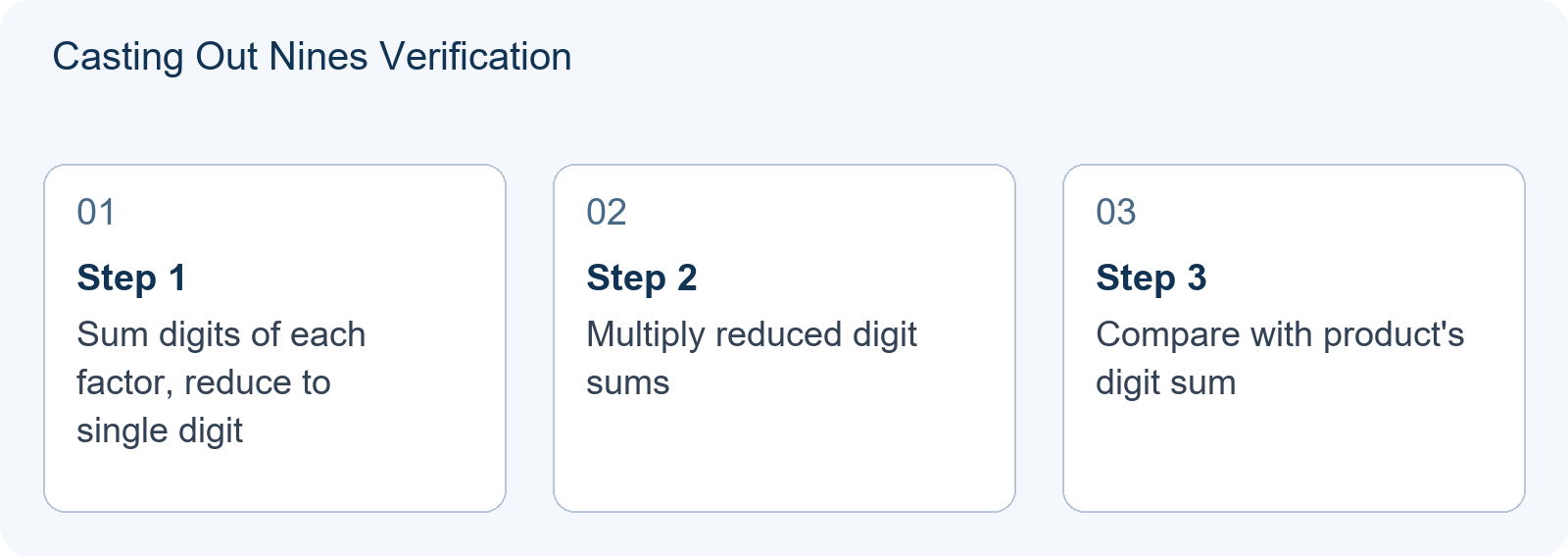
Core Technique 1: Casting Out Nines for Arithmetic Checks
Casting out nines is a classic verification method. It works because a number and the sum of its digits leave the same remainder when divided by 9.
Teaching Illustration: Suppose a student calculates 37 × 11 = 407 and wants to verify quickly.
- 37 → 3 + 7 = 10 → 1 + 0 = 1 (mod 9)
- 11 → 1 + 1 = 2 (mod 9)
- Expected product: 1 × 2 = 2 (mod 9)
- 407 → 4 + 0 + 7 = 11 → 1 + 1 = 2 (mod 9) ✓
The check confirms consistency. If the student had written 417 instead of 407, the digit sum would be 12 → 3, revealing the error immediately.
This method has limits. It detects many errors but not all—a transposed digit that differs by 9, for instance, passes the test. For complete confidence, pair it with the estimation methods below.
Core Technique 2: Order-of-Magnitude Estimation
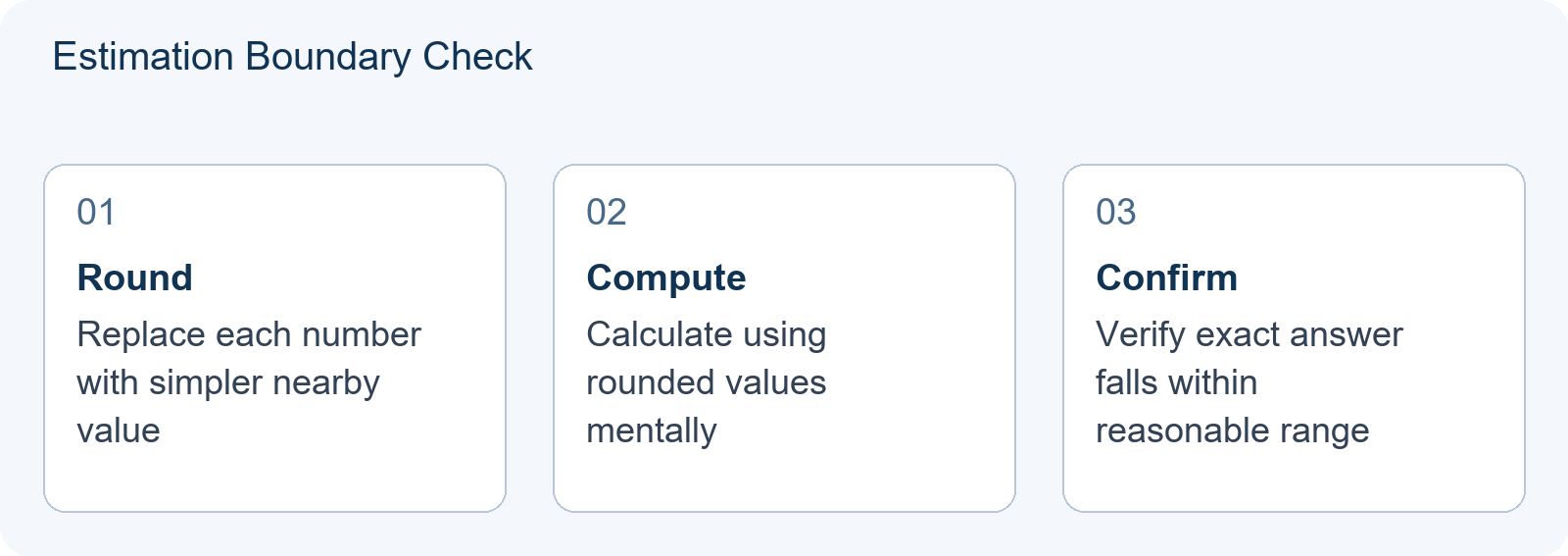
Before finalizing any calculation, ask: Is my answer reasonable? Order-of-magnitude estimation builds this habit.
Teaching Illustration: A problem requires 48 × 52 .
- Round: 50 × 50 = 2500
- Actual: 48 × 52 = 2496
The estimate and exact answer agree closely. If a student obtained 496 or 24,960, the estimation would flag a decimal or place-value error.
For younger AMO participants, simpler benchmarks work: Does the answer fall between two easy multiples? For 143 + 287, note that 140 + 290 = 430, so the exact sum 430 sits right at the anchor. A quick check shows why: 143 is 3 more than 140, and 287 is 3 less than 290, so the +3 and −3 cancel. A stronger verification habit uses non-cancelling bounds: 140 + 280 = 420 and 150 + 290 = 440, so the answer must lie between 420 and 440. This interval check works even when estimates do not match exactly.
Core Technique 3: Fraction and Percentage Cross-Checks
AMO problems often involve fractions, percentages, and ratios. Mental conversion between forms provides independent verification paths.
| Form A | Quick Mental Conversion | Form B |
|---|---|---|
| 3/5 | Multiply numerator by 20 | 60% |
| 7/8 | Know 1/8 = 12.5%, multiply | 87.5% |
| 125% | Write as 100% + 25% | 5/4 |
| 0.375 | Recognize 375/1000 | 3/8 |
Teaching Illustration: A problem states that 3/5 of students passed and 7/10 of those passed with distinction. What fraction passed with distinction overall?
Direct calculation: 3/5 × 7/10 = 21/50 .
Cross-check: Convert to percentages. 3/5 = 60%, and 70% of 60% is 42%. Convert back: 42% = 21/50. The match confirms the answer.
Core Technique 4: Last-Digit and Parity Checks
For rapid elimination of wrong answers, last-digit arithmetic is unmatched in speed.
Teaching Illustration: What is the units digit of 15 × 24 ?
- 5 × 4 = 20 → units digit 0
- Full calculation: 360 → units digit 0 ✓
Parity (odd/even) checks similarly. The sum of two odd numbers is even; the product of any integer with an even number is even. These properties eliminate answer choices instantly.
Teaching Illustration: Which cannot be the sum of three consecutive integers?
- Consecutive integers alternate odd-even-odd or even-odd-even
- Sum = odd + even + odd = even, or even + odd + even = odd
- Actually, more directly: n + (n+1) + (n+2) = 3n + 3 = 3(n+1), always divisible by 3
- Any candidate not divisible by 3 is impossible
This structural insight, derived from algebraic manipulation, outperforms brute-force checking.
Applying Checks to AMO-Style Problem Types
The techniques above integrate naturally with common AMO topics. For structured practice, students can reference related clinics on this site.
Magic squares and number patterns: The AMO Magic Squares: Use the Centre and Line Sum Before You Guess (Grades 4-7) article shows how line-sum properties verify digit placement. Mental addition of rows and columns catches placement errors without recalculation.
Probability and counting: The AMO Probability Without Replacement: The Shrinking-Denominator Clinic (Grades 6-9) clinic emphasizes shrinking denominators. A quick mental check—does my probability exceed 1? Do denominators decrease?—prevents common errors.
Combinatorial seating: The AMO Circular Seating: Fix One Person to Remove Rotational Double Counting (Grades 5-8) guide uses fixed-reference counting. Students can mentally verify whether their division by symmetry factor is reasonable by checking small cases.
Building a Personal Verification Routine
Effective mental-math practice follows a pattern: solve, then verify, then reflect. Here is a framework students can adapt.
- Solve once with full attention. Do not second-guess during initial work.
- Apply one fast check. Choose based on problem type: digit sum, estimation, or parity.
- Apply a second independent check if time permits. Different methods catching the same answer increase confidence.
- Flag uncertain problems. Return to them after completing clearer questions.
This routine develops with deliberate practice. Start with untimed checks, then gradually reduce the time allowed per verification.
Practice Drills for Daily Use
These drills require no special materials. Parents and students can integrate them into regular study.
Digit-sum speed: Given any multiplication fact, state the digit-sum check mentally. For 68 × 79 , expect (5)(7) = 35 → 8 (mod 9). Verify against the actual product’s digit sum.
Estimation races: Glance at a calculation and bound the answer within 10% before computing exactly. This builds number sense for AMO’s more complex problems.
Fraction triathlon: Convert randomly generated fractions to decimals and percentages mentally, then back to simplest form. For additional comparison strategies, students can practice identifying when common denominators are unnecessary, such as comparing 3/7 and 4/9 by cross-multiplication or converting to familiar percentage benchmarks.
When Mental Math Is Essential vs. Supplementary
Even in testing environments where calculators might hypothetically be permitted, mental skills retain distinct advantages:
| Situation | Mental-Math Advantage |
|---|---|
| Multiple-choice elimination | Rapidly discard implausible options before full calculation |
| Time-pressured sections | Faster than device retrieval and entry for simple checks |
| Open-response writing | Demonstrates reasoning process in written solutions |
| Unexpected device issues | Maintains performance regardless of equipment |
Teaching Illustration: Imagine a hypothetical testing scenario where basic calculators are available. A student using mental estimation might notice their calculator result 0.375 × 16 = 6.0 matches their mental prediction (3/8 × 16 = 6), confirming no entry error occurred. The mental check served quality assurance, not replacement of the tool.
Common Pitfalls and How to Avoid Them
Mental-math verification has failure modes. Awareness prevents overconfidence.
Pitfall 1: Relying solely on casting out nines. As noted, it misses errors of 9. Always pair with another method.
Pitfall 2: Rounding too aggressively. Estimating 48 × 52 as 50 × 50 works because the error is small relative to the answer. For 98 × 102 , rounding to 100 × 100 gives 10,000 against actual 9,996—still close, but for 91 × 109 , the same rounding yields 10,000 vs. 9,919, a larger relative gap. Adjust rounding strategy to the numbers involved.
Pitfall 3: Skipping verification when answers “feel right.” Cognitive bias favors confirmation. Build the habit of automatic checks regardless of confidence level.
Connecting to Broader AMO Preparation
Mental-math fluency supports every other preparation activity. Students who verify efficiently spend saved time on harder problems or review. The skill also transfers to related competition formats and school mathematics.
For students beginning AMO preparation, the AMO Grade 2: What a First-Year Parent Should Know Before Signing Up parent guide outlines foundational expectations. Older students approaching senior levels may reference AMO 12 Prep: A Realistic Plan for Senior Students for realistic planning timelines.
Whatever the official calculator policy in any given AMO season—information not established in current public sources—the capacity for independent mental verification remains a durable competitive advantage. It is not a substitute for deep conceptual understanding, but a complement that sharpens execution under pressure.
Summary Checklist for Students
- Master casting out nines for multiplication and addition checks
- Develop 10-second estimation habits for every calculation
- Memorize common fraction-percentage conversions for instant recall
- Use parity and last-digit properties for rapid elimination
- Practice the solve-verify-reflect routine until automatic
- Pair multiple verification methods for high-stakes problems
These techniques require no special equipment, no official confirmation of testing rules, and no advanced mathematics—only consistent practice. Students who integrate them build not just AMO performance, but lasting numerical confidence.
Diagnostic: Spot the Hidden Error in a Verbal Walkthrough
Even students who know casting-out-nines can misapply it under pressure. Try this self-check to see whether you catch the flaw.
Teaching Illustration: A student announces: “I calculated 58 × 31 = 1,798. I verified with nines: 58 → 5 + 8 = 13 → 4; 31 → 3 + 1 = 4; product should be 4 × 4 = 16 → 7. My answer 1,798 → 1 + 7 + 9 + 8 = 25 → 7. It matches, so I’m sure.”
The task: Before reading on, identify whether the verification is valid and whether the original multiplication is correct.
Teaching Illustration: A student calculates 58 × 31 = 1,788 and verifies with casting out nines: 58 → 5 + 8 = 13 → 4; 31 → 3 + 1 = 4; product should be 4 × 4 = 16 → 7. The answer 1,788 → 1 + 7 + 8 + 8 = 24 → 6. The check fails because 6 ≠ 7. The student now knows an error exists. To find it: estimate 60 × 30 = 1,800. The true product 1,798 is only 2 below this estimate, but the student’s answer 1,788 is 12 below—large enough to warrant rechecking. Recalculating: 58 × 30 = 1,740, plus 58 = 1,798. The correct product is 1,798. The error was a digit slip (1,798 written as 1,788). Practice by generating three two-digit multiplications, deliberately computing one incorrectly, then using nines plus estimation to find which is wrong and what the correct product should be.
Next practice task: Generate three two-digit multiplications, compute one incorrectly on purpose, then use nines plus estimation to find which is wrong and what the correct product should be.
General event background is available at Event background.
Frequently Asked Questions
Does AMO allow calculators in the exam?
Current public sources from SIMCC, the AMO organizer, do not verify a calculator policy. This article focuses on mental-math techniques that are valuable regardless of official rules. Check with your specific competition administrator for any season’s ground rules.
How long does it take to build reliable mental-math verification habits?
With consistent daily practice, most students develop functional verification habits over several weeks of regular application. Full automaticity typically requires months of varied practice across different problem types. Individual progress depends on starting proficiency and practice quality.
Can these techniques replace learning standard algorithms?
No. Mental-math verification complements, not replaces, standard methods. It catches errors and builds number sense but does not substitute for understanding why algorithms work or how to apply them to novel problems.