
When preparing for the American Mathematics Olympiad (AMO), students may encounter AMO Cryptarithms, also known as alphametic puzzles. These problems replace digits with letters, requiring you to determine which number each letter represents. Unlike standard arithmetic drills, cryptarithms test logical deduction, constraint satisfaction, and careful bookkeeping of carries. This guide provides a structured approach to solving these puzzles, focusing on the “carry logic” method—a powerful technique for narrowing down possibilities quickly.
What Are AMO Cryptarithms?
Cryptarithms are addition or multiplication equations where each distinct letter stands for a unique digit (0-9). Leading digits cannot be zero. For example, in the puzzle SEND + MORE = MONEY, S cannot be 0, nor can M. The goal is to find a mapping of letters to digits that makes the equation true. In the context of the AMO, these problems appear across various grades, scaling in complexity from simple two-digit additions to multi-column challenges involving carries and borrows.
While there is no single official rulebook for every possible cryptarithm variant, the core principle remains consistent: logical consistency must hold at every place value. Solving them requires patience and a systematic approach rather than random guessing.
The Carry Logic Method
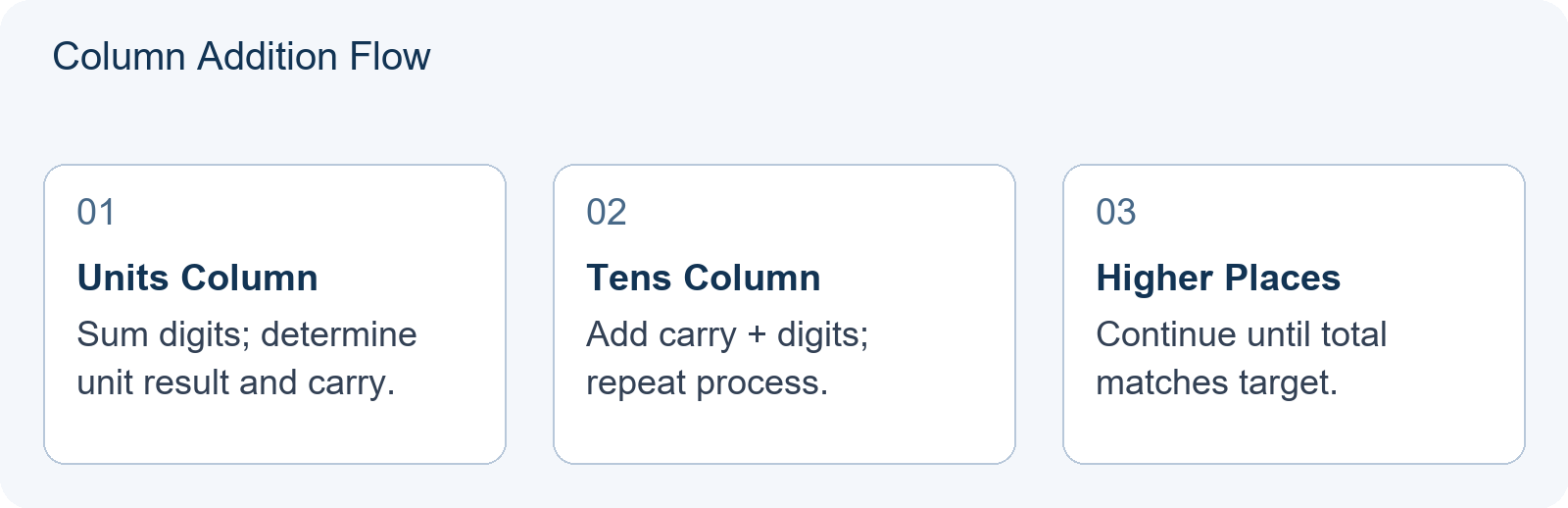
A useful strategy for many addition-based cryptarithms is analyzing the columns from right to left (units to higher places). This direction mirrors standard column addition. By focusing on the carries generated between columns, you can often deduce specific digit values early in the process.
Consider the following teaching illustration:
Worked Example: A + AB = 100
Let’s solve a simple cryptarithm where A and B represent distinct digits.
- Equation: A + AB = 100
- Interpretation: Here, “AB” represents a two-digit number with tens digit A and units digit B. So, AB = 10A + B.
- Rewritten Equation: A + (10A + B) = 100 → 11A + B = 100
Step 1: Analyze the Units Column
In column addition, we look at the units place first. The equation is effectively:
    A
  + AB
  ----
   100
Align the equation by place value:
      A  (Units: A)
    + AB (Tens: A, Units: B)
    ----
     100 (Hundreds: 1, Tens: 0, Units: 0)
This alignment is tricky because A is a single digit. Let’s treat A as 0A for alignment:
     0A
    +AB
    ---
    100
Units Column: A + B must end in 0. So, A + B = 10 or A + B = 0. Since A and B are digits and leading A cannot be 0 (if AB is a two-digit number, A≠0), A+B=0 implies A=B=0, which violates distinctness and leading zero rules. Thus, A + B = 10. This generates a carry of 1 to the tens column.
Tens Column: We have the carry from the units (1) plus the tens digit of AB (which is A). The result must end in 0 (from 100). So, 1 + A = 10 (since it must generate a carry to the hundreds place to make the final sum 100). Therefore, A = 9.
Hundreds Column: The carry from the tens column is 1. There are no other digits adding to the hundreds place. So, 1 = 1. This matches the target 100.
Solving for B: From the units column analysis, A + B = 10. Since A = 9, then 9 + B = 10, so B = 1.
Verification: A=9, B=1. Distinct? Yes. Leading zero? No. Check: 9 + 91 = 100. Correct.
This example illustrates how working from right to left allows you to use the constraints of the sum (ending in 0) to force specific relationships between digits. Note that this is one valid path; algebraic substitution (as shown in the rewritten equation 11A + B = 100) is another equally valid technique. Both rely on the same underlying logic.
Common Pitfalls and Checks
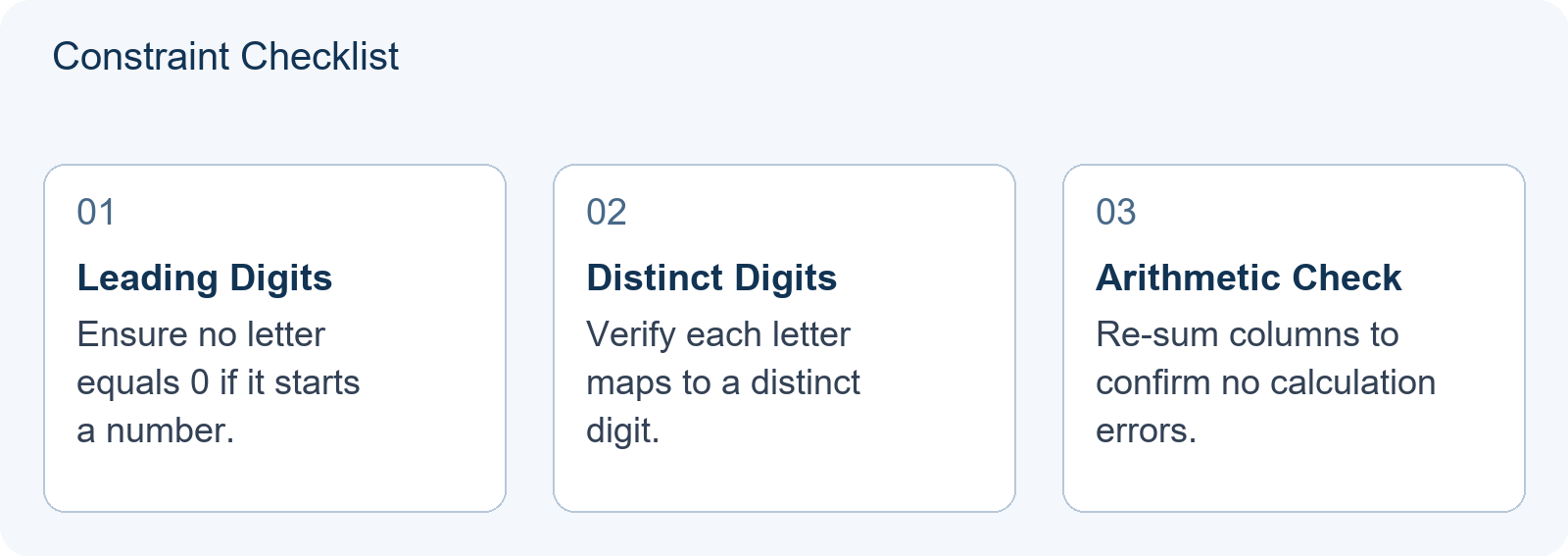
Dead ends can occur when solving cryptarithms. It is crucial to recognize that a contradiction may arise from a wrong initial assumption about a digit’s value OR from an arithmetic error during the carry calculation. Do not assume that reaching a contradiction proves your arithmetic was flawless; always re-check the sums.
| Pitfall | Description | Check Strategy |
|---|---|---|
| Leading Zero Violation | Assigning 0 to a letter that starts a multi-digit number. | Before starting, mark all leading letters as non-zero candidates. |
| Carry Miscount | Forgetting to add the carry from the previous column. | Write small carry numbers above each column explicitly. |
| Distinct Digit Ignorance | Assigning the same digit to two different letters. | Maintain a list of used digits and cross them off immediately. |
| Assumption Lock-in | Sticking to an initial guess despite contradictions. | If a contradiction appears, backtrack to the last certain deduction. |
Strategic Approaches for AMO Preparation
While carry logic is effective for addition, other techniques suit different structures. For multiplication cryptarithms, partial products can reveal more information than full-column analysis. For subtraction, borrowing logic replaces carrying but follows similar right-to-left reasoning.
Here are some practical steps to integrate into your study routine:
- Start with Constraints: Identify obvious limits. For example, if the sum of two n-digit numbers has n+1 digits, the leading digit of the result must be 1 (in base 10).
- Analyze the Most Constrained Column: The leftmost column can have fewer variables involved due to carries, making it easier to deduce values.
- Use Parity and Modulo: Sometimes, looking at whether a sum is even or odd helps eliminate options. For instance, if A + B = C and C is even, A and B must both be even or both be odd.
- Practice Timed Drills: AMO is timed. Familiarize yourself with quick deductions to save time for harder sections.
It is important to note that not every well-posed alphametic has a unique solution unless specified by additional constraints. Some puzzles may have multiple valid mappings. Always check if the problem statement guarantees uniqueness or asks for “a” solution versus “the” solution.
Integrating Cryptarithms into Broader AMO Prep
Cryptarithms are just one type of reasoning practice within broader AMO preparation. To maximize your score, balance this logical reasoning practice with other areas such as geometry, combinatorics, and number theory. Resources like AMO Section C: How to Write Open-Ended Solutions That Show Your Reasoning provide insights into presenting your work clearly, which is vital for open-response questions that may include logic puzzles.
Additionally, simulating exam conditions helps build speed. Refer to AMO Online Test: Simulating the 90-Minute Exam at Home for strategies on managing time across different question types, including those requiring deep logical deduction like cryptarithms.
For senior students tackling more complex variations, understanding foundational counting principles is key. See AMO Digit Placement: Count Arrangements Without Allowing a Leading Zero to strengthen your grasp of permutation constraints, which directly apply to assigning digits to letters.
Conclusion
Mastering AMO Cryptarithms requires a blend of arithmetic fluency and logical rigor. By employing carry logic—analyzing columns from right to left—you can systematically narrow down possibilities. Remember to verify assumptions, watch for leading zeros, and maintain a clear record of used digits. While this technique is powerful, it is part of a broader toolkit that includes parity checks, modulo arithmetic, and strategic backtracking. Consistent practice with varied puzzle types will enhance your confidence and accuracy in the actual competition.
From Deduction to Verification: The Two-Phase Check
The worked example above demonstrates how carry logic narrows possibilities, but finding a candidate solution is only half the battle. In timed competition settings, a risk is writing down the first set of digits that seems to fit the column sums, overlooking subtle constraints like digit distinctness or leading-zero rules until after committing to an answer. To bridge this gap, adopt a strict two-phase verification protocol: Deductive Narrowing followed by Global Consistency Check.
Phase 1: Deductive Narrowing (The Carry Logic)
This phase uses the right-to-left analysis shown in the previous section. You identify necessary conditions for each column. For instance, if the units column requires , you know a carry of 1 must propagate to the tens column. This step generates a candidate mapping. It does not prove the solution is valid; it only proves that any valid solution must satisfy these local column constraints.
Phase 2: Global Consistency Check
Once you have a candidate mapping (e.g., ), you must verify three global properties before finalizing your answer:
- Distinctness Audit: List all assigned digits. Are any repeated? In our example, and are distinct. If another letter also mapped to 9, this would be invalid unless the puzzle explicitly allows different letters to share a digit.
- Leading Zero Scan: Identify every letter that appears as the leftmost character in any multi-digit number. Ensure none of them map to 0. In , is the leading digit of . Since , this constraint is satisfied.
- Full Equation Reconstruction: Substitute the values back into the original algebraic form, not just the column view. Calculate . Does it equal 100? Yes. This catches errors where column-wise carries were miscalculated but the overall sum coincidentally looked plausible due to arithmetic slips.
Diagnostic Practice Task
Consider the cryptarithm: .
Task: Apply the two-phase check to determine if a unique solution exists under standard rules (distinct letters represent distinct digits; no leading zeros).
Step 1 (Narrowing): Units column: ends in . Tens column: plus any carry from units equals (since result is , i.e., ). Align by place value:
  XX
+ YY
----
  ZZ
Tens: . Units: .
If , then . Then tens: . This works for any such that . Example: (). Distinct? Yes. Leading zero? No.
If , then . Tens: , impossible for integer .
Conclusion: Multiple solutions exist. For example, gives , and gives . Both satisfy the column equations and the constraint that distinct letters represent distinct digits. Thus, uniqueness fails without an extra constraint.
Answer: The puzzle does not have a unique solution. A student claiming “the” answer without checking for multiple valid mappings has failed Phase 2.
This diagnostic highlights why “carry logic” alone is insufficient. It provides candidates; the global check validates them. In AMO-style open-response questions, explicitly stating “I verified distinctness and reconstructed the sum” can demonstrate rigorous reasoning even if the final numeric answer is complex.
General event background is available at Event background.
Frequently Asked Questions
Do all AMO cryptarithms have a unique solution?
Not necessarily. Uniqueness depends on the specific constraints given in the problem. Some puzzles may allow multiple valid digit assignments unless the problem states otherwise.
Is carry logic the only way to solve these puzzles?
No. Carry logic is a useful technique for addition, but algebraic substitution, parity analysis, and modular arithmetic are also effective methods depending on the puzzle structure.
Should I use a calculator when practising cryptarithms?
Cryptarithms are solved by reasoning, not by evaluating the equation in a calculator. Practise with written column methods and mental arithmetic, and check the current official AMO instructions if you need to know what is allowed in your exam.