
Direct Answer: Use Venn Regions to Avoid Double Counting
AMO Venn Diagrams are best used as a translation tool, not just a picture. When an American Mathematics Olympiad (AMO) word problem involves overlapping sets, label every distinct region before you calculate. For two sets, those regions are Only A, Only B, Both, and Neither. Watch for common errors: adding the shared group twice, omitting Neither, or treating a set total as if it meant Only that set. The site’s verified AMO fact base (2026) records the paper as 25 questions in 90 minutes for Grades 2-12; the Venn method below is independent teaching advice for overlap questions, not an official scoring rule. The goal is to convert each sentence into one region, then let arithmetic follow.
The Two-Circle Template: Defining the Four Regions
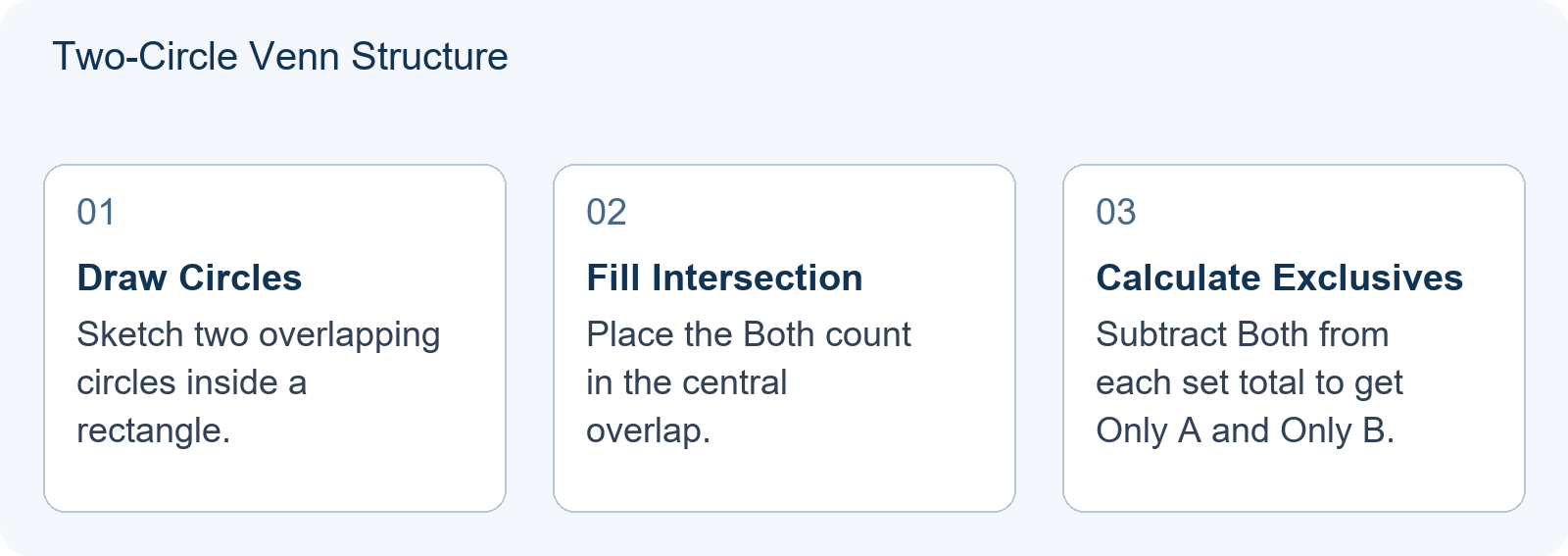
Draw a rectangle for the whole class or population. Inside it, draw two overlapping circles. Let Circle A be one category, such as Maths, and Circle B be another, such as Science. The rectangle has four useful regions. Labelling them before calculating prevents most overlap mistakes.
| Region | What it means | Sentence patterns |
|---|---|---|
| Only A | Takes A but not B | Only A, A but not B, exactly A |
| Only B | Takes B but not A | Only B, B but not A, exactly B |
| Both | Takes A and B | Both, A and B, in the overlap |
| Neither | Takes neither A nor B | Neither, none, outside both |
If a problem says 15 students take Science, that number is Only Science plus Both. If it says 6 students take both, that number goes in the central intersection. If it says 4 students take neither, that number sits outside both circles but inside the rectangle representing the whole class. A common error is reading “15 take Science” as Only Science = 15. That would double-count the shared students when you later add Maths and Science totals. If the problem gives the union, meaning at least one of the two sets, you can find Neither by subtracting the union from the total population. If it gives Neither and asks for the total, add the union and Neither.
Understanding the relationship between these regions is critical. The total population is always the sum of the four disjoint regions: Only A + Only B + Both + Neither. The union of A and B (students taking at least one subject) is Only A + Only B + Both. Alternatively, the union can be calculated using the inclusion-exclusion principle: Total in A + Total in B – Both. This formula works because adding Total in A and Total in B counts the “Both” group twice, so we must subtract it once to correct the overcount. Students often forget that “Total in A” includes the intersection, whereas “Only A” excludes it. Always check which term the question uses.
Worked Teaching Illustration: 18 Maths, 15 Science, 6 Both, 4 Neither
This is a teaching illustration, not an official contest problem. Suppose a class has 18 students taking Maths, 15 taking Science, 6 taking both, and 4 taking neither. We want the total number of students in the class.
First, draw two overlapping circles inside a rectangle. Place 6 in the central Both region. Next, find Only Maths: 18 minus 6 equals 12. Then find Only Science: 15 minus 6 equals 9. Place 4 outside both circles for Neither. The total class size is the sum of the four disjoint regions: 12 plus 9 plus 6 plus 4 equals 31.
Check with inclusion-exclusion for two sets: Total equals Maths plus Science minus Both plus Neither. That is 18 plus 15 minus 6 plus 4 equals 31. Notice that adding 18 and 15 directly gives 33, which would count the 6 shared students twice. The region method prevents that error. A useful sanity check is that the total must be at least as large as either single-set total. Here 31 is larger than both 18 and 15, so the answer is plausible.
Let us consider a variation where the total is known, and we need to find the intersection. Suppose there are 31 students in total, 18 take Maths, 15 take Science, and 4 take neither. How many take both? First, find the union: Total minus Neither = 31 – 4 = 27. So, 27 students take at least one subject. Using the formula Union = A + B – Both, we have 27 = 18 + 15 – Both. Therefore, 27 = 33 – Both, which means Both = 6. This reverse calculation confirms our previous example and demonstrates how the regions interact logically.
Three-Circle Extension: Work from the Innermost Region Outward
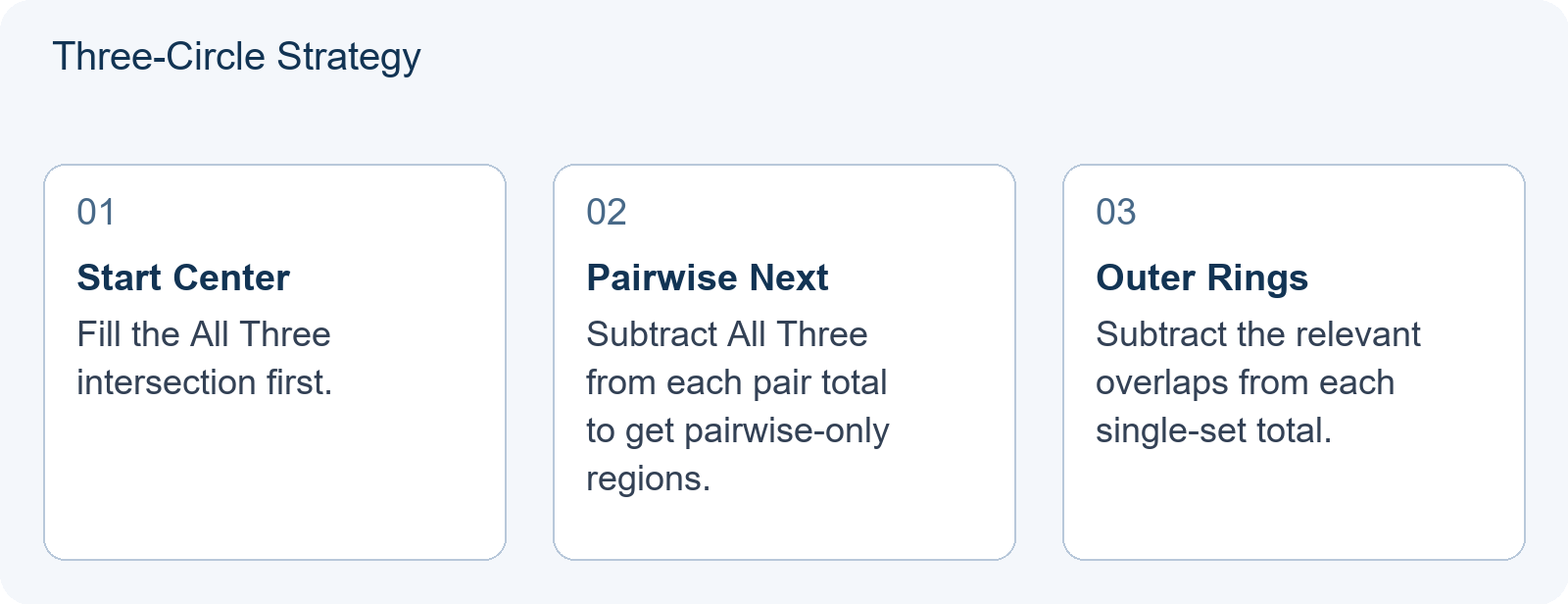
Three circles create eight regions if you include the outside region: Only A, Only B, Only C, Only AB, Only AC, Only BC, All Three, and None. The order matters. Start with All Three. Then fill the pairwise-only regions by subtracting All Three from each pair total. Then fill the single-only regions by subtracting the three relevant overlaps from each single total. Finally add None if it is given. Skipping the centre first creates cascading errors in every later subtraction.
Teaching illustration with three sets: A class has 32 students. 12 play Football, 14 play Basketball, 10 play Tennis. 5 play Football and Basketball, 4 play Football and Tennis, 3 play Basketball and Tennis, 2 play all three, and 6 play none. Find each region.
All Three equals 2. Football and Basketball only equals 5 minus 2, which is 3. Football and Tennis only equals 4 minus 2, which is 2. Basketball and Tennis only equals 3 minus 2, which is 1. Only Football equals 12 minus the three Football overlaps: 12 minus left parenthesis 3 plus 2 plus 2 right parenthesis equals 5. Only Basketball equals 14 minus left parenthesis 3 plus 1 plus 2 right parenthesis equals 8. Only Tennis equals 10 minus left parenthesis 2 plus 1 plus 2 right parenthesis equals 5. None equals 6. Total check: 5 plus 8 plus 5 plus 3 plus 2 plus 1 plus 2 plus 6 equals 32. This matches the stated class size. This is a teaching illustration, not an official problem.
In three-circle problems, treat the phrase “Football and Basketball” as the entire intersection of those two sets, including those who also play Tennis. Therefore, to find the region that is strictly “Football and Basketball but NOT Tennis,” you must subtract the “All Three” value from the given pair value. A common mistake is failing to do this. Always ask yourself: Does the given number include the triple overlap? If yes, subtract it to isolate the pairwise-only region.
Diagnostic: Common Errors in Overlap Problems
Watch for three error patterns in overlap questions. First is double-counting: adding A and B totals directly without subtracting Both. Second is missing Neither: finding the union but forgetting the students outside both circles when the question asks for total population. Third is misreading Only versus total: the phrase “10 take Maths” means Only Maths plus Both plus any other overlaps; it does not mean Only Maths.
To self-check, ask whether the total is at least as large as every single set total. If your total is smaller than one set total, you have almost certainly subtracted incorrectly. Also verify by summing the disjoint regions and by using the two-set formula Total equals A plus B minus Both plus Neither. For three sets, use the full inclusion-exclusion pattern or sum the seven regions inside the three circles. A fourth useful check is to label every number with its region before doing any addition. If a number cannot be assigned to one clear region, the translation step is not finished.
Another subtle error involves boundary conditions. In some problems, categories might be mutually exclusive by definition (e.g., gender in certain contexts), resulting in a zero intersection. Do not assume disjoint sets unless the problem text confirms it. Conversely, do not assume non-zero intersections if the problem implies exclusivity. Read carefully for words like “distinct,” “separate,” or “exclusive.”
Practice Routine: Translate Sentences Before Calculating
Build a strict translation routine. Read one sentence at a time and write the region label before doing arithmetic. For example, “twice as many students take only Physics as take both Physics and Chemistry” becomes Only P equals 2 times Both. “Five students take neither” becomes Neither equals 5. “Ten take Maths and Science” becomes Both equals 10, unless the wording says “only” or “exactly.” Leave unknown regions as variables. Once the diagram is labelled, set equations from the relationships.
This separates language from calculation and reduces errors under time pressure. Look for qualifiers: only, exactly, at least, both, neither, all three. Each qualifier changes the target region. Practise with short invented sets first, then move to past-paper or textbook questions. If you find yourself stuck, re-read the question specifically for words that describe the overlap. The diagram should become a map of the sentences, not a decoration added after the algebra. Consistent practice with this structured approach improves speed and accuracy.
When dealing with inequalities, such as “at least 5 students take both,” assign a variable x >= 5. Express other regions in terms of x. Often, the total population constraint will force x to a specific integer value. For instance, if the maximum possible value for x leads to a negative region elsewhere, adjust x downward until all regions are non-negative integers. This logical bounding technique is essential for harder AMO problems where direct numbers are scarce.
Course Fit and Resource Preparation
If you are preparing for AMO-style papers, Venn diagrams belong with broader counting and logic practice. For a wider treatment of arrangement and counting questions, see AMO Counting and Probability: Combinatorics, Logic and Arrangement Problems (2026). Because overlap errors can begin with language, the sentence patterns discussed in Reading AMO Questions in English: The Sentence Patterns That Cost Marks (2026) can help you separate totals from exclusive groups. If you are also working on multi-step word problems, the ratio and whole-job structures in The Units Method for AMO Word Problems: Ratio, Fractions and Percentage Change (Grades 4-8, 2026) offer complementary practice in translating relationships before calculating.
General event background is available at Event background.
Frequently Asked Questions
Should I use a Venn diagram or a table for AMO problems?
Use a Venn diagram for problems involving overlapping categories, such as students taking multiple subjects or playing multiple sports. Use a table for independent choices or sequential events, such as picking a shirt then trousers. If the problem mentions both, either, neither, only, or exactly, a Venn diagram is usually clearer.
What if the problem doesn’t give the Both number?
If the intersection is unknown, assign it a variable such as x. Express the Only regions in terms of x and the given totals. Then use the total population equation, or the union equation, to solve for x. This algebraic approach works even when direct numbers are missing.
How do I handle At Least One in Venn diagrams?
For two sets, At Least One is the union: add the two set totals and subtract the intersection, or sum Only A, Only B, and Both. For three sets, do not just subtract one intersection; use the full inclusion-exclusion pattern or sum the seven regions inside the three circles. Add the outside region only if the question asks for the whole population.