
When preparing for the American Mathematics Olympiad (AMO), students often encounter combinatorics problems involving digit placement. A frequent source of error is failing to account for the “leading zero” constraint. In standard numerical notation, a number cannot begin with the digit 0 unless it is the single-digit number 0 itself. This article explains how to correctly count arrangements of digits while respecting this rule, using clear teaching illustrations that are not official contest questions.
The Core Principle: Why Leading Zeros Matter
In many AMO-style problems, you are asked to form numbers from a set of distinct digits. The critical distinction between a simple permutation and a valid number formation is the position of the first digit. If the set includes the digit 0, placing it at the start creates an invalid representation for multi-digit numbers.
Consider the set {0, 1, 2}. The total permutations of these three digits taken three at a time is 3 × 2 × 1 = 6. However, only some of these yield valid three-digit numbers. The arrangements 012 and 021 are not three-digit numbers—they are the two-digit numbers 12 and 21 with a leading zero. The valid three-digit numbers from {0, 1, 2} without repetition are: 102, 120, 201, and 210. That is only 4 valid three-digit numbers, not 6. This confirms that 012 and 021 must be excluded.
Understanding this mechanism is essential for accurate scoring. Many students apply the general permutation formula without adjusting for the restricted first position. This leads to overcounting. The correct approach involves either subtracting invalid cases from the total permutations or calculating valid cases by fixing the first digit first. Both methods must be applied carefully depending on whether digits can be repeated.
Method 1: Subtracting Invalid Cases
This method is intuitive when the total number of permutations is easy to calculate. Suppose we want to form three-digit numbers using the distinct digits {0, 1, 2, 3}. First, calculate the total ways to arrange any three of these four digits. This is a permutation of 4 items taken 3 at a time: P(4,3) = 4 × 3 × 2 = 24. Next, identify the invalid cases where the first digit is 0. If the first digit is fixed as 0, we have two positions left to fill from the remaining three digits {1, 2, 3}. The number of ways to do this is P(3,2) = 3 × 2 = 6. Therefore, the number of valid three-digit numbers is 24 − 6 = 18. This subtraction method works well when the restriction applies only to the first position and all other positions are unrestricted among the remaining pool.
Method 2: Fixing the First Position
An alternative approach is to construct the number step-by-step, ensuring validity at each stage. Using the same set {0, 1, 2, 3} to form three-digit numbers, we start with the hundreds place. It cannot be 0, so there are 3 choices: {1, 2, 3}. Once the first digit is chosen, we move to the tens place. We have used one digit, leaving three digits available (including 0). So, there are 3 choices for the tens place. Finally, for the units place, two digits remain unused, giving 2 choices. Applying the multiplication principle with remaining choice counts: 3 × 3 × 2 = 18. This matches the result from Method 1. This constructive method is often less prone to logical errors because it enforces the constraint immediately rather than relying on a subsequent correction.
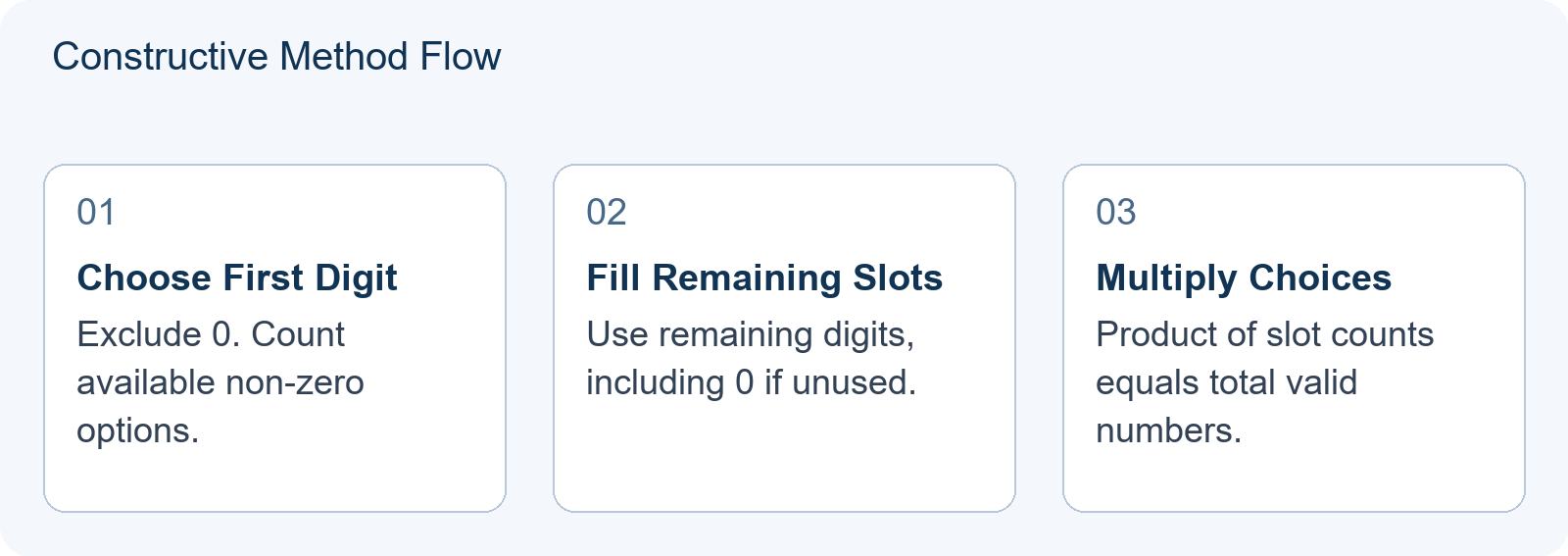
Diagram: Constructive Method Flow
Step 1: Choose First Digit
Exclude 0. Count available non-zero options. For {0,1,2,3}, this gives 3 choices.
Step 2: Fill Remaining Slots
Use remaining digits, including 0 if unused. After choosing first digit, 3 digits remain including 0.
Step 3: Multiply Choices
Product of slot counts equals total valid numbers: 3 × 3 × 2 = 18 valid three-digit numbers.
Teaching Illustration: Distinct Digits Without Repetition
Teaching Illustration — not an official AMO contest problem.
Consider this practice scenario: How many distinct three-digit numbers can be formed using the digits {0, 5, 7, 9}? Note that no repetition is allowed. Using the constructive method: The first digit has 3 options (5, 7, 9). The second digit has 3 options (the remaining two non-zero digits plus 0). The third digit has 2 options. Total = 3 × 3 × 2 = 18. Let’s verify by listing: 507, 509, 570, 579, 590, 597, 705, 709, 750, 759, 790, 795, 905, 907, 950, 957, 970, 975. This confirms 18 unique values. Students should practice identifying when the set contains zero and when it does not, as the calculation changes significantly if zero is absent.
Contrasting Case: When Repetition Is Allowed
A superficially similar problem might allow digit repetition. For instance, forming three-digit numbers from {0, 1, 2} where digits can be reused. Here, the first digit still cannot be 0, so there are 2 choices (1 or 2). The second digit can be any of the 3 digits (0, 1, 2). The third digit can also be any of the 3. Total = 2 × 3 × 3 = 18. Notice that the answer coincidentally matches the previous non-repetition case with four digits, but the logic is entirely different. If a student blindly applies a 3 × 3 × 3 rule for three-digit numbers, they get 27, incorrectly including 000, 001, 002, 010, etc., which are not valid three-digit representations. Recognizing the difference between “distinct digits” and “repetition allowed” is a key skill for AMO preparation.
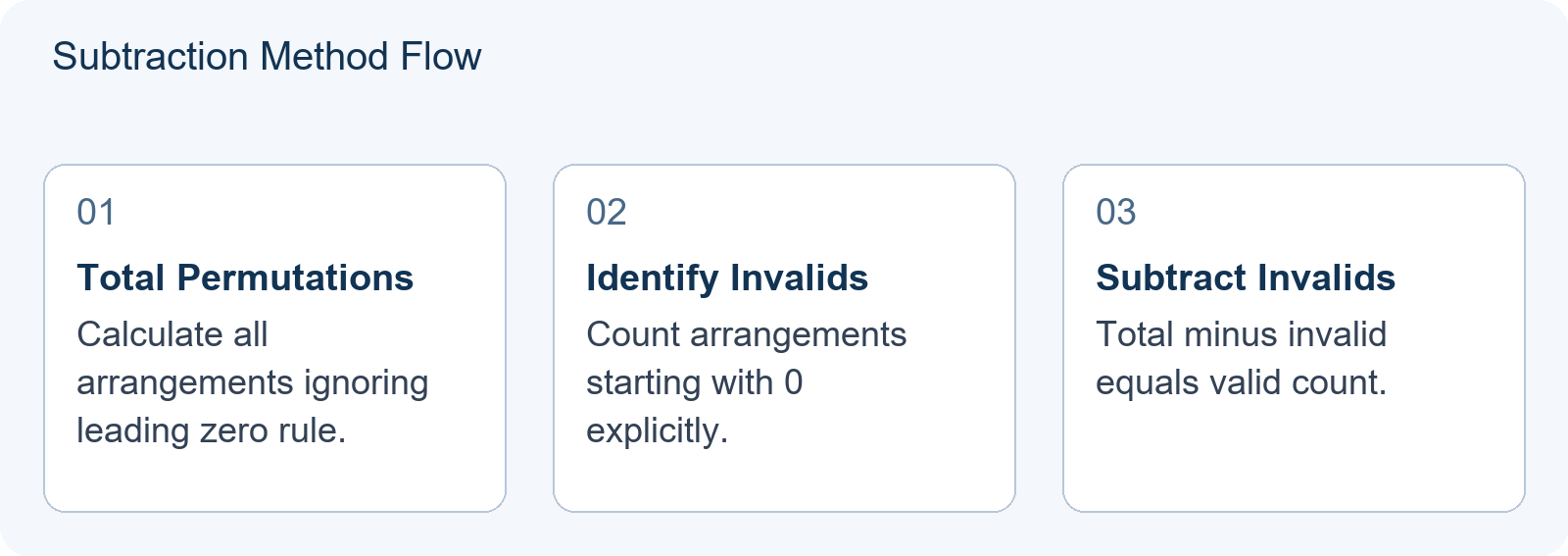
Diagram: Subtraction Method Flow
Step 1: Total Permutations
Calculate all arrangements ignoring leading zero rule. For 4 digits taken 3 at a time: P(4,3) = 24.
Step 2: Identify Invalids
Count arrangements starting with 0 explicitly. Fix 0 first, arrange 2 from remaining 3: P(3,2) = 6.
Step 3: Subtract Invalids
Total minus invalid equals valid count: 24 − 6 = 18 valid three-digit numbers.
Diagnostic Application: Identifying the Error Type
To test understanding, consider this scenario: A student calculates the number of four-digit numbers from {0, 1, 2, 3, 4} as 5 × 4 × 3 × 2 = 120. What is wrong? The student calculated permutations of 5 items taken 4 at a time, ignoring the leading zero constraint. The correct calculation should exclude cases starting with 0. Total permutations = P(5,4) = 120. Invalid cases (starting with 0): Fix 0 at start, arrange remaining 3 from {1,2,3,4}: P(4,3) = 4 × 3 × 2 = 24. Valid = 120 − 24 = 96. Alternatively, constructive method: First digit 4 choices (1-4), second 4 choices (remaining + 0), third 3, fourth 2. 4 × 4 × 3 × 2 = 96. The diagnostic reveals that the student failed to adjust for the restricted first position.
Implications for Learning Strategy
If a student consistently makes errors in digit placement, it indicates a need to strengthen foundational combinatorics concepts rather than just practicing more problems. Feedback should focus on visualizing the slots: draw four boxes for a four-digit number. Label the first box “Not 0” and the others “Any remaining.” This physical mapping helps internalize the constraint. For parents and educators, observing whether a student uses the subtraction method or the constructive method can reveal their comfort level with abstract algebra versus concrete step-by-step logic. Both are valid, but mixing them up causes errors.
Related Resources and Next Steps
For families seeking to support their child’s preparation, reviewing past papers is useful, but analyzing the type of error is more valuable. If your child struggles with these constraints, look for resources that break down combinatorics into small steps. You may find related topics in our AMO Counting and Probability: Combinatorics, Logic and Arrangement Problems (2026) guide helpful for broader context. Additionally, understanding how to manage time during such detailed counting tasks is crucial; see our article on AMO Calculation Fluency: Building Mental-Maths Speed Without Losing Accuracy (Grades 3-8) for tips on maintaining speed without sacrificing accuracy. For students working through number theory foundations, our AMO Number Theory Decoded: Divisibility, Remainders and Digit Problems (Grades 5-12, 2026) article provides complementary material on how digits behave in different mathematical contexts. For those interested in structured feedback on specific problem types, consulting with a tutor who specializes in competition math can provide targeted diagnostics. Remember, this site serves as an authorized AMO registration partner; always verify current rules via official channels, but use these logical frameworks to build confidence.
Advanced Diagnostic: The “Zero-Exclusion” Trap in Multi-Step Constraints
A common pitfall for students preparing for the American Mathematics Olympiad (AMO) is misapplying the leading-zero rule when additional constraints are present. Consider a teaching illustration where you must form three-digit numbers from the set {0, 1, 2, 3} such that the number is even and no digits repeat. Many students calculate the total valid three-digit numbers (18, as shown earlier) and then incorrectly assume half are even, yielding 9. This logic fails because the parity constraint interacts with the leading-zero restriction.
To solve this correctly, we must break the problem into cases based on the units digit, since an even number must end in 0 or 2. Teaching Illustration — not an official AMO contest problem.
Case 1: The Units Digit is 0
If the last digit is fixed as 0, the leading zero issue disappears for the first position because 0 is already used at the end. We have two remaining positions to fill using the digits {1, 2, 3}. The hundreds place can be any of these 3 digits. The tens place can be any of the remaining 2 digits. Calculation: 3 × 2 = 6 valid numbers (e.g., 120, 130, 210, 230, 310, 320).
Case 2: The Units Digit is 2
If the last digit is fixed as 2, the available pool for the first two positions is {0, 1, 3}. Here, the leading-zero constraint applies again. The hundreds place cannot be 0, so it has only 2 choices ({1, 3}). Once the hundreds digit is chosen, the tens place can take either 0 or the remaining unused non-zero digit, giving 2 choices. Calculation: 2 × 2 = 4 valid numbers (e.g., 102, 132, 302, 312).
Synthesis and Error Analysis
Total valid even numbers = 6 + 4 = 10. Notice that the naive “half of 18” method gave 9, which is incorrect. The error arises because the distribution of even/odd endings is not uniform across all valid permutations due to the restricted first slot. When 0 is available for the units place, it frees up the first place; when 0 is forced out of the units place (by choosing 2), it remains a threat to the first place.
This diagnostic highlights why case-based reasoning is superior to symmetry arguments in constrained combinatorics. Students should practice identifying whether a specific digit’s placement affects the availability of other restricted slots. For broader context on handling complex restrictions, review our guide on AMO Counting and Probability: Combinatorics, Logic and Arrangement Problems (2026). To strengthen foundational speed in verifying these counts, see AMO Calculation Fluency: Building Mental-Maths Speed Without Losing Accuracy (Grades 3-8). Finally, for related number theory concepts involving digit properties, consult AMO Number Theory Decoded: Divisibility, Remainders and Digit Problems (Grades 5-12, 2026).
Frequently Asked Questions
Does the leading zero rule apply to single-digit numbers?
No, the number 0 is a valid single-digit number. The restriction applies only when forming multi-digit numbers where a leading zero would change the value or representation.
What if the problem allows repeating digits?
The first digit still cannot be 0. Subsequent digits can repeat any available digit, including 0. Adjust the count per slot accordingly: first digit count excludes 0, all other positions use full available set.
How many valid three-digit numbers can be formed from {0, 1, 2} without repetition?
Only 4: 102, 120, 201, and 210. The arrangements 012 and 021 are not three-digit numbers—they are 12 and 21 with a leading zero, so they must be excluded.