
Reverse operations problems on the AMO ask you to find an unknown starting number after a chain of arithmetic changes has already happened. The key decision is the order in which you undo each step. Undo them in the wrong order and the answer collapses, even if every individual calculation is correct. This article shows the exact undoing sequence, works through a complete example with every step verified, presents a contrasting case where a different-looking problem requires a different approach, and gives you a short diagnostic to identify whether your next task is order discipline, inverse-operation fluency, or translating English descriptions into mathematical steps.
What “Undo in the Right Order” Actually Means
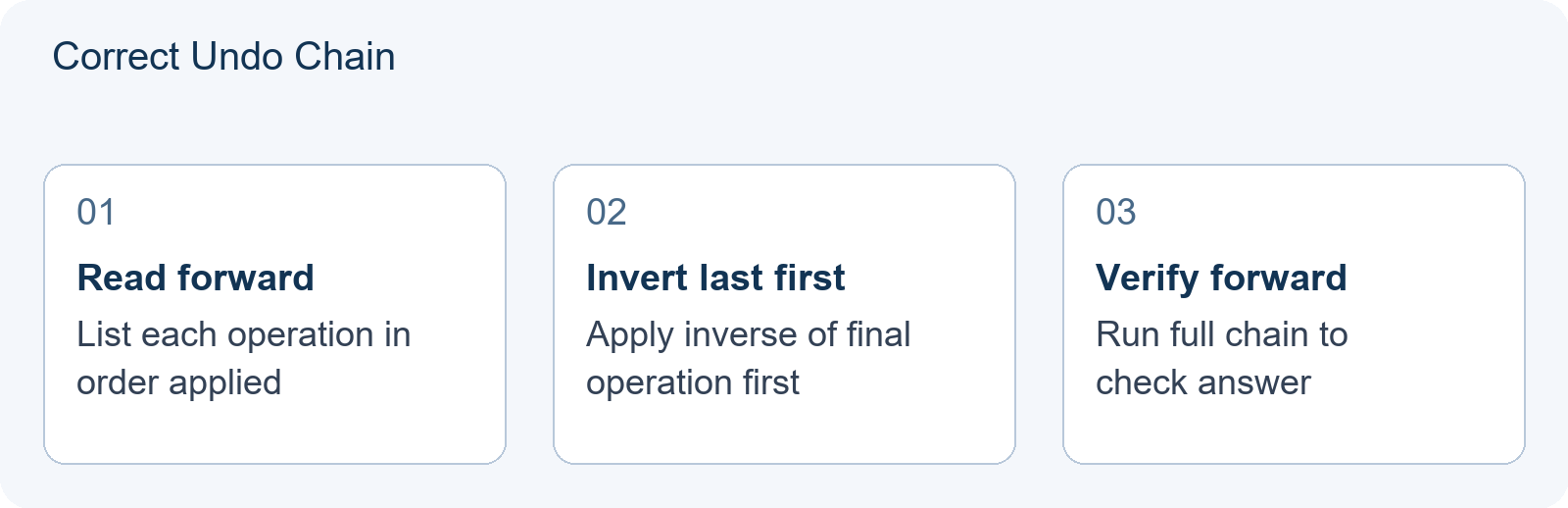
A reverse operations problem presents a final result and a sequence of operations performed on an unknown starting number. Your task is to recover that starting number. The method is straightforward in principle: apply the inverse of each operation in the reverse of the original order. If the original moved from left to right through addition, then multiplication, then subtraction, your undoing moves from right to left through addition, then division, then subtraction.
The AMO tests this not as a memorised procedure but as a reading-comprehension and planning task. Students must first parse the word problem to extract the operations and their sequence, then hold that sequence in working memory while applying the inverse chain. The AMO Algebra, Patterns and Sequences: How to Find the Rule and Work Backwards (2026) article covers the forward direction—finding a rule and extending it. This article addresses the backward direction that completes the skill pair.
A Fully Worked Example: The Bookshop Problem
Consider this teaching illustration: A student buys a book for 8 dollars, then spends half her remaining money on a notebook, then loses 5 dollars, and finally has 11 dollars left. How much did she start with?
The forward chain is: start with unknown amount M; subtract 8 for the book; halve the remainder; subtract 5; end at 11. So the chain is: M → M − 8 → (M − 8) ÷ 2 → (M − 8) ÷ 2 − 5 = 11.
Now undo from the final value 11, right to left. The last operation was “subtract 5,” so add 5: 11 + 5 = 16. The previous operation was “divide by 2,” so multiply by 2: 16 × 2 = 32. The first operation was “subtract 8,” so add 8: 32 + 8 = 40.
Verify by running forward: start with 40. Book costs 8, leaving 32. Half of 32 is 16. Lose 5, leaving 11. The check confirms 40 is correct. Every arithmetic step is reversible and the order of undoing is the exact reverse of the forward chain.
Where Order Matters Most: A Contrasting Case
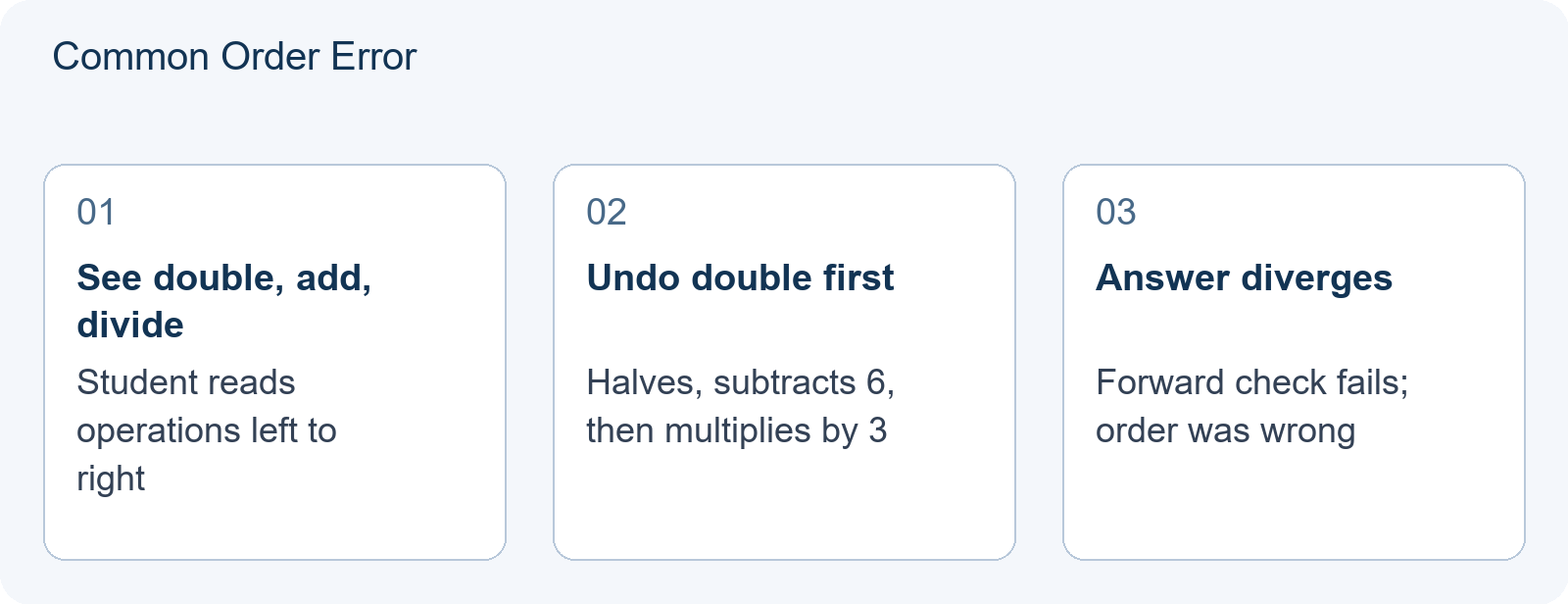
Suppose a problem reads: “A number is doubled, then 6 is added, then the result is divided by 3, giving 4. Find the original number.” The forward chain is: N → 2N → 2N + 6 → (2N + 6) ÷ 3 = 4.
The correct undoing—the ONLY order that works—starts from 4 and applies inverses from right to left. The last forward operation was “divide by 3,” so the first inverse is multiply by 3: 4 × 3 = 12. The previous forward operation was “add 6,” so the next inverse is subtract 6: 12 − 6 = 6. The first forward operation was “double,” so the final inverse is halve: 6 ÷ 2 = 3. The correct inverse order ×3, −6, ÷2 gives the answer 3.
Verify forward: 3 doubled is 6; add 6 gives 12; divide by 3 gives 4. Correct.
A common error is to apply the inverse operations in the same order the operations appear in the problem, rather than in reverse order. A student might halve first, then subtract 6, then multiply by 3. Starting from 4, this wrong order ÷2, −6, ×3 gives: 4 ÷ 2 = 2; 2 − 6 = −4; −4 × 3 = −12. Running forward from −12: −12 doubled is −24; add 6 gives −18; divide by 3 gives −6, which is not 4. The answer is wrong because the undoing order was wrong, even though each individual inverse operation was correctly identified.
To confirm the error is in the order and not the arithmetic, change the final value to 5. Correct undoing: 5 × 3 = 15; 15 − 6 = 9; 9 ÷ 2 = 4.5. Verify: 4.5 × 2 = 9; 9 + 6 = 15; 15 ÷ 3 = 5. The wrong-order undoing gives: 5 ÷ 2 = 2.5; 2.5 − 6 = −3.5; −3.5 × 3 = −10.5. Verify: −10.5 × 2 = −21; −21 + 6 = −15; −15 ÷ 3 = −5, which is not 5. The answers diverge completely. The operations do not commute, and order discipline is essential.
The Hidden Trap: Operations That Look Reversible But Are Not
Some AMO problems embed operations that seem straightforward but create ambiguity. “Square the number and then subtract 9” is reversible for positive starting values but introduces two roots when undone: if the final result is 7, then before subtracting 9 we had 16, and the original could be 4 or −4. AMO problems at the primary level usually work with positive whole numbers, but the awareness that squaring loses sign information is part of mature reverse-operation thinking.
Another trap is percentage change. “Increase by 20%” undoes to “divide by 1.2,” not “decrease by 20%.” A student who decreases by 20% after an increase by 20% will not return to the original value. This connects to the The Units Method for AMO Word Problems: Ratio, Fractions and Percentage Change (Grades 4-8, 2026), where percentage multipliers are handled as scaling factors rather than additive adjustments.
Diagnostic: Which Skill Needs Your Attention?
Try this short self-check without a calculator. Problem: A number is divided by 4, then 7 is subtracted, then the result is multiplied by 3, giving 15. What is the number?
If your first step was to divide 15 by 3, you have the correct undoing instinct. If you subtracted 7 from 15 first, you are reading left-to-right instead of right-to-left. If you wrote 15 ÷ 3 = 5, then 5 + 7 = 12, then 12 × 4 = 48, verify: 48 ÷ 4 = 12; 12 − 7 = 5; 5 × 3 = 15. Correct.
Now try: A number has 3 subtracted from it, then the result is squared, giving 64. What could the number be? This is (n − 3)² = 64, so n − 3 = 8 or n − 3 = −8. Thus n = 11 or n = −5. If you answered 11 or −5, you handled the dual solution correctly. If you answered only 11, you missed the negative root. If you wrote √(64) + 3 = 8 + 3 = 11 without considering that −8 + 3 = −5 is also valid, your inverse-operation repertoire needs extension.
Your next task depends on your error pattern. Order errors mean you need to slow down and explicitly label “last forward operation = first inverse operation” before calculating. Sign or root errors mean you need to review the full inverse definition for each operation type. Calculation errors in the inverses themselves mean you need drill on the AMO Calculation Fluency: Building Mental-Maths Speed Without Losing Accuracy (Grades 3-8) fundamentals before tackling multi-step reversals.
Connecting Reverse Operations to Other AMO Topics
Reverse operations appear across the AMO syllabus in disguise. In remainder problems, finding the smallest number that fits several conditions is essentially undoing multiple modular constraints. The forward construction builds a number that leaves specific remainders; the backward direction starts from the remainder pattern and recovers the original. This article’s undoing logic helps when the problem gives the final remainder pattern and asks for the original number.
In age problems, the statement “in five years, Alice will be twice as old as she was three years ago” sets up an equation that is solved by isolating the variable—undoing operations in order. In pattern problems, finding the term number from a given term value requires reversing the pattern rule. In geometry, working backwards from an area ratio to find a side length applies the same principle. The skill is not a separate topic but a cross-cutting tool that appears whenever the final state is known and the initial state must be recovered.
Building Reliable Working Memory for Multi-Step Reversal
The AMO’s 25-problem format is structured in three sections with points per question increasing from 3 to 5 to 6, which typically reflects increasing complexity. Under test conditions, holding the operation sequence in memory while computing inverses is itself a tested skill. A suggested practice technique: after reading the problem, write the forward chain as a single line with arrows before doing any calculation. For the bookshop problem: M → −8 → ÷2 → −5 → 11. Then write the inverse chain directly below: 11 → +5 → ×2 → +8 → M. The visual alignment prevents order errors and frees working memory for the arithmetic.
Another suggested technique is to verbalise the inverse chain: “The last thing that happened was losing five, so the first thing I undo is adding five.” This explicit naming catches the common error of undoing the first operation first. With practice, the naming becomes internalised and automatic. A third technique is to estimate before calculating: if the final answer is 11 and several reductions happened along the way, the starting number is probably larger than 11, which gives a sanity check on whether your recovered value is reasonable.
What to Request When You Are Ready for Structured Practice
If you have worked through the diagnostic above and identified whether your priority is order discipline, inverse-operation fluency, or translating word descriptions into mathematical chains, you are ready to request targeted practice. A useful preparation consultation would specify: your grade level, whether you are preparing for the first time or refining after a previous attempt, and which of the three error patterns—order, inverse, or translation—showed up in your self-check. This information lets any guide select problems at the appropriate difficulty and format: single-step inverse review, two-step ordered reversal, or full multi-step word problems with distractor information.
The AMO’s three-section format rewards students who can recognise when reverse operations apply and execute them accurately under time pressure. Reverse operations are not the only method needed, but they are a reliable fallback when a problem gives a final state and asks for an initial condition. Mastering the undoing order, verifying by running forward, and recognising where operations cease to be one-to-one, puts you in position to handle these problems efficiently and to identify exactly where your own understanding needs strengthening.
Frequently Asked Questions
Why can’t I just undo operations in the same order they appear in the problem?
Because each operation wraps around the result of the previous one. You must peel layers from the outside in. Undoing the first operation first removes the inner layer while the outer layer is still intact, which distorts the structure.
Does this method work for every AMO word problem with an unknown start?
It works whenever the problem describes a deterministic sequence of reversible operations. If the problem contains branching conditions or probabilistic steps, a different approach is needed. Most AMO reverse problems at the primary level use the deterministic chain structure covered here.
How do I check my answer quickly during the test?
Run the forward chain with your recovered starting number. If you reach the stated final value, your undoing was correct. This forward verification takes seconds and catches both order errors and arithmetic slips.