
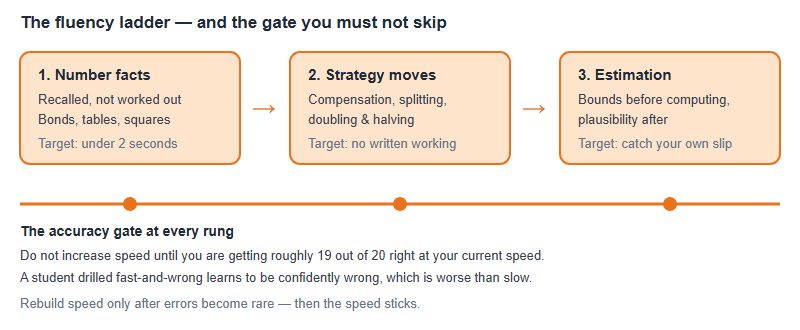
Calculation fluency is the ability to compute accurately without conscious effort. In AMO it matters less because fast arithmetic directly wins marks, and more because slow arithmetic steals the attention a hard question needs. This guide covers five mental-maths moves, estimation as a checking tool, and a drill schedule built on one rule: accuracy first, speed second.
Why arithmetic speed is a competition skill, not a talent signal
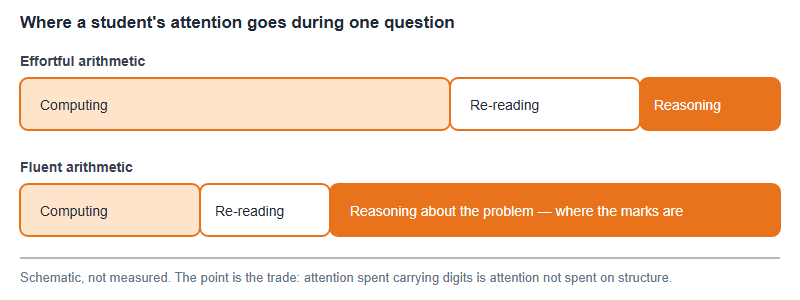
Watch a student work through a multi-step word problem and you can usually see the moment it goes wrong. It is rarely the moment they choose the wrong method. It is the moment they stop thinking about the problem and start doing long multiplication in the margin. For thirty or forty seconds their whole attention sits on carrying digits — and when they surface with the number, they have lost the thread. They multiply where the question asked for a difference, or they answer the sub-question instead of the question.
That is the real cost of weak fluency. It is not the clock; a slow computation might cost twenty seconds. It is that arithmetic done effortfully occupies the same working memory the student needs for the reasoning, and the reasoning is where the marks are. A fluent student computes almost in the background and keeps the structure of the problem in view the whole time.
This is also why fluency work pays off disproportionately for younger competitors. Across the practice papers we mark for students in Grades 3 to 8, much of what is lost is not “could not do it” — it is slips and misreads on questions the student could clearly handle. Slips of that kind respond very well to a few weeks of structured fluency work. Genuine content gaps do not.
One practical caveat before you plan around any of this: whether a calculator or any other calculating aid is permitted is set by the organiser and printed in the official contest instructions, which vary by level and by season. Confirm yours on the official AMO pages or through your registration channel. Training to compute by hand is the safe default in either case, because it is the assumption that never leaves you stranded. (For orientation on the competition itself, see what AMO is. AMO is run by SIMCC in Singapore together with Southern Illinois University Carbondale, for Grades 2 to 12. It is not the AMC, which is a separate competition run by the MAA in the United States.)
Five mental-maths moves that carry most of the load
Competition arithmetic rewards a small number of transferable moves far more than it rewards general drilling. The five below cover the large majority of the awkward computations that appear inside otherwise ordinary questions. Teach them as named moves so a student can say which one they are using — naming makes them retrievable under pressure.
| Move | What it replaces | Worked example | Where it shows up |
|---|---|---|---|
| Compensation (round, then adjust) |
Column addition and subtraction | 198 + 47 → 200 + 47 = 247, then −2 = 245 | Totals, running sums, money and length problems |
| Doubling & halving | Written multiplication | 25 × 48 → 50 × 24 → 100 × 12 = 1200 | Anything involving 5, 25, 50, and area questions |
| Splitting (the distributive law) |
Multiplication by two-digit numbers | 7 × 63 → (7 × 60) + (7 × 7) = 420 + 21 = 441 | Rate, ratio and repeated-group problems |
| Complements | Borrowing across zeros | 1000 − 387 → distance up to 1000 = 613 | Change, remainders, “how many more” questions |
| Switching form (fraction ↔ decimal ↔ percent) |
Long division | 37.5% of 240 → 3/8 of 240 → 240 ÷ 8 × 3 = 90 | Percentage, discount and part-whole problems |
The fifth move is the one most students are missing, and it is worth over-investing in. A student who knows that 0.125 is one eighth, that 5/8 of 240 is 150, and that 15% is simply 10% plus half of it, will finish a percentage question in the time another student takes to set up the long division. Build the core conversion set until it is recall rather than calculation: halves, quarters, eighths, fifths, tenths, twentieths, and thirds as recurring decimals.
Add one more habit that is technically a check rather than a move: quick divisibility. Knowing at a glance that 471 is divisible by 3 because its digits sum to 12, or that a number ending in 7 cannot be a multiple of 5, saves whole minutes on factor questions and catches wrong answers before they are written down.
Estimation is not guessing — it is your only self-marking tool
In a timed paper nobody hands the student a correct answer to compare against. Estimation is the substitute. Trained properly it does two jobs: it sets expectations before a computation so the student notices when the result is impossible, and it provides a fast plausibility check afterwards.
- Bound it first. Before computing 19 × 21, say “about 400”. The exact answer, 399, then confirms itself. A result of 3990 or 39 announces a place-value slip instantly.
- Check the last digit. 63 × 47 must end in 1, because 3 × 7 = 21. If the written answer ends in anything else, it is wrong without needing to be redone. (The answer is 2961.)
- Check parity. A sum of four even numbers cannot be odd. An odd total from an even-only sum means an arithmetic error, not a hard question.
- Check plausibility in context. A walking speed of 400 km/h, an age of −3, or a discount price above the original price are all self-reporting errors. Young students frequently write these without blinking because they have stopped thinking about what the numbers describe.
- Check the share. If a part is supposed to be a fraction of a whole, the answer must be smaller than the whole. This single check catches a surprising share of ratio errors.
Estimation habits also protect students at the top of the paper. When questions get harder, students start writing down whatever number their last line produced, because they are relieved to have produced anything at all. A trained plausibility reflex intercepts that.
A drill schedule that actually builds fluency
Fluency responds to frequency, not to volume. Eight to ten focused minutes on most days will outperform a single ninety-minute session at the weekend, every time. The session should be short enough that concentration never sags, because practice done tired teaches sloppiness.
A workable format: twenty questions, one timer, one written record of time taken and number wrong. Two lines in a notebook per session is enough. What you are watching for is the relationship between the two numbers — not the time alone.
| Band | What to drill | Signal you are ready to move on |
|---|---|---|
| Grades 3–4 | Bonds to 20 and 100; multiplication and division facts; doubling and halving; complements to 100 and 1000 | Facts answered by recall in about two seconds, with no finger counting |
| Grades 5–6 | Two-digit multiplication by splitting; the fraction–decimal–percent core set; unit fractions of quantities; quick divisibility by 2, 3, 4, 5, 9 | A question like “5/8 of 240” answered without written working |
| Grades 7–8 | Percentage increase and decrease; ratio scaling; squares to 25 and powers of 2 to 1024; factorising two- and three-digit numbers on sight | Estimating a bound for any computation before starting it, automatically |
Two rules protect the whole system. First, always drill at the band the student is actually sitting — drilling above it inflates the error count and teaches nothing about speed. If you are unsure which band applies, see AMO grade levels explained and confirm the current arrangement officially. Second, hold the accuracy gate. If errors are running above roughly one in twenty, the answer is never “go faster and be more careful”; it is to slow down until errors are rare and then rebuild.
Where fluency stops helping
Fluency has a ceiling, and families regularly run past it. Once a student computes accurately and without visible effort, further arithmetic drilling adds close to nothing, and the time is much better spent on non-routine problems where the difficulty is choosing a method rather than executing one. A fast calculator who cannot find a way into an unfamiliar question will not score well, and no amount of extra drilling changes that.
Two honest framing points for parents. Arithmetic speed is not a measure of mathematical ability — it is a trainable mechanical skill that happens to remove obstacles, and treating it as talent puts pressure on a child for no reason. And awards in AMO are percentile-based, meaning results depend on how the whole cohort performs in that season, not on hitting a fixed score; see how AMO scoring works, and confirm the current award arrangements on the official pages before setting any target.
The sensible sequence, then, is this: build fluency early and quickly in the year, get it to the point where it is invisible, and then leave it on maintenance — five minutes a few times a week — while the real preparation time goes to problems that make the student think.
Frequently asked questions
Are calculators allowed in AMO?
That is set by the organiser and printed in the official contest instructions. Confirm on the official AMO pages before planning around it.
How long should daily mental-maths practice be?
Eight to ten focused minutes on most days. Fluency responds to frequency far more than to volume, and short sessions protect accuracy.
My child is fast but careless. Should we train speed or accuracy first?
Accuracy, always. Slow the drill until errors are rare, then rebuild speed at that accuracy level so the speed sticks.
Is AMO the same competition as the AMC?
No. AMO is run by SIMCC in Singapore with SIU, for Grades 2 to 12. The AMC is a separate competition run by the MAA in the United States.
This site is operated by Hanlin Education as an authorized AMO registration partner for China. AMO (American Mathematics Olympiad) is run by SIMCC (Singapore International Math Contest Centre) together with Southern Illinois University Carbondale; we are not the organiser and do not speak for it. Contest dates, eligibility, permitted materials, paper structure and award arrangements are set by the organiser and can change between seasons — confirm all details on the official SIMCC / AMO pages or through your registration channel. Factual errors are corrected within 7 working days of being reported.