
AMO levels are named by United States grade, from Grade 2 to Grade 12. Most families in China are not in a US-labelled system: the child is in Year 8, or MYP 2, or 初一 (Chinese Grade 7). The rule that settles almost every case is simple — enter the grade your child is currently enrolled in, not the one their age or their maths set suggests. This guide maps the four common systems and flags the cases worth checking first.
The rule that settles most cases
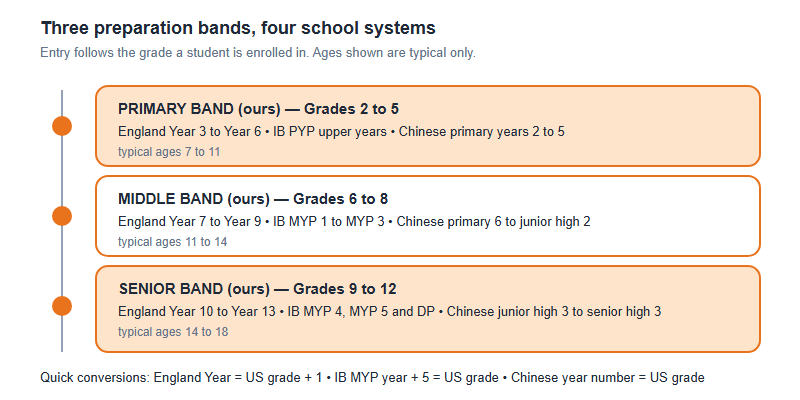
AMO is organised by the Singapore International Mastery Contests Centre (SIMCC) together with Southern Illinois University, and it runs one 90-minute paper per level across Grades 2 to 12. For preparation we group the levels into three bands — primary for Grades 2 to 5, middle for Grades 6 to 8, senior for Grades 9 to 12. That grouping is our own rather than an organiser structure, so confirm the current level groupings on the official AMO pages. Our overview of the AMO grade levels from Grade 2 to Grade 12 sets out in detail.
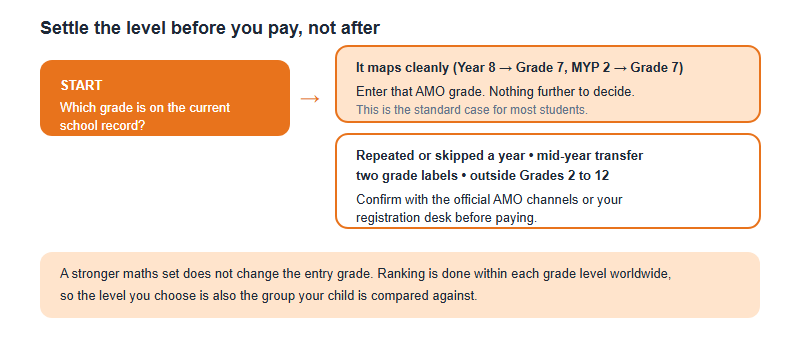
The operative principle is that a student sits the paper for their current grade. That sounds obvious until you notice what it rules out. It rules out entering by age, which is where most mistakes start, because school entry cutoffs differ by country and two children born a fortnight apart can legitimately sit in different grades. It also means mathematical strength is not by itself the deciding factor: a Grade 6 student who takes maths with the Grade 8 class would normally enter as a Grade 6 entrant. Whether a stronger student may enter a higher level is a rule set by the organiser, so confirm it on the official AMO pages before registering.
So the question is not “how old is my child” or “how good are they”. It is: what grade is printed on the current school record? Translate that into the US numbering, and you have your level.
The mapping: British Years, IB programmes and Chinese school years
Three rules of thumb do most of the work, and the table below spells them out row by row.
- England and Wales: Year number = US grade + 1. Year 3 is Grade 2; Year 9 is Grade 8.
- Chinese system: the numbering already matches. 小学四年级 is Grade 4, 初一 is Grade 7, 高一 is Grade 10.
- IB: MYP year + 5 = US grade in the common configuration. MYP 1 is usually Grade 6, MYP 5 is usually Grade 10, and DP1 and DP2 are Grades 11 and 12.
| Typical age | US grade = AMO level | England / Wales | IB programme year | Chinese school year | Our preparation band |
|---|---|---|---|---|---|
| 7–8 | Grade 2 | Year 3 | PYP | 小学二年级 (Primary 2) | Primary |
| 8–9 | Grade 3 | Year 4 | PYP | 小学三年级 (Primary 3) | Primary |
| 9–10 | Grade 4 | Year 5 | PYP | 小学四年级 (Primary 4) | Primary |
| 10–11 | Grade 5 | Year 6 | PYP (final year) | 小学五年级 (Primary 5) | Primary |
| 11–12 | Grade 6 | Year 7 | MYP 1 | 小学六年级 (Primary 6) | Middle |
| 12–13 | Grade 7 | Year 8 | MYP 2 | 初一 (Grade 7) | Middle |
| 13–14 | Grade 8 | Year 9 | MYP 3 | 初二 (Grade 8) | Middle |
| 14–15 | Grade 9 | Year 10 | MYP 4 | 初三 (Grade 9) | Senior |
| 15–16 | Grade 10 | Year 11 | MYP 5 | 高一 (Grade 10) | Senior |
| 16–17 | Grade 11 | Year 12 (Lower Sixth) | DP1 | 高二 (Grade 11) | Senior |
| 17–18 | Grade 12 | Year 13 (Upper Sixth) | DP2 | 高三 (Grade 12) | Senior |
Two caveats belong with that table. Ages are typical, not definitional: England uses a 1 September cutoff, mainland Chinese schools commonly use a 31 August or 1 September cutoff, and US states vary, so a child can sit a year either side of the age shown and still be correctly placed. And IB schools do not all begin MYP at the same point — a minority start MYP a year earlier or later, in which case the school’s own grade equivalent, not the MYP number, is what you should use.
Why the level you enter changes the result you get
Getting the level right is not administrative tidiness. It decides two things at once.
The first is the paper. Each level is written for the grades it covers, and the organiser groups some grades together, so entering a different level changes the difficulty your child meets, not just the label on the certificate. Check the current level groupings on the official AMO pages.
The second matters more, and families rarely realise it at registration. AMO awards are decided by rank within each grade level, worldwide. There is no fixed pass mark; the recognised bands run at roughly the top 8 per cent for gold, the next 12 per cent for silver and the next 20 per cent for bronze, so approximately the top 40 per cent of a level receives a medal. Our explainer on how AMO scoring works goes through the mechanics. The practical consequence is that the level you enter is the cohort you are measured against. Entering a grade below your child’s own would not simply make the paper easier — it would place them in a comparison group they do not belong to, which is exactly why the current-grade rule exists.
It also means a result carries a specific meaning: a Grade 7 bronze says something about where a student stands among Grade 7 entrants globally. That is a far more useful signal than a raw score, and it only holds if the level is correct.
Six situations where families guess wrong
The mapping above covers the standard case. These six do not resolve from a table, and each is worth a message to the official channels or to your registration desk before you pay, rather than an assumption you discover was wrong on results day.
- Started school early, started late, or repeated a year. The child’s age no longer predicts the grade. Use the enrolled grade and confirm if the school record itself is ambiguous.
- Mid-year transfer, or a Southern-hemisphere January intake. A child moving from an Australian or New Zealand calendar into a northern one can be between grade labels for several months. Confirm with the official AMO channels which date the organiser uses to fix a student’s grade, since it may not be contest day.
- Accelerated maths set. A Grade 6 student in the Grade 8 maths class is still a Grade 6 entrant under the current-grade principle. If you believe there is a case for something different, that is a decision for the organiser and not one to assume.
- Two grade labels on one report. Bilingual schools frequently print both 年级 and a US-style grade, and occasionally the two disagree by a year. Ask the school which one it uses for external registrations.
- Below Grade 2 or beyond Grade 12. AMO runs Grades 2 to 12. A Grade 1 student sits outside the range; the usual answer is to wait a year rather than to enter early.
- Home education or a gap year. There may be no school record to quote. Confirm what evidence of grade the organiser expects before registering.
One more source of confusion: AMO grades are not AMC grades
Because both contests use grade numbers and both carry the word American, families regularly arrive at registration having researched the wrong competition. The two are unrelated organisations.
AMO is run from Singapore by SIMCC with Southern Illinois University, covers Grades 2 to 12, is referenced to the US Common Core, runs 90 minutes per level, and leads on to SIMOC and IJMO. Our introduction to AMO covers that structure.
The AMC — the American Mathematics Competitions — is run by the Mathematical Association of America in the United States. It is a different ladder with different entry bands, its own timing, and its own onward route. If you are comparing the two, take the AMC details from the MAA’s own pages rather than from any summary, including this one. The only point being made here is that an AMO Grade 8 entry and an AMC 8 entry are not the same thing, and a level worked out for one tells you nothing about the other.
One last practical note. Whichever level you land on, register it once and register it correctly: the grade on the entry is what determines the paper sat and the cohort ranked. If anything in your situation is not covered by the table above, ask before the registration window closes rather than after.
Frequently asked questions
Does my child enter by age or by school grade?
By the grade they are currently enrolled in. Age is only a guide, because school start cutoffs differ between countries.
My child is in Year 8 at a British-curriculum school. Which AMO grade is that?
English Year 8 usually matches US Grade 7. Check the grade printed on the school report, then confirm before you register.
Can a strong student sit a higher level?
Entry is normally by the current grade, but whether a student may enter a higher level is a rule set by the organiser. Confirm it on the official AMO pages before you register.
Does the level change how the medal is decided?
Yes. Ranking is done within each grade level worldwide, so your child is compared with students entered at the same level.
This site is operated by Hanlin Education as an authorized AMO registration partner for China. AMO is run by the Singapore International Mastery Contests Centre (SIMCC) together with Southern Illinois University; we are not the organiser, and AMO is not the American Mathematics Competitions (AMC) run by the MAA in the United States. Grade equivalences above are typical guidance for common school systems, not organiser rules; eligibility, dates, fees and award bands are set by the organiser — always confirm current details on the official SIMCC / AMO pages before registering. If you spot an error in this article, tell us and we will correct it within 7 working days.