
Speed, distance and time questions are where confident calculators lose marks. The arithmetic is easy; the modelling is not. Almost every journey question reduces to three moves: identify the quantity that stays fixed, combine two speeds into one closing speed when objects move together or apart, and build average speed out of totals instead of averaging the speeds. This guide works through all three, with drills.
Why journey questions punish good arithmetic
A student who can multiply three-digit numbers in their head will still lose a journey question, because the difficulty sits before the arithmetic. The question hands you three or four numbers and invites you to combine them immediately. The trained response is the opposite: read the whole situation, decide what is being held constant, and only then reach for a calculation.
That habit matters more in a contest built the way AMO is. AMO is a 90-minute paper per level, open to Grades 2 to 12, organised by the Singapore International Mastery Contests Centre (SIMCC) together with Southern Illinois University. It is not the American Mathematics Competitions run by the MAA in the United States, despite the shared word “American”. If the contest itself is new to you, our guide to what AMO actually is sets out the structure first. Within a fixed time limit, the students who finish are rarely faster at multiplying. They are faster at deciding what kind of problem they are looking at.
Here is the single most useful fact in the whole strand. For a fixed distance, speed and time are inversely proportional. If two people cover the same route and their speeds are in the ratio 3 : 4, their times are in the ratio 4 : 3. No formula needed, no unknown distance to invent. A large share of middle-grade journey questions collapse the moment a student flips that ratio confidently instead of setting up algebra.
One relationship, three forms — and the unit discipline that decides marks
Everything in this topic comes from one relationship, written three ways:
- distance = speed × time — when you know how fast and how long
- time = distance ÷ speed — when you know how far and how fast
- speed = distance ÷ time — when you know how far and how long
Errors almost never come from choosing the wrong form. They come from units. Three rules remove most of them.
Convert first, not last. Pick one system at the start — everything in kilometres and hours, or everything in metres and seconds — and convert every given number into it before any calculation. Half-converted working is where a correct method turns into a wrong answer. The bridge is worth memorising: 1 metre per second is 3.6 kilometres per hour, because 3600 seconds in an hour divided by 1000 metres in a kilometre gives 3.6.
Use fractions of an hour, not decimals. Forty-five minutes is three quarters of an hour. Written as 0.75 it is still exact, but 20 minutes as 0.333 is not, and across a three-stage journey that rounding compounds. A cyclist at 16 km/h for 45 minutes covers 16 × 3/4 = 12 km, and the fraction keeps it to one line.
Write the unit beside every number. It costs a second and it catches the classic disaster of dividing kilometres by minutes and then reporting the result as km/h.
One tactical note specific to this contest. AMO is reported not to deduct marks for a wrong answer, though the marking scheme should be confirmed on the official AMO pages, and awards are decided by rank within each grade level rather than by a fixed pass mark — our explainer on how AMO scoring works sets that out. The consequence for this topic is direct: a journey question you cannot finish should still receive your best estimate. If a car travels 200 km and you know the answer lies between two and three hours, write the value you believe most. A blank is strictly worse than a considered guess.
Meeting, overtaking and the closing-speed idea
When two objects move at once, students often try to track both. There is no need. Convert the pair into a single object closing a single gap.
Two cyclists riding towards each other reduce the gap between them at the sum of their speeds. Two cyclists riding in the same direction reduce the gap at the difference of their speeds. Once you have that one closing speed, the question becomes a plain division: gap divided by closing speed gives the time.
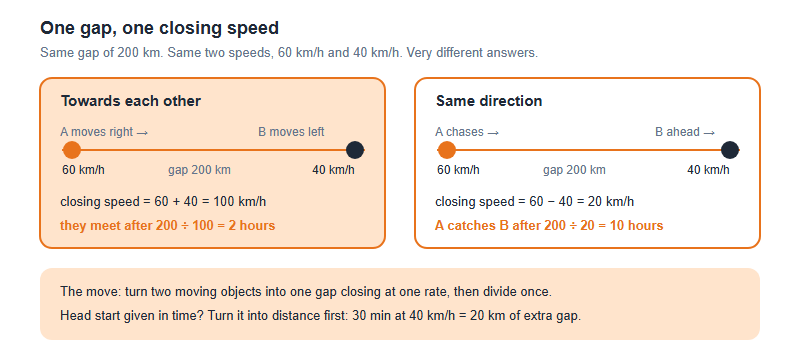
Head starts are where this goes wrong. A question may say the second runner sets off twenty minutes later. That is not a gap you can use directly — you must convert it into distance at the first runner’s speed before dividing. Twenty minutes at 12 km/h is 4 km, and 4 km is the number that belongs in the division.
The same logic covers rivers, escalators and wind. An object inside a moving medium travels at its own speed plus or minus the speed of the medium: a boat going downstream moves at boat speed plus current, upstream at boat speed minus current. Two directions give two equations, and adding them eliminates the current in a single line.
| Journey shape | What stays fixed | The move | The usual trap |
|---|---|---|---|
| Two objects approaching | the gap between them | gap ÷ (sum of the speeds) | tracking each object separately |
| One object chasing another | the gap between them | gap ÷ (difference of the speeds) | leaving a head start in minutes instead of converting it to distance |
| Same route travelled twice at different speeds | the distance | flip the speed ratio to get the time ratio | averaging the two speeds |
| Equal times at different speeds | the time | distance ratio equals the speed ratio | flipping the ratio when it should stay the same way round |
| Journey in several stages | nothing — treat each leg separately | total the distances and the times, then divide once | adding or averaging speeds across legs |
| Moving medium (river, wind, escalator) | own speed and medium speed | downstream = own + medium; upstream = own − medium | using one single speed for both directions |
The average-speed trap: 60 and 30 give 40, not 45
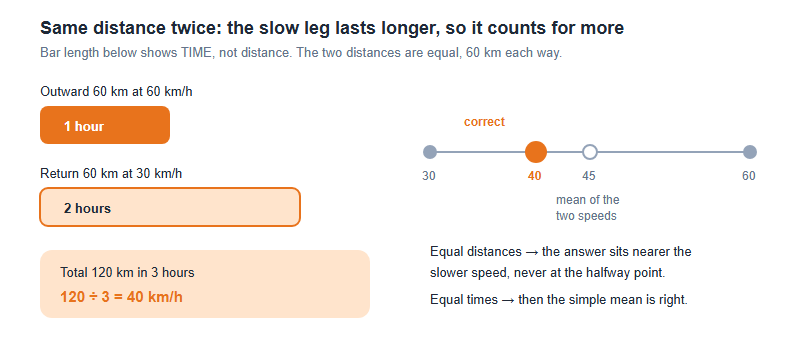
This is the most reliably mishandled question in the strand, and it deserves understanding rather than memorising. A car drives 60 km to a town at 60 km/h, then returns along the same road at 30 km/h. What is the average speed for the whole trip?
Almost every untrained student answers 45. The correct answer is 40, and the reason is that average speed is always total distance divided by total time — never the mean of the speeds. Outward, 60 km at 60 km/h takes 1 hour. Back, 60 km at 30 km/h takes 2 hours. Total 120 km in 3 hours, which is 40 km/h.
Two extensions are worth drilling once the main idea lands. First, when a question gives two speeds but no distance, invent a friendly one — take the lowest common multiple of the speeds, so 60 and 30 suggest 60 km each way and every number stays whole. The answer never depends on the distance you choose, which is a satisfying thing for a student to verify once for themselves.
Second, a stop counts. If the driver rests for 30 minutes at the town, total time becomes 3.5 hours and the average speed for the whole trip falls to 120 ÷ 3.5, roughly 34.3 km/h. Questions insert that half hour precisely to separate students who divide by total elapsed time from those who divide by moving time only.
Stated generally: average speed is a time-weighted mean of the speeds. Whenever equal distances are covered at different speeds, the slower leg occupies more of the clock and therefore drags the average down towards it.
A three-week drill that fixes the usual losses
This strand rewards a short concentrated block far more than scattered practice. Three weeks at roughly 25 minutes a day, four days a week, moves most middle-grade students from guessing to modelling.
Week 1 — units and one-step journeys. Twelve conversions a day, said out loud: minutes into fractions of an hour, m/s into km/h and back. Then five single-stage questions where the only work is choosing the right form of the relationship. Success looks like zero unit errors across a whole session, not speed.
Week 2 — closing speed. Alternate meeting and overtaking questions so the student must decide whether to add or subtract, rather than repeating yesterday’s move on autopilot. Add head-start variants from day three. One habit is worth insisting on: before calculating, say the sentence “the gap is ___ km and it closes at ___ km/h”. A student who cannot fill both blanks is not ready to divide.
Week 3 — average speed and multi-stage journeys. Begin every question by drawing a two-row table with distance and time for each leg, then total each column. Students who build the table stop averaging speeds, because the table gives them nowhere to do it.
Build two checks into every session. First, the sanity band: if the journey contains no stops, an average speed must lie between the slowest and the fastest speed in it. An answer outside that band is wrong, and noticing takes two seconds. Second, the reasonableness check: if a walking pace comes out at 90 km/h, a conversion went the wrong way.
How far to push depends on the level. Primary students handle meeting problems and simple average speed with friendly numbers; the behaviour of equal-distance journeys sits more comfortably from the middle grades upward, and moving-medium problems belong in the middle and senior bands. Our breakdown of the AMO grade levels from Grade 2 to Grade 12 shows where each grade level sits. The syllabus emphasis for any given season is set by the organiser, so confirm it on the official AMO pages rather than assuming last season’s balance repeats.
Frequently asked questions
Does AMO always include speed and distance questions?
Question mixes change between seasons. Treat this strand as likely rather than guaranteed, and confirm the current syllabus on the official AMO pages.
Is average speed just the mean of the two speeds?
Only when the times are equal. When the distances are equal, divide total distance by total time and you get a lower figure.
Should minutes be written as fractions or decimals?
Fractions of an hour stay exact: 45 minutes is 3/4 h. Decimals invite rounding errors part-way through a multi-stage journey.
What if my child cannot finish a journey question in time?
Write the best estimate anyway. AMO is reported not to deduct marks for wrong answers, so a blank is unlikely to beat a considered guess, but confirm the marking scheme for your level on the official AMO pages.
This site is operated by Hanlin Education as an authorized AMO registration partner for China. AMO is run by the Singapore International Mastery Contests Centre (SIMCC) together with Southern Illinois University; we are not the organiser, and AMO is not the American Mathematics Competitions (AMC) run by the MAA in the United States. Dates, fees, eligibility, paper format and award bands are set by the organiser — always confirm current details on the official SIMCC / AMO pages. Worked examples above are illustrative and written for this guide. If you spot an error in this article, tell us and we will correct it within 7 working days.