
Start with one timeline, not one sentence at a time
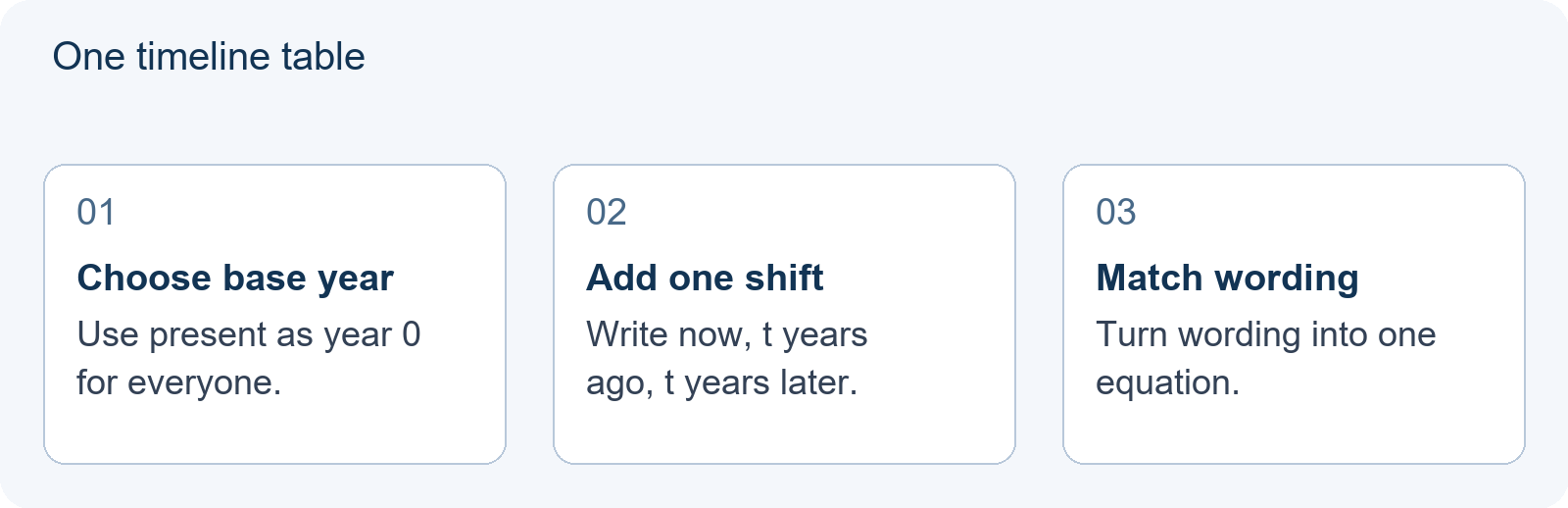
To solve an AMO-style age problem, do not translate the sentence word by word. Put every person on one timeline. Let the present be year 0, and let t be the same time shift for everyone. Then ‘t years ago’ becomes age now minus t, and ‘in t years’ becomes age now plus t. The ‘was’ or ‘will be’ sentence supplies one equation. Check the result by substituting back into the original wording. This one-table method is the core answer for Grades 4-8 working on AMO-style age problems.
For AMO preparation, according to the AMO site information supplied for this guide, AMO is a Grade 2-12 competition with a 90-minute, 25-question paper. The same source lists 15 multiple-choice questions at 3 points, 5 open questions at 5 points and 5 open questions at 6 points, for 100 points; wrong answers incur no penalty. Those paper facts matter here only because they set the context: age-style problems can be practised in short multiple-choice form or as open questions where the working must be readable.
What should the timeline table contain?
Use a small table before writing algebra. The columns should make the time shift visible for every person, not just for the person mentioned first.
| Person | Age now | Age t years ago | Age t years later |
|---|---|---|---|
| A | a | a – t | a + t |
| B | b | b – t | b + t |
If a question says ‘five years ago’, put 5 in the t column. If it says ‘in three years’, use t = 3. Do not write one person’s age with a past shift and another person’s age with no shift. If the problem uses two different time shifts, label them separately, such as t1 and t2; do not force them to be the same number.
A useful wording map keeps the translation honest:
| Wording in the problem | Timeline entry | Error to avoid |
|---|---|---|
| ‘n years ago’ | Subtract n from every relevant person | Subtracting n from only one person |
| ‘in n years’ | Add n to every relevant person | Adding n to the total once instead of each age |
| ‘sum of their ages now’ | Add present ages only | Using past or future ages in the present sum |
| ‘difference in their ages’ | Subtract the two present ages | Thinking the difference changes with time |
Before writing equations, decide what the variable means. A practical choice is the time shift t, especially when the question asks ‘in how many years’ or ‘how many years ago’. If the question asks for present ages, you may use one present age and express the other from the stated sum or difference. Either choice is fine, but write the definition down so the final answer is not an unlabelled number.
Worked teaching illustration: a future ‘will be’ statement
Teaching illustration only; this is hypothetical and not an official AMO question. A father is 34 and his son is 8. In how many years will the father be twice as old as the son?
| Person | Now | In t years |
|---|---|---|
| Father | 34 | 34 + t |
| Son | 8 | 8 + t |
The wording ‘father will be twice the son’ gives 34 + t = 2(8 + t). Expand the right side: 34 + t = 16 + 2t. Subtract t from both sides: 34 = 16 + t. So t = 18. In 18 years the father is 52 and the son is 26. Check: 52 = 2 x 26. The answer satisfies the original sentence, not merely the equation.
Also notice the age difference. Now the father is 34 – 8 = 26 years older. In 18 years he is 52 – 26 = 26 years older. Age difference stays fixed when both people move forward on the same timeline. That invariant is a quick extra check.
The table also blocks a specific false start. A student may add 18 only to the father and write 34 + 18 = 52, then compare 52 with 8. The table forces the son’s age to move too, so the comparison is 52 with 26. In age problems, every comparison must happen in the same year.
Why the combined-age trap changes by 2, not 1
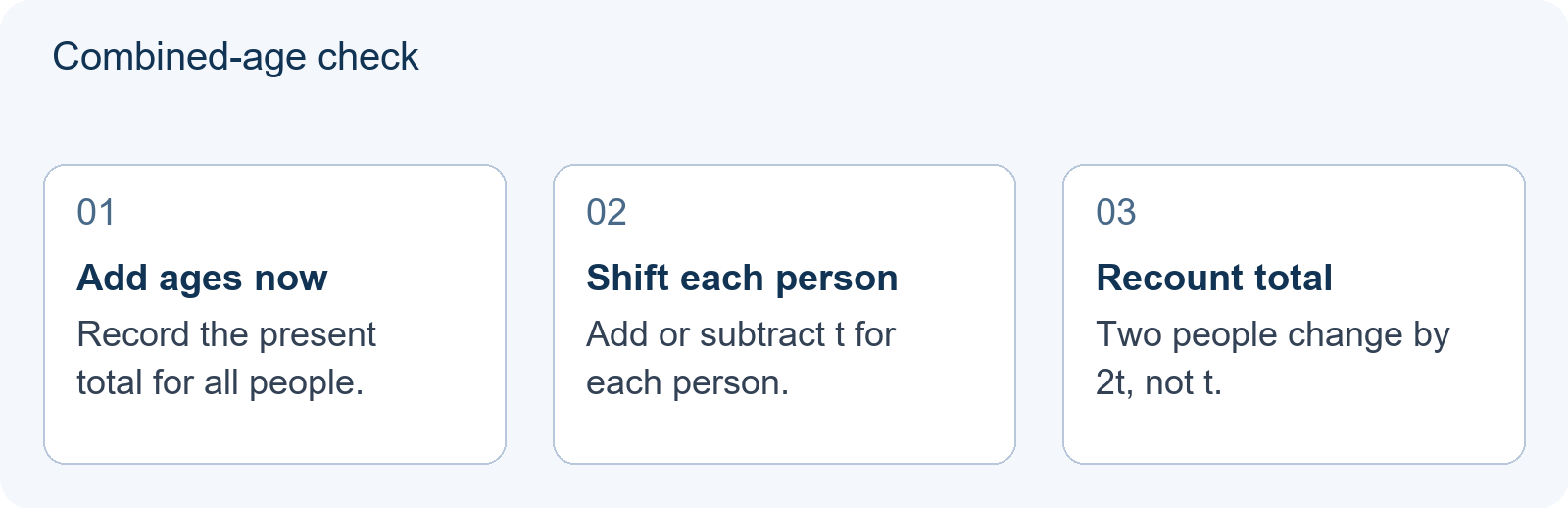
A specific slip to guard against is adding the time shift once to a combined age. If two people are each t years older, their combined age rises by 2t, not t. In the father-son example, their present combined age is 34 + 8 = 42. In 18 years it is 52 + 26 = 78. The increase is 78 – 42 = 36, which is 2 x 18. A student who writes 42 + 18 = 60 has treated two people as one person.
The same idea extends: for three people, a shared shift of t years raises the combined age by 3t. For one person, it rises by t. The number of people matters. A second related invariant is that the difference between two people’s ages does not change when both ages move by the same amount.
Past shifts work in the opposite direction. If the question moves t years into the past, each person is t years younger, so a two-person combined age decreases by 2t. A student who says ‘five years ago their combined age was 45 – 5 = 40’ for two people has made the same one-person error. For two people it should be 45 – 10 = 35 before substituting individual ages.
Worked teaching illustration: a past ‘was’ statement plus a current sum
Teaching illustration only; this is hypothetical and not an official AMO question. Five years ago, a mother was four times as old as her daughter. Their present ages sum to 45. Find their present ages.
| Person | Now | 5 years ago |
|---|---|---|
| Mother | m | m – 5 |
| Daughter | d | d – 5 |
The present sum gives m + d = 45, so m = 45 – d. The past relationship gives m – 5 = 4(d – 5). Substitute: 45 – d – 5 = 4d – 20. Simplify: 40 – d = 4d – 20. Add d to both sides: 40 = 5d – 20. Add 20: 60 = 5d. So d = 12 and m = 33. Check five years ago: mother 28, daughter 7, and 28 = 4 x 7. The present sum is 33 + 12 = 45. The age difference is 21 now and was 21 five years ago.
This second illustration shows why the table should be built before substitution. If the student writes the past relationship using present ages without subtracting 5 from both people, the equation looks reasonable but describes the wrong year. The table makes both subtractions visible before any algebra begins.
An alternative check uses the age difference. The mother is 21 years older than the daughter. Five years ago the mother was four times the daughter, so the daughter’s age then must account for three equal parts of the difference. Since 21 divided by 3 is 7, the daughter was 7 and the mother was 28. That is consistent with present ages 12 and 33. This shortcut is not required, but it is a useful independent check when the relationship is a simple multiple.
Three checks before you write the answer
| Check | Question to ask | Repair |
|---|---|---|
| Base year | Did I choose one present year for all people? | Rewrite every age as now plus or minus the shift. |
| Same shift | Did every person receive the same time shift? | Add or subtract t in every row, not just one row. |
| Original wording | Does the check match the sentence, not just the equation? | Substitute the answer back into the original ‘was’ or ‘will be’ statement. |
For example, after finding t = 18, ask: ‘In 18 years, is the father twice the son?’ After finding the mother and daughter ages, ask: ‘Five years ago, was the mother four times the daughter?’ If the check uses present ages instead of the requested time, it is not a full check.
A fourth check is worth adding when the problem gives a total. Recompute the total using the two ages you found, and verify that the total belongs to the same year as the statement. If the problem gives a past total, do not compare it with a present total. The year label is part of the arithmetic.
How to write the solution in an open-response section
The AMO paper includes open questions worth 5 points and open questions worth 6 points, according to the same AMO site information. In those sections, the table is not only a thinking tool; it is also a way to make the solution readable. Define the variable, state the time relationship, solve the equation, and finish with a checking sentence.
For instance, write ‘Let t be the number of years from now’, then show the two future ages, then the equation, then the check. Avoid unlabelled algebra such as ’34 + t = 16 + 2t’ with no sentence explaining what t means or which year is being compared. A compact written frame can be: ‘Let t be …; the father’s age then is …; the son’s age then is …; the condition says …; solving gives …; check: …’. That frame is not a scoring formula, but it keeps the reasoning visible.
The AMO Section B: A 5-Mark Open-Question Writing Clinic covers open-response presentation more directly; for age problems, the extra requirement is that the timeline base year must be visible.
How to use this in a short diagnostic or lesson
Give one future-statement problem and one past-statement problem. Ask the student to fill the timeline table before writing any equation. If the student jumps to an equation, ask them to name the base year and the shared shift. If the student forgets the combined-age drift, ask them to list both ages before and after the shift, then add them. If the student mixes past and future, ask them to underline the time words first.
For adjacent word-problem structures, the AMO Reverse Operations: Undo a Multi-Step Word Problem in the Right Order article is useful when the problem gives a final value and asks you to work backward; age problems usually need a forward timeline instead. The The Assumption Method for AMO Word Problems: Heads and Legs, Two Prices and Excess-and-Shortage (2026) article covers a different setup with fixed totals. Keeping those methods separate helps students choose the right first move.
If you bring a problem to a teacher or programme, bring the filled timeline table and the original sentence, not just the final answer. That makes the error pattern visible: wrong base year, missing shift on one person, or a combined-age total that was increased by t instead of 2t. This is preparation advice, not a scoring rule or a promise of a particular result.
General event background is available at Event background.
Frequently Asked Questions
How do I set up an AMO-style age problem with ‘was’ and ‘will be’?
Choose the present as the base year. Write each person’s age now, then add or subtract the same time shift t. Translate the ‘was’ sentence with past ages and the ‘will be’ sentence with future ages. Solve the resulting equation and substitute back into the original wording.
Why does a two-person combined age rise by 2 each year?
Because both people get one year older each year. If two people are each t years older, the combined age rises by 2t. For three people it rises by 3t. The combined-age increase must match the number of people, not just the number of years.
How can I check an age answer before writing it down?
Substitute the answer into the original sentence, using the correct past or future year. Also check that every person received the same time shift, that the age difference stayed fixed, and that any combined age increased by the correct multiple of t.