
Section B of the AMO paper is the group of five open questions worth 5 points each — 25 of the paper’s 100 points — sitting between the 15 three-point multiple-choice questions of Section A and the five six-point open questions of Section C. The paper runs 90 minutes for Grades 2–12, carries no negative marking, and can be taken online or on paper at school. The useful target for a Section B answer is not length. It is a short written chain that a reader can follow from the first line to the last.
That distinction matters more than it sounds. A Section B question is a writing task with a small footprint: a student has roughly the same time per mark as anywhere else on the paper, but fewer marks to earn than in Section C, so the answer needs less scaffolding and more precision. The paper structure and format details used here follow the AMO competition facts recorded for this guide (2026). Everything about how to shape an answer is a teaching judgment, not an official mark scheme, and this article keeps those two things clearly separated.
How Section B differs from Section A and Section C
Students who prepare section by section often arrive with the wrong expectation. Section A rewards a decision; Section C rewards a complete argument. Section B rewards something in between: the single step that makes the answer inevitable, written down so that it can be inspected. The table below compares the three groups using the paper structure above, with the typical-risk row marked as coaching observation rather than official guidance.
| Feature | Section A | Section B | Section C |
|---|---|---|---|
| Number of questions | 15 | 5 | 5 |
| Points per question | 3 | 5 | 6 |
| Answer form | Multiple choice | Written solution | Written solution |
| Share of the 100 points | 45 | 25 | 30 |
| Typical risk (coaching observation) | Choosing a trap option | Hiding the key step inside working | Running out of structure or time |
| What a reader needs | The chosen letter | A chain anyone can re-check | A finished argument |
A particularly costly Section B failure is neither a blank page nor a wrong final number. It is a page of correct arithmetic with the decisive idea buried in the middle of line six, where nothing points to it. For contrast on the two neighbouring sections, see AMO Section A: An Elimination-First Clinic for 3-Point Multiple-Choice Questions and AMO Section C: How to Write Open-Ended Solutions That Show Your Reasoning.
The four-line frame: what a checkable answer looks like
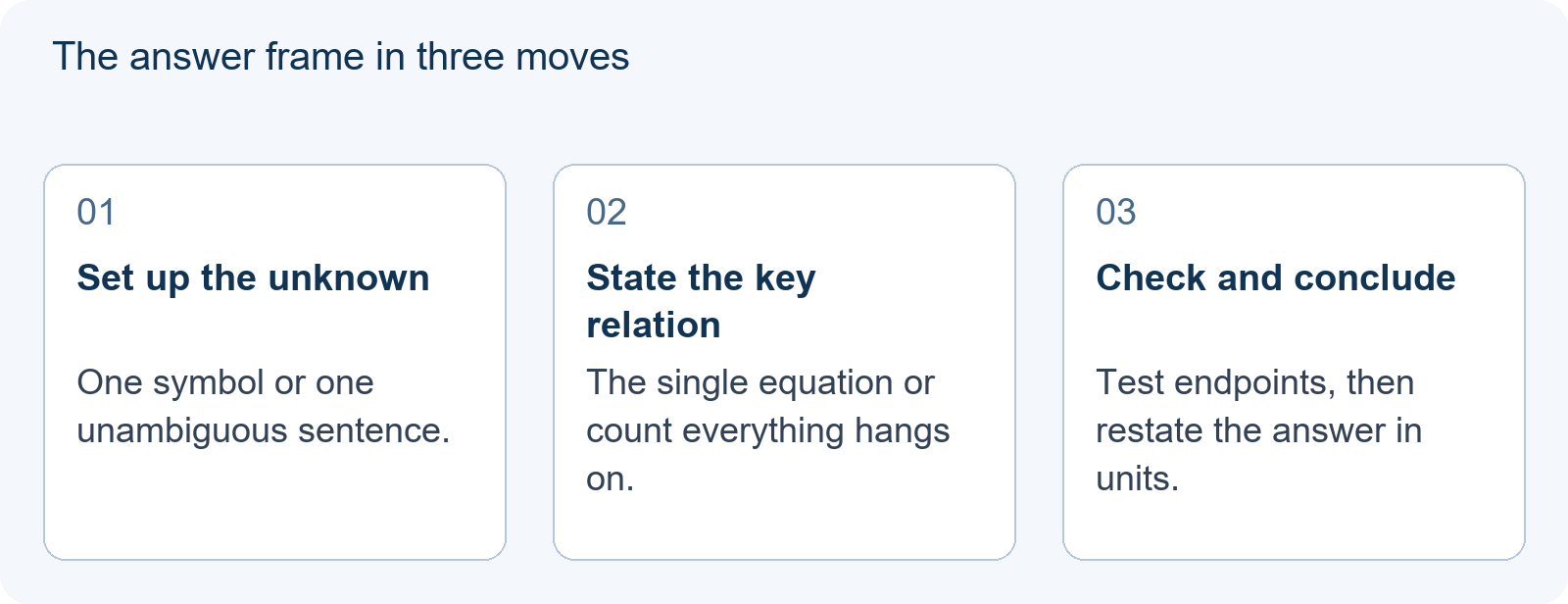
Before any worked example, here is the frame students can reuse across the whole section. It is a teaching device for organising prose, not a claim about how the paper is marked.
- Line 1 — set up. Name the unknown with a symbol or a clean sentence: ‘Let c be the centre entry.’ A reader should know what every later symbol means without guessing.
- Line 2 — key relation. Write the one equation, inequality or counting statement that everything else hangs on. If the student can only produce this line, they still have something worth writing.
- Line 3 — check. Test the endpoints, substitute back, or verify one small case. This is the line that converts ‘I think’ into ‘I know’, and it is the line students skip under time pressure.
- Line 4 — conclusion. Restate the answer in the question’s own units, with the word ‘because’ doing real work: ‘…so the centre must be 5, because any other centre makes the four centre-lines sum to the wrong total.’
The frame is deliberately shorter than a Section C solution: no restatement of the problem, no decorative diagram, no second method. On a five-point question the extra material costs time and can dilute the step that earns the credit.
Teaching illustration: why the centre of a 3×3 magic square must be 5
This is a teaching illustration written for this article. It is not an actual AMO problem and carries no official status.
The setting: a 3×3 grid is filled with the digits 1 to 9, each used exactly once, so that every row, every column and both diagonals have the same total. Prove that the centre square must contain 5. The premise ‘each used exactly once’ is essential; without it nothing follows.
Written as a five-mark-style answer:
- Set up. Let c be the centre entry and let the common total be s. The nine entries add to 1+2+…+9 = 45, and the three rows are three equal totals, so 3s = 45 and s = 15.
- Key relation. Consider the four lines through the centre: the middle row, the middle column, and the two diagonals. Together they cover all nine squares, counting the centre four times and every other square exactly once. Their combined total is therefore 4 × 15 = 60.
- Check. The same combined total can be written as the sum of all nine entries plus three extra copies of the centre: 45 + 3c. Setting 45 + 3c = 60 gives 3c = 15.
- Conclusion. Therefore c = 5. The centre must be 5.
Notice what the answer honestly does not do: it proves the centre is forced to be 5, not that such a square exists. A student who adds one sentence — ‘this establishes necessity only’ — shows that they know the difference between proving a condition and proving existence. That distinction is part of the reasoning.
Teaching illustration: the answer-only script, repaired
A second teaching illustration, not an actual AMO problem.
Question: how many two-digit whole numbers are divisible by 3? A strong student may write a single number and move on. Here is the same result written so it can be checked.
- Set up. A two-digit multiple of 3 has the form 3k with 10 ≤ 3k ≤ 99.
- Key relation. Dividing through gives 10/3 ≤ k ≤ 33, and since k is a whole number, 4 ≤ k ≤ 33. The count is 33 − 4 + 1 = 30.
- Check. 3 × 4 = 12 is indeed the smallest two-digit multiple, 3 × 33 = 99 the largest, and 3 × 3 = 9 and 3 × 34 = 102 fall outside the range. The endpoints are right, so the count is right.
- Conclusion. Exactly 30 two-digit numbers are divisible by 3.
The arithmetic in the repaired version is no harder than in the one-word version. What changed is that a reader can now see the boundary conditions and confirm them independently. That is what ‘checkable’ means in practice, and it is the transferable habit for the whole section.
The stuck-student diagnostic: four states and what to write
Parents often cannot tell whether a frozen child is missing knowledge, missing structure, or missing time. The four states below separate those causes, because each needs a different response.
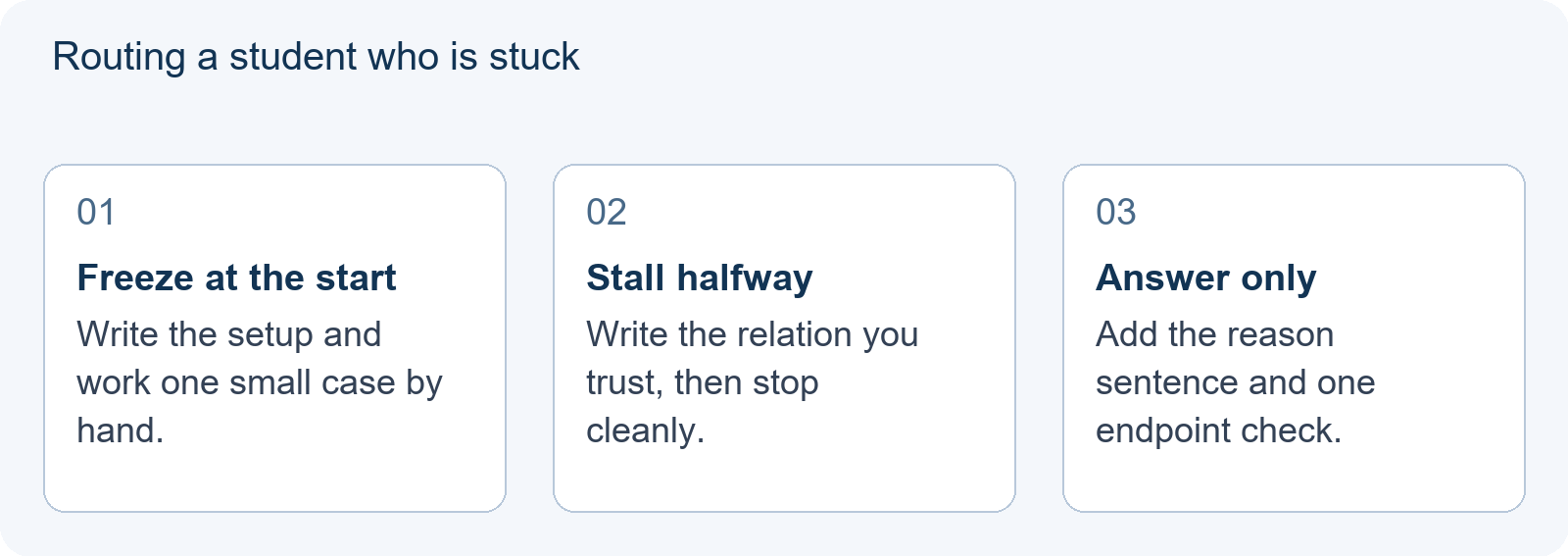
| Symptom | Likely cause | What to write anyway |
|---|---|---|
| No start at all | Cannot see the entry point | The setup line, plus one small case worked by hand |
| Starts, then stalls halfway | Key relation seen but not trusted | The relation as far as it is known, then a clean stop |
| Correct answer, no reasoning | Habit, not knowledge | Insert the check line and one sentence of reason |
| Reasoning right, arithmetic slip | Speed, not understanding | Re-check endpoints before writing the conclusion |
The third row is the first to check, because it can be a habit rather than a knowledge gap. A student who writes only ’30’ is not necessarily weak at counting multiples of 3; they may simply never have been asked to make the answer inspectable. The fourth row is a different problem and does not respond to more explanation of the topic. If the same arithmetic slips recur under time, the pattern is better recorded than re-taught — the The AMO Error Log: A Four-Cause System That Turns Lost Marks Into Points (2026) is a method for doing that on paper.
Time: six to eight minutes a question, and where it comes from
The paper allows 90 minutes for 25 questions and 100 points, so the average is 0.9 minutes per point across the whole paper. That average is not a plan. A workable starting point, offered as coaching judgment rather than official guidance, is to protect about 30–35 minutes for Section B, because five questions at roughly six to seven minutes each already use that much. Keep Section A brisk enough to fund that block, and do not raid Section C to finish Section B: the six-point questions sit at the end, and time taken from them is taken at the worst moment.
Inside the Section B block, a five-point question is a six-to-eight-minute job if it includes a check: about two minutes to find the relation, three to write it, one to check, and one to conclude. The average across five questions should be nearer six minutes so that one hard question can take eight without breaking the plan. If the relation has not appeared after two minutes, write the setup and a small case and move on — the setup is not wasted, and returning later with fresh eyes is often faster than staring. Practise the timing under real conditions with a full timed paper.
A practice routine that takes twenty minutes a week
One open question a week, done twice, is enough to build the habit — provided the second attempt is a rewrite and not a re-solve.
First attempt: time it, write it as an exam answer, do not look anything up. Then wait a day. Second attempt: rewrite the same solution using only the four-line frame, without re-deriving anything. The rewrite is short by design; if it fits in six lines, the frame worked. Finally, compare the two versions side by side and ask one question: which line in the rewrite is doing the real work? If the answer is ‘the conclusion’, the reasoning is still missing. If it is ‘the key relation’, the answer is now checkable.
Students whose block is reading the question rather than writing the answer should work on that separately; it is a comprehension problem before it is a writing problem. Keep the weekly rewrite in one notebook so that a month of work becomes visible as a trend rather than a set of isolated attempts.
Preparing for a reasoning-focused consultation
If the diagnosis above is unclear, the most useful thing to bring to a one-to-one session is evidence, not a description. Bring one completed Section B practice answer written under time, and one rewritten version of the same question. Two pages of a student’s own handwriting reveal more than a conversation about confidence: they show whether the setup appears, whether the key relation is visible, whether a check exists, and whether the conclusion restates the answer in the question’s units.
Also useful: the specific question where the student stopped, and a note on where in the six-to-eight-minute window the stop happened. A student who stalls at minute two has a different problem from one who stalls at minute six, and only one of them needs more topic teaching. With those three items — a timed answer, a rewrite, and a stop-point — a tutor can aim the session at structure, at arithmetic reliability, or at reading, instead of guessing.
Section B is small: five questions, 25 points, perhaps 30–35 minutes of a 90-minute paper. It is also the section where a student’s writing habits are most exposed, because there is no option list to hide behind and no long solution to hide inside. A four-line answer, checked at the endpoints, is a modest piece of work. It is also a reliable way to turn a partly-solved question into a scoreable one.
General event background is available at Event background.
Frequently Asked Questions
How many questions are in AMO Section B, and how much is it worth?
Section B is the five open questions worth 5 points each, so 25 of the paper’s 100 points. It sits inside a 25-question, 90-minute paper for Grades 2–12, after 15 three-point multiple-choice questions and before five six-point open questions. The paper carries no negative marking.
Does a wrong final answer lose marks in a Section B question?
The paper has no negative marking, so a wrong answer does not subtract points. Beyond that, we do not state partial-credit rules as official. The practical consequence is to write the setup, the key relation and the check as separate lines, so that the reasoning is visible even when the final number is not yet secure.
Should a student answer Section B before Section C?
The paper notes used here do not state a required order, so treat the order as exam technique rather than an official rule. Section B questions carry fewer marks, so a student who is confident there can bank them quickly and return to the six-point questions with time in hand. A student who is slow on written work should consider starting Section C early rather than risking the last questions in a hurry. Either way, keep roughly six minutes on average per five-point question, with a hard stop at eight minutes on any one question.