
Students preparing for the AMO Results: Choosing Your Next Maths Competition and Preparation Step often default to finding common denominators for every fraction comparison. That habit is safe, but it is not always efficient. In a timed competition with 25 questions across 90 minutes, the extra seconds spent on unnecessary calculation can cost you the chance to check harder problems later.
Why the Common Denominator Becomes a Trap
The common denominator method works because it converts fractions to the same unit. Once denominators match, you simply compare numerators. The trap appears when students apply this method reflexively, even when a faster path exists. In competition-style problems, fractions are often chosen so that cross-multiplication, benchmark comparison, or unit-fraction reasoning resolves the question more quickly.
A useful teaching observation is that students who drill “always find the LCD” without decision practice often stall on problems where the numbers are deliberately friendly to a different approach. The goal is not to abandon common denominators, but to choose the right tool for the specific numbers in front of you. This flexible approach to strategy selection is a skill that develops through deliberate practice with varied problem types.
Case 1: When a Shortcut Wins
Teaching illustration—hypothetical problem for strategy practice.
Suppose you need to compare these two fractions:
Compare 7/12 and 5/8
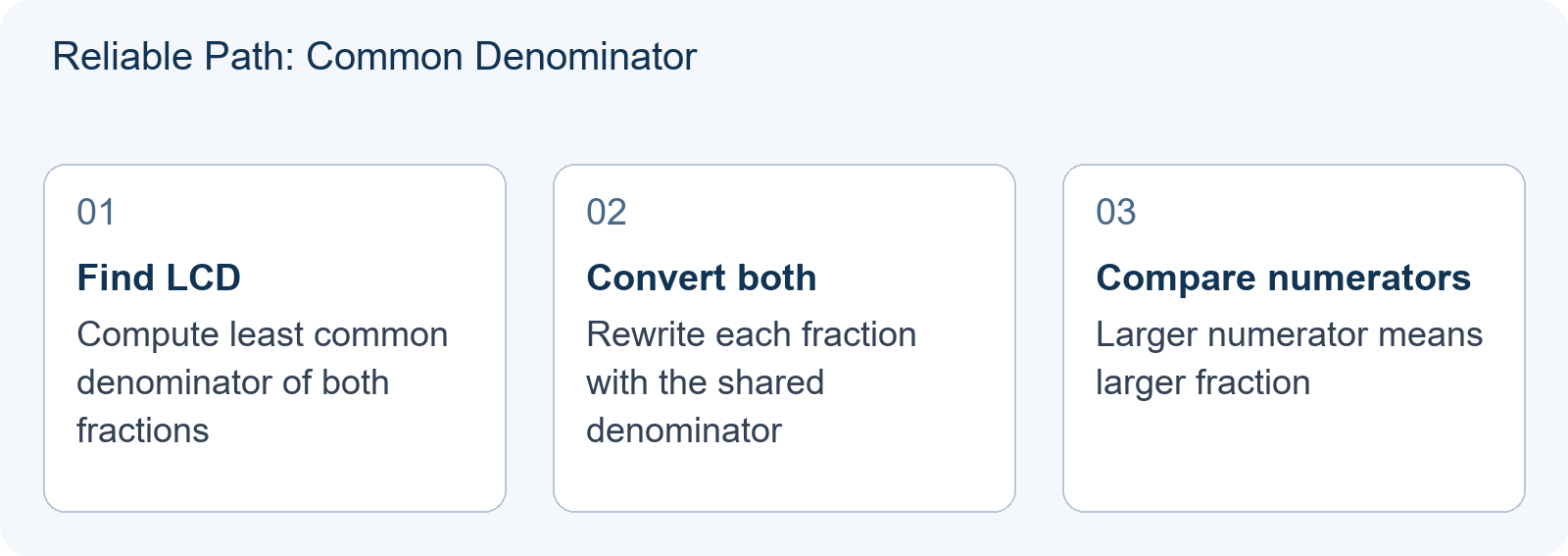
A student using the common denominator method would find the least common denominator of 12 and 8, which is 24. Then:
- 7/12 = 14/24
- 5/8 = 15/24
So 7/12 < 5/8. This is correct, but it required finding the LCD and converting both fractions.
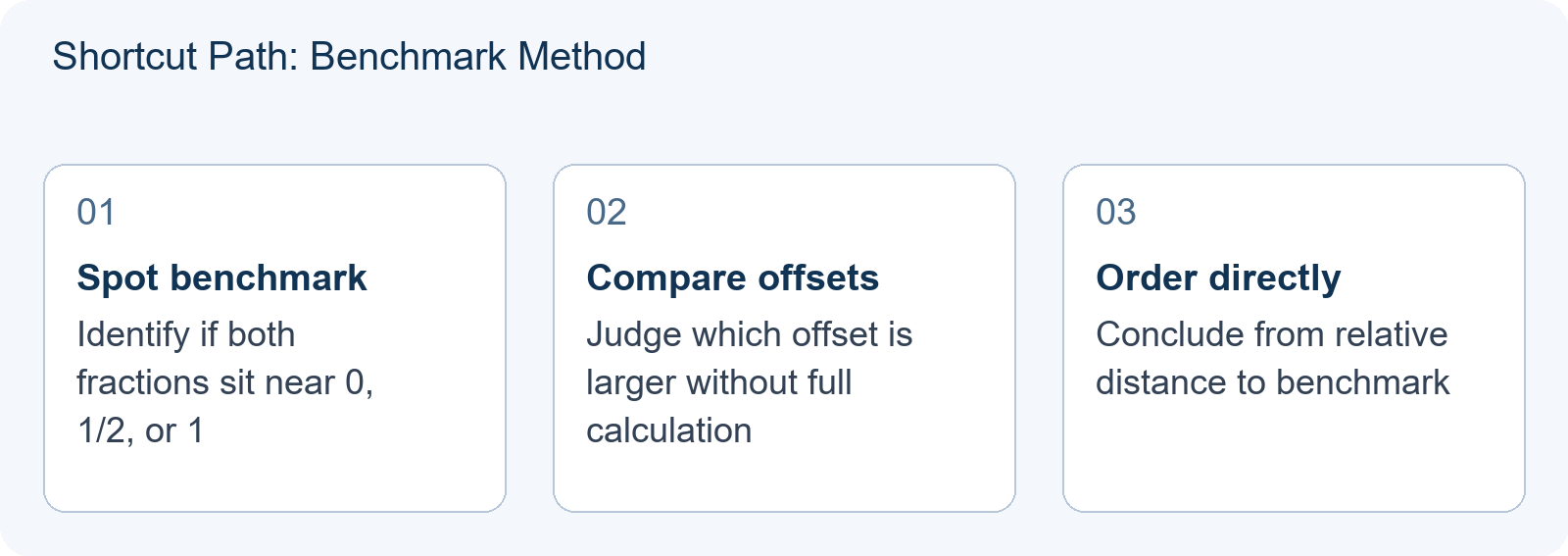
Now consider a faster path using benchmark reasoning. Notice that 7/12 is one-twelfth above 6/12 (which equals 1/2), while 5/8 is one-eighth above 4/8 (which also equals 1/2). Compare the distances above one-half: 1/12 versus 1/8. Since 1/12 < 1/8, the fraction 7/12 is closer to one-half from above, meaning it is smaller than 5/8. The same conclusion, reached without ever finding 24.
This shortcut works because both fractions sit on the same side of a clean benchmark (1/2), and their offsets have an obvious size relationship. The key insight is recognizing when numbers align with familiar reference points.
Case 2: When the Shortcut Fails and Common Denominators Save You
Teaching illustration—hypothetical problem for strategy practice.
Not every problem yields to benchmark reasoning. Consider:
Compare 5/9 and 7/11
Attempting benchmark reasoning: both are above 1/2, but their distances from 1/2 are 1/18 and 3/22. Those offsets are not obviously ordered without calculation. You might try cross-multiplication: 5 × 11 = 55 and 7 × 9 = 63, so 5/9 < 7/11. That is efficient here.
But suppose the problem were:
Compare 4/15 and 3/10
Benchmark reasoning again struggles: 4/15 is slightly below 1/3, and 3/10 is also slightly below 1/3. The offsets from 1/3 are not immediately illuminating. Cross-multiplication gives 4 × 10 = 40 and 3 × 15 = 45, so 4/15 < 3/10. Alternatively, the common denominator of 30 yields 8/30 versus 9/30—clean and decisive.
The lesson: when neither benchmark nor cross-multiplication offers a clear advantage, the common denominator becomes the reliable fallback rather than the reflexive first move.
Diagnostic Decision Table
| Situation | Try First | Why |
|---|---|---|
| Both fractions near 0, 1/2, or 1 with obvious offsets | Benchmark reasoning | Avoids any multiplication |
| Simple cross-products under 100 | Cross-multiplication | Two products, direct comparison |
| One denominator divides the other easily | Quick common denominator | Only one fraction changes |
| Awkward offsets, no clean benchmark | Full common denominator | Guaranteed systematic path |
Building the Decision Skill
Flexible number sense matters in competition mathematics more than mechanical repetition. To develop this flexibility, practice with a deliberate pause: before calculating, ask which path the numbers invite. A suggested training sequence for individual or classroom use:
- Work five comparison problems using only benchmark reasoning, even if common denominators feel safer.
- Work five more using only cross-multiplication, timing yourself against the benchmark method.
- Finally, work five problems where you must choose the method before starting—no switching mid-problem.
This builds the ability to match a strategy to a problem, not just execute a strategy correctly. Teachers and parents can support this by encouraging students to explain their choice of method before beginning calculation, reinforcing the decision-making process rather than focusing solely on correct answers.
What to Demonstrate Next
After working through these cases, a learner should be able to: look at two fractions, identify whether a benchmark or cross-multiplication offers a faster path than common denominators, execute that path correctly, and recognize when the common denominator is genuinely the cleanest choice. This decision step is what separates routine arithmetic from competition-ready reasoning.
For broader context on how AMO problems layer skills across grade levels, see the AMO Results: Choosing Your Next Maths Competition and Preparation Step. If you are earlier in preparation, the Common AMO Mistakes: Why Students Lose Marks — and How to Fix Each One (2026) covers errors that cost marks across all problem types. For format-specific questions, the AMO Online vs Paper: Which Test Format Should Your Child Take? explains how test delivery affects preparation.
Remember that the AMO format—25 questions in 90 minutes, with no penalty for wrong answers—rewards both accuracy and efficient time use. Strategy selection in fraction comparisons is one small place where those minutes add up. Developing awareness of when to use each method is a practical skill that improves with intentional practice.
Frequently Asked Questions
Should I ever skip finding common denominators entirely?
No. Common denominators remain a reliable fallback when benchmarks are unclear and cross-products are messy. The goal is to choose faster methods when the numbers allow, not to avoid the standard method altogether.
How do I know if cross-multiplication is faster than common denominators?
Estimate the products mentally. If both products are under 100 and easy to compute, cross-multiplication is usually faster. If one product is large or awkward, finding a common denominator may be cleaner.
Does AMO allow calculators during the test?
The AMO competition is administered online or as an in-school paper-based test. Specific tool policies vary by administration setting. Students should prepare to solve fraction comparisons using mental math and written work, as this builds the number sense tested in the competition.