
A “greatest possible” or “least possible” question is two questions in one. You must find an arrangement that reaches a value, and you must show that no arrangement beats it. Students who do only the first half write down the first large number they find; students who do only the second half prove a limit nobody can reach. The reliable routine is bound, then build — and keep working until the two meet.
Why the first answer you find is rarely the best one
Try this before reading on: split 10 into positive whole numbers, as many as you like, so that their product is as large as possible. A natural first try is 5 + 5, which gives 25. It feels balanced and final. It is not close.
Keep experimenting and the product climbs. Five 2s give 32; 3 + 3 + 4 gives 36, and so does 3 + 3 + 2 + 2. The first attempt was a genuine example — a build — but nothing about it showed that better builds did not exist. That is the whole trap in one question, and it is why greatest-and-least questions reward a routine rather than a hunch.
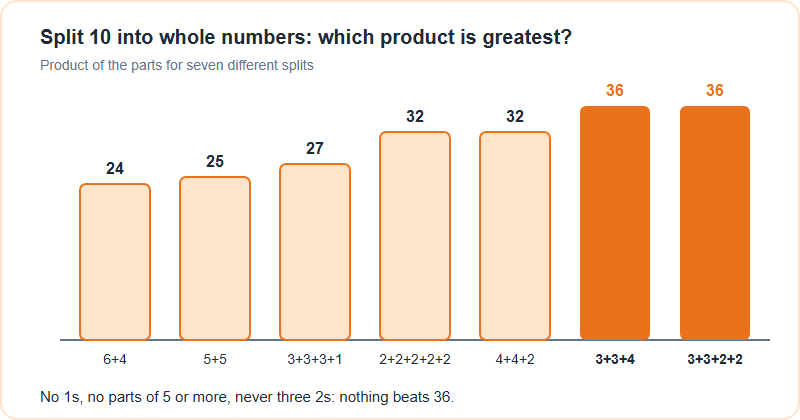
Why can nothing beat 36? Three short arguments settle it. A part equal to 1 never helps, because adding that 1 to another part makes the other part bigger and the product larger. A part of 5 or more should always be split into 2 and the rest, because 2 × (n − 2) is larger than n whenever n is bigger than 4. And three 2s lose to two 3s: both add up to 6, but 2 × 2 × 2 = 8 while 3 × 3 = 9. So the best split uses 3s with at most two 2s, and a 4 counts as 2 + 2. For a total of 10 that forces 3 + 3 + 2 + 2, or equivalently 3 + 3 + 4: product 36. Now the bound and the build agree, and only then is the question finished.
Bound, then build: the two-part routine
Every greatest-or-least question can be run through the same three moves.
- Bound. Find a reason the answer cannot pass some value. The usual sources are counting (“at most one from each pair”), size (“three different digits add up to at least 3”) and budget (“one pack holds at most 6”).
- Build. Produce an explicit example that reaches a value, written out in full so it can be checked against every condition in the question.
- Compare. If the bound and the build meet, stop: that value is the answer. If they do not, either the bound is loose or the build can improve, and the gap tells you where to push.
Worked example: what is the largest four-digit number whose digits are all different and add up to 10? Start with the bound. The last three digits are all different, so the smallest they can add up to is 0 + 1 + 2 = 3, which means the first digit is at most 10 − 3 = 7. A first digit of 8 or 9 is impossible however the rest are arranged. Now build: with a 7 in front, the other three digits must be different and add up to 3, which forces 2, 1 and 0, and the largest arrangement of those is 7210. The build reaches the bound, so 7210 is the answer.
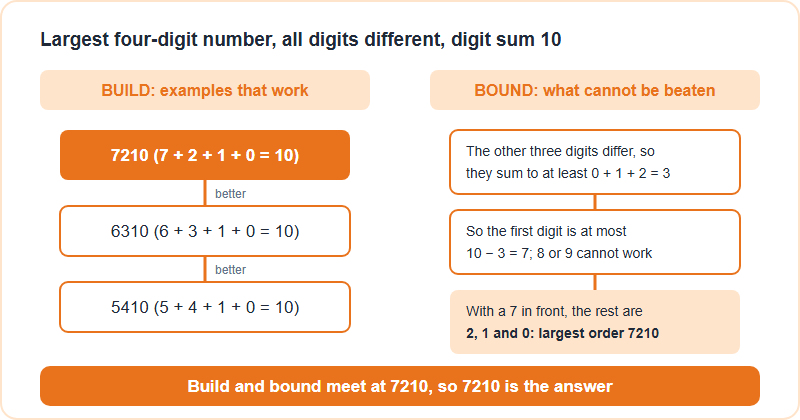
Notice what a loose bound looks like. “The first digit is at most 9” is true, but you cannot build anything starting with 9 or 8, so the attempt to build is what forces the bound down to 7. The two halves work on each other: a failed build exposes a weak bound, and a sharp bound tells you which builds are worth trying.
Least-possible questions run the same way from the other side. Stickers come in packs of 1, 4 and 6: what is the fewest packs that give exactly 8 stickers? Taking the biggest pack first gives 6 + 1 + 1, three packs, but 4 + 4 needs only two. And one pack holds at most 6, fewer than 8, so at least two packs are needed. Bound and build meet at 2.
Five shapes of greatest-and-least question
The stories vary endlessly, but most questions in this family fall into a handful of shapes, each with a favourite kind of bound. The examples below were written for this guide, some along classic textbook lines; which shapes appear at which level on a given paper is the organiser's decision.
| Shape | Example | Bound move | Build | Answer |
|---|---|---|---|---|
| Digit arrangements | Largest four-digit number with different digits adding up to 10 | Three different digits add up to at least 3, so the first digit is at most 7 | 7, then 2, 1, 0 | 7210 |
| Fixed sum, best product | Positive whole numbers adding up to 10 with the greatest product | No 1s, no parts of 5 or more, never three 2s | 3 + 3 + 2 + 2 | 36 |
| Fewest pieces | Packs of 1, 4 and 6 making exactly 8 | One pack holds at most 6 | 4 + 4 | 2 packs |
| Most items under a rule | Choose numbers from 1 to 20 with no two chosen numbers consecutive | Pair 1–2, 3–4 and so on up to 19–20: at most one from each of the 10 pairs | All ten odd numbers | 10 |
| Shapes with a fixed measurement | Rectangle with whole-number sides, perimeter 20 cm, greatest area | Length and width add up to 10, and two whole numbers adding up to 10 multiply to at most 25 | A 5 cm by 5 cm square | 25 square cm |
The pairing idea in the fourth row deserves a second look, because it turns an intimidating “at most how many?” into a one-line bound. Split the numbers into groups from which you can use at most one each; the number of groups is your bound. Then find a selection that takes exactly one from every group. A close cousin, the “how many must you take to be certain?” question, uses worst-case thinking instead and belongs with pigeonhole problems in our counting and probability guide.
The traps: greedy choices, forgotten conditions and the square that counts
Greedy choices. Taking the biggest piece first is a build, not a proof. Sometimes it happens to be right: with packs of 1, 2 and 5, the fewest packs for 18 is 5 + 5 + 5 + 2 + 1, five packs. You still need the bound. With only four packs, reaching 18 would need at least three 5s — without them, four packs make at most 5 + 5 + 2 + 2 = 14 — and then the fourth pack would have to be a 3, which does not exist, while four 5s make 20. So four packs cannot work, and five is the least. With packs of 1, 4 and 6 the same greedy habit gave the wrong answer, which is why the bound is never optional.
Forgotten conditions. Words such as “whole”, “different”, “positive” and “at least one of each” change answers. If the parts of 10 may be any positive numbers rather than whole numbers, 36 is no longer the maximum: four equal parts of 2.5 give 2.5 × 2.5 × 2.5 × 2.5 = 39.0625. For older students the governing fact is that, with a fixed sum and a fixed number of parts, the product is largest when the parts are equal, so the only question left is how many parts to use. Underline every condition before you build anything.
The square that counts. In the rectangle question, some students rule out the square and answer 24 from a 6 by 4 rectangle. In standard mathematics a square is a rectangle, and the Common Core says so directly in its Grade 5 geometry standard 5.G.B.3. Unless a question says the sides must differ, the 5 by 5 square is allowed and the answer is 25.
Stopping at the bound. A bound on its own is a claim, not an answer. If you cannot build an example that reaches it, suspect the bound before you suspect the question, and look for the condition that pulls it down — exactly as the digit example forced 9 down to 7.
Training the habit, band by band
The routine only becomes automatic when it is written out every time in practice, even when the answer seems obvious. Two habits do most of the work.
- The two-line rule. Under every greatest-or-least answer, write “Reached by” followed by the example, and “Cannot beat because” followed by the reason. If the second line will not come, the answer is not finished.
- The sixty-second attack. After finding an answer, spend one minute trying to beat it. Either the build improves, or the reason you failed becomes your bound.
The family grows with age. These are the preparation bands we use for our own planning rather than an official structure, so match practice to your child's level with our AMO grade levels guide.
- Primary, around Grades 2–5: largest and smallest numbers from digit cards, fewest coins or packs from small sets, and “at most how many?” questions explored with real objects before any pairing argument.
- Middle, around Grades 6–8: products with a fixed sum, greedy failures, rectangles with a fixed perimeter, and pairing bounds written as a single sentence.
- Senior, around Grades 9–12: continuous versions where equal parts maximise a product, inequalities used as bounds, and optimisation under several conditions at once.
Finally, where this sits. AMO, the American Mathematics Olympiad, is run by SIMCC in Singapore together with Southern Illinois University for Grades 2 to 12, and Southern Illinois University describes its papers as aligned with the US Common Core; our guide to what AMO is explains the set-up. It is not the AMC of the Mathematical Association of America. Greatest-and-least reasoning turns up across competition mathematics whoever the organiser is, but format and marking are contest-specific, so read how AMO scoring works and confirm current rules on the official pages before deciding how much time a two-sided check deserves on the day.
Frequently asked questions
What does a greatest-possible question ask me to show?
Two things: an example that reaches the value, and a reason nothing can beat it. Leaving out either half is how wrong answers happen.
Does taking the biggest piece first always give the fewest pieces?
No. With packs of 1, 4 and 6, biggest-first makes 8 as 6 + 1 + 1, three packs, but 4 + 4 needs only two packs.
How is this different from a pigeonhole question?
Pigeonhole questions ask what must be true even in the worst case. Greatest-and-least questions ask for the best value that can be reached.
Does a square count as a rectangle in these questions?
Yes, unless the question says the sides differ. The Common Core states that squares are rectangles, so a 5 by 5 square can be the answer.
This site is operated by Hanlin Education as an authorized AMO registration partner for China. AMO (the American Mathematics Olympiad) is run by SIMCC in Singapore together with Southern Illinois University (SIU); it is not the MAA's AMC. We are not the organiser. Topic coverage, paper format, marking and dates are set by the organiser and can change, so confirm details on the official SIMCC / AMO pages. All worked examples in this article were written for this guide; the split-10 product question and its argument follow a classic textbook problem. Any factual error will be corrected within 7 working days.