
A student who is top of the class in school maths can still find AMO hard, and it is almost never a sign that they are “not a maths person”. School maths mostly asks students to execute a method that has just been taught. Competition maths asks them to choose one that has not. That is a different skill, it is trainable, and this is how to close it.
Exercises and problems are not the same task
In a school lesson, a question usually arrives with its method attached. The chapter is called “percentage change”, the worked example is on the board, and the exercise underneath is the same shape with different numbers. Doing it well requires accuracy, care and fluency — genuinely valuable things, and exactly what a report card measures.
A competition question arrives naked. There is no chapter heading, no worked example, and often no signal at all about which branch of maths it belongs to. The student's first job is not to calculate; it is to work out what kind of question this is. Mathematicians call the first kind an exercise and the second a problem, and the gap between them is where most confident students lose marks.
This matters for AMO specifically because it spans Grades 2 to 12 and builds its items on the U.S. Common Core State Standards and then extends them, so familiar topics arrive in unfamiliar forms. A student can have met every topic on the paper at school and still be doing something unfamiliar with them. (For orientation, see what AMO is. AMO is organised by SIMCC in Singapore together with Southern Illinois University Carbondale — it is not the AMC, which is a separate competition run by the MAA in the United States. Paper structure and question counts are set by the organiser and vary; confirm on the official AMO pages.)
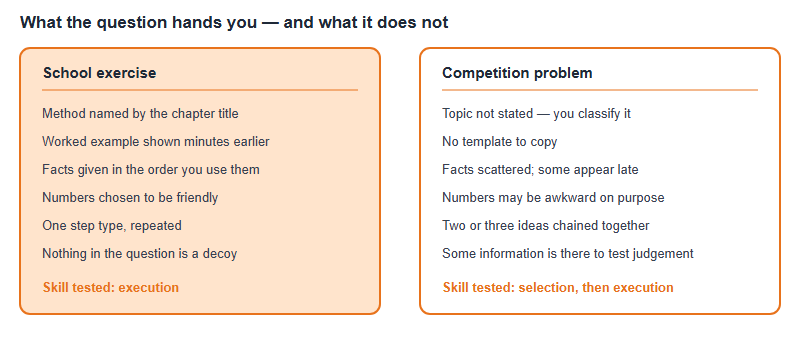
The five differences that do the damage
| Difference | What it looks like in the paper | Why a strong school student trips |
|---|---|---|
| Unstated topic | Nothing tells you whether this is a ratio question, a counting question or a number question | They have practised retrieving a method by heading, never by inference from the wording |
| Multi-step chaining | The output of step one is the input of step two, and the question only asks for the end of step three | Each step is easy alone; holding three together is a separate skill that school exercises rarely stretch |
| Unfamiliar packaging | A standard idea dressed as a puzzle about seats, coins, handshakes or digits | They recognise the textbook costume, not the idea underneath it |
| Deliberate distractors | A number in the stem that is not needed, or a condition that only bites at the end | School questions have no spare parts, so students assume every number must be used |
| No permission to be stuck | The first thirty seconds produce no method at all | A student used to instant recognition reads being stuck as failure and freezes instead of experimenting |
The last row is the one families underestimate. For a student who has never in their life read a maths question without immediately knowing what to do, thirty seconds of blankness is emotionally significant. They interpret it as evidence about themselves rather than as the normal opening phase of a hard problem. Competitive students learn a different reading of that same moment: this is the part where I try things.
Diagnose before you buy more practice
“Do more practice papers” is the standard response and it is often the wrong one, because four quite different failures look identical on a results sheet. Sit with the student and one marked paper, and for each lost mark work out which of these four it was. Ten minutes of this is worth more than a month of undirected practice.
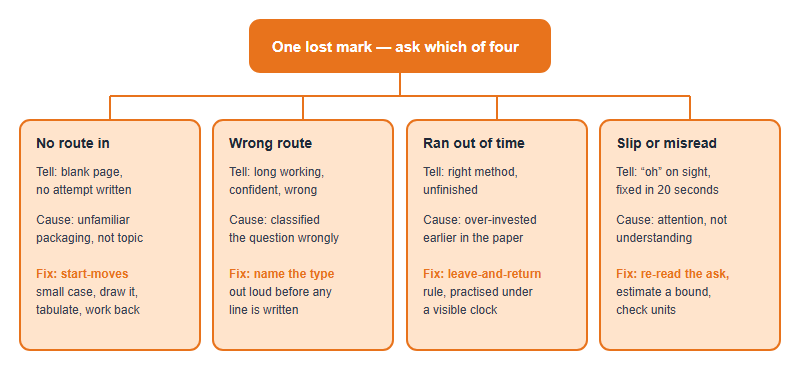
In the practice papers we mark for students who arrive with strong school grades, the first two columns, and then the fourth, are the ones we see most often, while genuine “never met this topic” failures are comparatively rare. That is encouraging news, because the first two columns respond to a specific kind of training rather than to more content.
A six-week bridge from exercises to problems
The training principle is uncomfortable and simple: the student must spend regular time on questions where nobody tells them the method, and must be allowed to be stuck without rescue. Every time an adult supplies the first step, the exact skill being built is removed from the session.
- Weeks 1–2 — one problem a day, ten-minute rule. One unfamiliar question, ten minutes on a timer, no help and no looking anything up. If it is unsolved at ten minutes, stop and write one sentence: what I tried and where it broke. That sentence is the point of the exercise, not the answer.
- Weeks 3–4 — classify before you compute. Same daily problem, but first the student says aloud what type of question it is and which start-move they are choosing: try a small case, draw it, make a table, work backwards, look for what stays the same. Naming the move converts guessing into a repeatable decision.
- Week 5 — read solutions as a skill. Take three problems already attempted and study full solutions properly: for each line, ask “what would have made me think of that?” Reading a solution to feel finished teaches nothing; reading it to harvest the trigger teaches a lot.
- Week 6 — mixed sets under a clock. Six to eight problems from different areas in one sitting, so the student must classify cold, with no topic cue. This is the closest simulation of the real difficulty, and it is where the earlier weeks show up.
Two guardrails. Practise at the level the student will actually sit — working a band above inflates the “no route in” count and teaches helplessness rather than technique (see AMO grade levels explained, and confirm the current arrangement officially). And keep sessions short. A daily ten-minute problem sustained for six weeks beats a three-hour Sunday marathon, because the skill being built is a habit of approach, and habits are built by repetition rather than by duration.
What parents should — and should not — conclude
Do not conclude that a mismatch between school grades and a competition result says something about ability. The two measure different things; a high school-maths grade with a modest competition score is one of the most common profiles there is, and it usually describes a well-taught, careful student who has simply never been asked to select a method before.
Do not conclude the opposite either. A strong competition result does not mean the student should be accelerated at school, and it is not a prediction about anything in particular. It means they enjoyed an unfamiliar puzzle and had time to think.
Be careful reading a single year's result too closely. AMO awards are percentile-based, so an outcome reflects how the whole cohort performed in that season as well as how the student did — see how AMO scoring works, and confirm current award arrangements on the official pages. A student can improve genuinely and land in a similar band, or hold steady and move. Judge progress by whether the “no route in” column is shrinking on their own practice papers, which is a measure you control and can see every week.
Finally, protect the student's relationship with the subject. The purpose of a competition at Grades 2 to 12 is to give a child the experience of thinking hard about something genuinely interesting and finding a way through. A family that treats a bronze-band result as a failure teaches a child that unfamiliar problems are dangerous — which is precisely the belief the non-routine gap is made of.
Frequently asked questions
My child gets top marks at school but struggled in AMO. Is something wrong?
No. School maths mostly tests executing a taught method; competition maths tests choosing one. The second skill is trainable and simply untrained.
Should we skip ahead to harder material to close the gap?
Usually not. The gap is about unfamiliar question types, not missing content, so mixed non-routine practice at the current level works better.
How long should a student sit with a problem before getting help?
About ten minutes, then write down what was tried and where it broke. Being stuck productively is the skill being built.
Is AMO the same as the AMC?
No. AMO is run by SIMCC in Singapore with SIU for Grades 2 to 12; the AMC is a separate competition run by the MAA in the United States.
This site is operated by Hanlin Education as an authorized AMO registration partner for China. AMO (American Mathematics Olympiad) is run by SIMCC (Singapore International Math Contest Centre) together with Southern Illinois University Carbondale; we are not the organiser and do not speak for it. Contest dates, eligibility, paper structure and award arrangements are set by the organiser and can change between seasons — confirm all details on the official SIMCC / AMO pages or through your registration channel. Factual errors are corrected within 7 working days of being reported.