
In the last two weeks before an AMO sitting, almost nothing new can be learned well enough to be trusted under time pressure — but plenty of existing accuracy can be lost. This is a taper: fourteen days that convert what a student already knows into marks, with timed sets first, error-log revision second, and a deliberately light final 48 hours.
Why the final fortnight is for sharpening, not learning
Serious preparation has a build phase — weeks of new topics, slow problems, and getting things wrong on purpose. That phase has a natural end, and it is roughly two weeks before the paper. After that point, a topic met for the first time behaves badly: it is recognisable but not reliable, so a student spends four minutes on a question they half-remember instead of two minutes on three questions they own.
The failure pattern is consistent. A student notices a weakness in the final ten days, panics, and spends the remaining time in the one area where they are least fluent. The paper arrives and the weakness is still a weakness, while the strengths have gone quietly rusty from neglect. A taper inverts this: it protects fluency, narrows the material, and reduces volume as the date approaches, so the student meets the paper sharp rather than saturated.
Set your own dates by counting backwards from your sitting. AMO's contest dates, registration windows and paper structure are set by the organiser and change from season to season, so confirm yours on the official AMO pages or through your registration channel before building a calendar around it. (For orientation on the competition itself, see what AMO is. AMO is run by SIMCC in Singapore together with Southern Illinois University Carbondale for Grades 2 to 12 — it is not the AMC, which is a separate competition run by the MAA in the United States.)
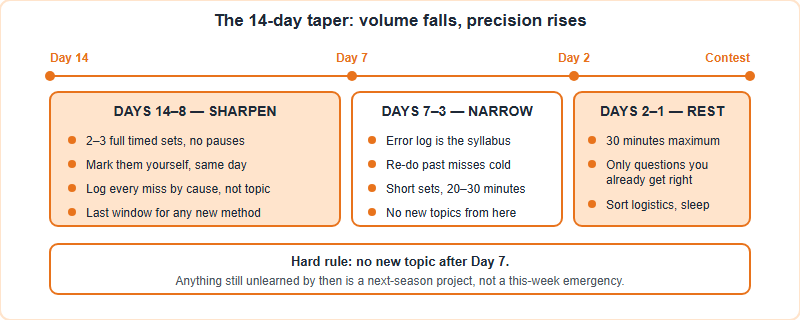
Days 14 to 8: full sets, timed, marked the same day
This week is about running the whole distance, not about topics. Two or three complete practice sittings, each done in one uninterrupted block with a clock visible, is more valuable than fifteen scattered problem sessions. Sit at a table, not a bed. Do not look anything up mid-paper. Do not pause the timer to think.
The marking matters more than the sitting. Mark it yourself, on the same day, while you can still remember what you were thinking — a paper marked three days later teaches almost nothing, because the reasoning that produced each error has evaporated. Then log every miss by cause rather than by topic. Most students write “geometry” in their notes. That is not actionable. These four labels are:
- Timing — I never reached it, or I reached it with two minutes left.
- Misread — I solved a slightly different question from the one printed.
- Slip — correct method, arithmetic or transcription error.
- Gap — I had no route into the question at all.
In most logs we see, the first three labels together outnumber the fourth. That is good news, because timing, misreads and slips all respond to two weeks of work, whereas gaps mostly do not. Practise at the level you will actually sit, too — drilling a band above yours inflates the gap count and tells you nothing useful (see AMO grade levels explained, and confirm your level officially).
Days 7 to 3: the error log becomes the entire syllabus
Now stop covering ground. For these five days the only material is the questions you have already got wrong — from this fortnight's timed sets and from the weeks before. Nothing else. It feels unproductive, which is exactly why most students skip it and keep opening new material instead.
Re-do each logged question cold: blank paper, no glance at the previous attempt, no worked solution nearby. A question you can only solve while looking at your old working is not yet learned. Aim for short sessions, twenty to thirty minutes, with a clear stopping point. Two of those a day beats one ninety-minute session, because attention decays and late-session practice teaches sloppiness.
Attack the labels in this order, because the return per hour is steepest at the top:
- Slips first. They are the cheapest marks in the whole preparation. Usually the fix is mechanical: write the working down the page instead of across it, keep one line per step, and copy the number from the question rather than from memory.
- Misreads second. Build the habit of underlining the final noun in every question before starting — how many students, how many ways, the probability, the 20th term. Ten seconds per question.
- Timing third. Practise the skip decision as a skill in its own right (below).
- Gaps last, and only if genuinely quick. If a gap can be closed in one sitting, close it. If it needs a week, let it go.
| Days out | Main activity | Session length | Explicitly avoid |
|---|---|---|---|
| 14–12 | Full timed set + same-day marking + cause log | One full sitting, plus 30 min review | Looking up solutions mid-paper |
| 11–9 | Second full timed set; last window for a genuinely new method | One full sitting, plus 30 min review | Starting a topic you have never met |
| 8 | Optional third timed set, or a half-length set | 45–60 min | Two full papers in one day |
| 7–5 | Re-do logged slips and misreads, cold | 2 × 25 min | Any new topic; any new resource |
| 4–3 | Re-do logged timing questions; practise skipping | 2 × 25 min | Marathon sessions; late nights |
| 2 | Light mixed set of questions you already get right | 30 min maximum | Anything that could shake confidence |
| 1 | Confirm timing and arrangements; sleep normally | 0–20 min | Discovering a new weakness |
Practising the skip — a 30-second decision, not a 4-minute failure
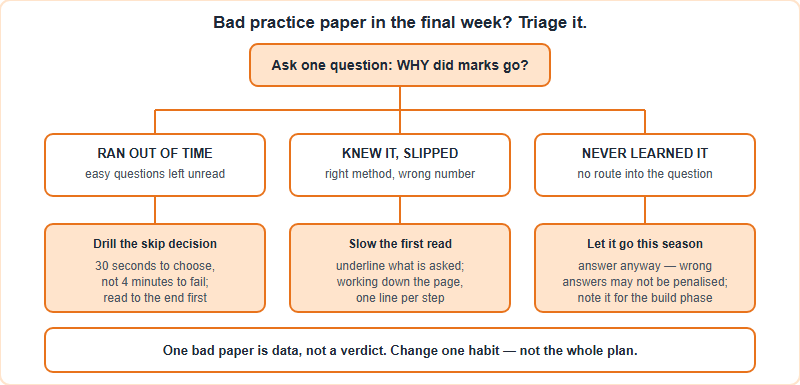
Timing losses are almost never caused by working slowly. They are caused by staying too long on one question. A student who spends seven minutes on a problem they were never going to finish has not lost one question; they have lost three, because the two easy questions at the end went unread.
Train the decision explicitly. Give yourself thirty seconds per question to answer one thing: do I have a route in? If yes, commit and finish it. If no, mark it and move on immediately — not after “just one more idea”. Come back only when everything you can do is done.
Skipping is cheap wherever a paper carries no penalty for wrong answers — confirm the current marking rules for your sitting on the official AMO pages, and see how AMO scoring works. That means the correct endgame is mechanical: with a few minutes left, make sure every question carries your best answer rather than a blank. Practise this in your Days 14–8 sittings, so that on the day it is a routine rather than a scramble.
When a practice paper goes badly in the final week
It happens often, and it is the most dangerous moment in the taper, because the natural response — abandon the plan, study harder, start something new — is exactly wrong. One paper is a sample of one, taken on one afternoon, under conditions that may have included a bad night's sleep. Treat it as data and triage it.
The final 48 hours, and the morning itself
Two days out, cap study at thirty minutes and choose questions the student reliably gets right. The purpose is not revision; it is walking into the room with recent memories of success rather than recent memories of struggle. Discovering a new weakness at this point cannot be acted on and can only cost sleep.
Use the spare time on arrangements instead — confirm the sitting time, the venue or platform, and what is permitted in the room with your school or registration channel, since these are set by the organiser and can differ by year and location. Getting this settled early removes the most avoidable source of contest-morning stress.
On the morning, do a warm-up rather than a revision session: three or four easy questions, twenty minutes before starting, purely to get the pen moving and the arithmetic awake. No new material, no difficult problems, no checking whether a shaky topic has magically become solid. In the questions we field from families each season as an authorised AMO registration partner in China, the most common last-minute request is for “a few more hard problems the night before”. It is the one request worth declining — the last night is for sleep, and the fortnight before it is where the marks were always going to be made.
Frequently asked questions
Should my child sit a full practice paper the day before AMO?
No. A full sitting the day before adds fatigue and risks a confidence knock with no time to respond. Keep the last two days light.
Is it too late to learn a new topic ten days out?
Usually yes. After Day 7 a half-learned topic costs more time in the paper than it earns. Log it for the next build phase instead.
When exactly should the 14 days start?
Count backwards from your own sitting. AMO contest dates and arrangements are set by the organiser — confirm them on the official AMO pages.
Does this apply to the AMC as well?
This plan is written for AMO, run by SIMCC with SIU for Grades 2–12. The AMC is a separate MAA competition with its own format and rules.
This site is operated by Hanlin Education as an authorized AMO registration partner for China. AMO (American Mathematics Olympiad) is run by SIMCC (Singapore International Mastery Contests Centre) together with Southern Illinois University; we are not the organiser. Contest dates, registration windows, eligibility, paper structure and award criteria are set by the organiser — please confirm all details on the official SIMCC / AMO pages. Factual corrections are made within 7 working days.