
Ratio, fraction and percentage word problems are where middle-grade AMO papers are won and lost. The reliable method is not algebra and not guesswork: convert every quantity into the same “unit”, then track what stays constant when the situation changes. Three invariants cover almost every before-and-after question. Here is the method, with worked problems and a drill plan.
For orientation: AMO, the American Mathematics Olympiad, is organised by SIMCC in Singapore together with Southern Illinois University (SIU), covers Grades 2 to 12, and is built on a US Common Core framework. It is not the AMC, a separate contest run by the MAA in the United States. If you are new to the contest, our overview of what AMO is is the place to start; sitting the right level matters more than most families expect, which we cover in AMO grade levels explained.
Why this strand decides the middle grades
Around Grades 4 to 8, the papers stop testing whether a student can compute and start testing whether they can model. A ratio question rarely involves hard arithmetic — the numbers are usually small and deliberately clean, because the paper is worked by hand without a calculator inside a 90-minute sitting. What makes these questions hard is that the quantities keep moving: someone spends money, someone gives away sweets, a price rises and then falls. Students who try to hold three changing quantities in their head run out of working memory long before they run out of time.
The units method solves that by writing the moving parts down in one consistent currency. It is bookkeeping, not cleverness, which is precisely why it is teachable and why it holds up under exam pressure. And a partially built model is still worth finishing — the unit count usually resolves in the last line. Marking rules are set by the organiser and can vary by level and cycle, so confirm them for your sitting on the official SIMCC / AMO pages; how marks convert into medals and percentiles is set out in our guide to AMO scoring.
The units idea, in one page
A ratio of 3 : 2 does not mean “3 and 2”. It means one quantity is made of 3 equal units and the other of 2 units of the same size. Everything else follows from that single sentence.
- Convert language into units immediately. “A has three-fifths as many as B” becomes A : B = 3 : 5. “There are 4 boys to every 3 girls” becomes 4 : 3 with 7 units in the total.
- Count the total units. A 3 : 2 split has 5 units in total; a 4 : 3 : 2 split has 9. Most questions hinge on knowing what one unit is worth.
- Find the value of one unit, then answer the actual question. The commonest lost mark in this strand is a correct unit value followed by answering for the wrong quantity — giving the total when the question asked for the difference.
- Beware unequal units. If two different ratios appear in the same problem, their units are usually not the same size. Make them comparable before combining: to compare A : B = 2 : 3 with B : C = 4 : 5, scale so that B matches, giving A : B : C = 8 : 12 : 15.
Fraction statements convert the same way. “Three-quarters of the boys equals two-thirds of the girls” becomes 3B/4 = 2G/3, so B : G = 8 : 9 — and a quick check confirms it, since three-quarters of 8 and two-thirds of 9 are both 6.
Before and after: the three invariants
Nearly every hard ratio question at these levels is a before-and-after problem, and nearly every before-and-after problem is solved by answering one question first: what has stayed the same? There are only three usual answers.
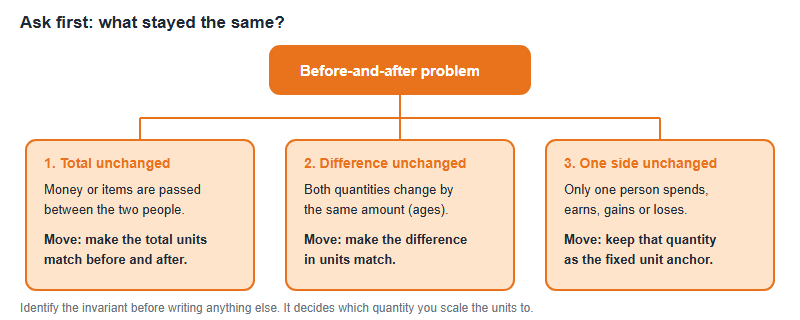
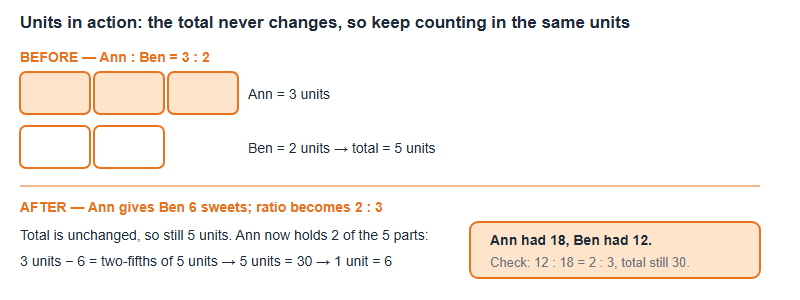
Invariant 1 — the total does not change. This is the sweets problem in the diagram above. Ann and Ben share sweets in the ratio 3 : 2; Ann gives Ben 6 and the ratio becomes 2 : 3. Because sweets only moved between them, the total is fixed at 5 units throughout. Ann ends with two of five parts, so 3 units minus 6 equals two-fifths of the total; that gives 5 units = 30, one unit = 6, and so Ann started with 18 and Ben with 12. The check takes five seconds: 12 : 18 does simplify to 2 : 3.
Invariant 2 — the difference does not change. Age problems are the standard case, because everyone ages at the same rate. Ann is three times as old as Ben; in six years she will be twice as old. Ben is 6 and Ann is 18 — in six years, 12 and 24. Notice the difference is 12 both before and after, which is the structural fact that makes the problem solvable at all. Students who miss the invariant end up trying to guess and check; students who see it write one line.
Invariant 3 — one quantity does not change. Sam and Tom have money in the ratio 5 : 3. Sam spends $40 and then they have equal amounts. Tom never spent anything, so his 3 units are the anchor: 5 units minus 40 equals 3 units, so 2 units = 40 and one unit = 20. Sam had $100, Tom had $60, and Sam now has $60. Anchoring on the unchanged side is what keeps the unit size constant across the two situations.
| Invariant | Typical wording | First move | Trap to avoid |
|---|---|---|---|
| Total unchanged | “A gives B…”, “they swap…” | Match total units before and after | Treating the two ratios as having the same unit size |
| Difference unchanged | “in 6 years…”, “5 years ago…” | Match the difference in units | Adding the years to only one person |
| One quantity unchanged | “only A spent…”, “B saved nothing more” | Anchor units to the fixed quantity | Rescaling the anchor and losing the unit size |
| Nothing obvious | Both change by different amounts | Name one unit as x and write both states | Abandoning units too early for messy algebra |
Percentage change, reverse percentage and successive change
Percentages are ratios wearing a different hat, and three specific patterns account for most of the marks lost.
Successive change does not add up. A price rises by 20% and then falls by 20%. The instinct says the price is back where it started; the arithmetic says otherwise, because the two changes are percentages of different starting values. Multiply instead: 1.20 × 0.80 = 0.96, so the price ends 4% below where it began. Teaching students to multiply factors rather than add percentages fixes an entire question family at once.
Reverse percentage means dividing, not subtracting. If a jacket costs $96 after a 20% discount, the original price is not $96 plus 20%. The $96 represents 80% of the original, so divide: 96 ÷ 0.8 = $120. Written in units, this is even cleaner — 80% is 4 units of 20%, so one unit is 24, and five units is 120.
Percentage points are not percent. If a proportion moves from 40% to 50%, that is a rise of 10 percentage points but a 25% increase in relative terms. Questions sometimes deliberately test which of the two is being asked for, and the only defence is reading the sentence twice.
One more habit worth building: convert awkward percentages into fractions before computing. Working out 37.5% of 64 by decimal multiplication is slow and error-prone by hand; recognising 37.5% as three-eighths turns it into 64 ÷ 8 × 3 = 24. In a no-calculator paper, fraction equivalents for 12.5%, 25%, 33⅓%, 37.5%, 62.5%, 75% and 87.5% are worth memorising outright.
A four-week drill plan
This strand improves quickly under short daily practice, because most of what is being trained is recognition rather than computation.
- Week 1 — translation only. Fifteen sentences a day, converted into units without solving anything. “Two-thirds as many”, “for every 5 there are 3”, “a quarter of the remainder”. The exercise is finished when the bar model is drawn, not when an answer appears. This feels strange and is the single highest-return week.
- Week 2 — one invariant at a time. Three problems a day, all from the same invariant, so the pattern becomes visible. Total unchanged on Monday and Tuesday, difference unchanged mid-week, one-side-unchanged at the end.
- Week 3 — percentages. Successive change, reverse percentage, percentage points, and the fraction equivalents drilled to instant recall.
- Week 4 — mixed and timed. Ten unlabelled problems in twenty minutes. The student must write the invariant name before starting each one. Marking the invariant is worth as much attention as marking the answer.
In the practice sets our tutors mark, the most common failure in this strand is not a wrong method — it is a student who found the value of one unit correctly and then answered a question that was never asked. Building the habit of underlining the actual question before starting, and re-reading it before writing the final line, recovers marks faster than any new technique. Assembling four weeks of problems graded by invariant is the obstacle most families hit: our preparation guide sets out how we structure practice, and you can ask us there for recommendations matched to your child’s grade.
On timing: SIU has published a 2026 AMO testing period running from mid-October into November, with registration required a set interval before the chosen test date, and lists its own sittings as paper-based. Because format, dates, deadlines and fees all differ by country and registration route — some regional routes run online sittings — confirm your own sitting on the official SIMCC / AMO pages before planning backwards. From late July there is room for two full four-week blocks with a rest week between them.
Frequently asked questions
Should my child use algebra or bar models for these problems?
Either, provided the invariant is identified first. Bar models are usually faster up to about Grade 8; algebra scales better after that.
Why is the units method emphasised over formulas?
Because before-and-after questions change the quantities, while a formula assumes they are fixed. Units keep the bookkeeping consistent.
How many ratio questions appear on an AMO paper?
The organiser does not publish fixed topic weightings, and the balance varies by level and year. Confirm current guidance on the official AMO pages.
Are these the same problems as on the AMC?
No. AMO is run by SIMCC with SIU across Grades 2 to 12; the AMC is a separate MAA contest in the USA with a different syllabus and pathway.
This site is an independent English-language guide for families preparing for AMO, operated by Hanlin Education. The American Mathematics Olympiad is organised by SIMCC (Singapore International Mastery Contests Centre) together with Southern Illinois University (SIU); we are not the official AMO or SIMCC organiser, we are not affiliated with them, and we do not set the rules. Formats, dates, fees, syllabus scope and award thresholds are decided by the organiser and change from cycle to cycle — for official registration, rules, dates and fees, always refer to the official organiser and confirm details on the official SIMCC / AMO pages. Factual errors are corrected within 7 working days of notice.