
AMO geometry rewards a good diagram far more than a long formula list. Most questions from Grade 3 to Grade 10 fall into three families: chase an angle, cut an area into pieces, or count objects in space. Each family runs on a handful of facts a student can hold in their head. Here is the whole set, plus the drawing protocol that makes them work.
Some orientation first. AMO, the American Mathematics Olympiad, is organised by SIMCC in Singapore together with Southern Illinois University (SIU) for Grades 2 to 12 on a US Common Core framework, and it is not the AMC run by the MAA in the United States — different organiser, different levels, different pathway. New to the contest? Start with our guide to what AMO is. Each level sits its own 90-minute paper, worked by hand without a calculator, and the exact question structure is set by the organiser — confirm the current format for your sitting on the official SIMCC / AMO pages.
What AMO geometry actually rewards
Two things shape how geometry should be prepared.
First, no calculator. That single rule tells you the geometry cannot depend on messy numerical work. Answers come out clean because the questions are designed around relationships — equal angles, equal areas, ratios — rather than around computation. If a student finds themselves multiplying four-digit numbers in a geometry question, they have almost certainly missed a shortcut.
Second, partial progress is worth finishing. In geometry that matters more than in any other strand, because work on a diagram very often reveals the answer even when the full argument never closes, so a part-built solution rarely deserves to be abandoned. Marking rules are set by the organiser and can vary by level and cycle, so confirm them for your sitting on the official SIMCC / AMO pages; how marks convert into medals is set out in our explainer on AMO scoring.
A note on scope: geometry at the primary levels is largely about shape properties, perimeter and area, while the upper levels expect fluency with polygons, ratio and three-dimensional reasoning. The organiser does not publish a fixed topic weighting per paper, so treat the map below as a guide to what is worth training rather than a promise about any particular year. Which level your child sits is the bigger lever, and we cover that in AMO grade levels explained.
Family 1 — angle chasing: eight facts solve most of them
Angle chasing is the purest AMO geometry skill: you are given one or two angles and asked for another, and the path runs through a chain of small deductions. The facts required are remarkably few.
- Angles in a triangle add to 180°; angles on a straight line add to 180°; angles round a point add to 360°.
- An exterior angle of a triangle equals the sum of the two opposite interior angles.
- In an isosceles triangle, the angles opposite the equal sides are equal.
- With parallel lines: corresponding angles are equal, alternate angles are equal, and co-interior angles add to 180°.
- The interior angles of an n-sided polygon add to (n − 2) × 180°.
- The exterior angles of any convex polygon add to 360°, whatever n is.
- Therefore each interior angle of a regular n-gon is 180° − 360°/n — 108° for a pentagon, 120° for a hexagon.
- A polygon with n sides has n(n − 3)/2 diagonals.
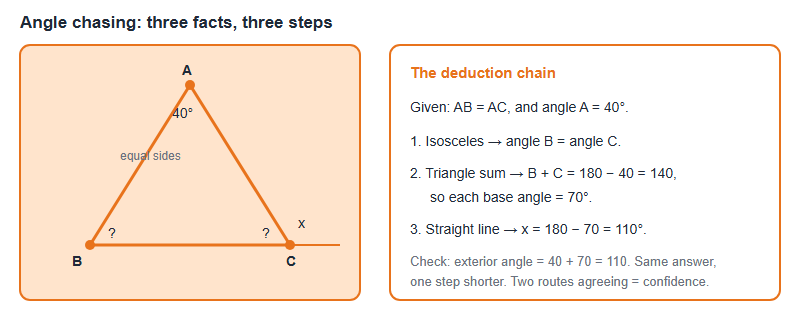
The worked chain below is typical of the middle levels. Notice that no step is difficult; the difficulty lives entirely in knowing which fact to reach for next, which is exactly what repetition fixes.
Family 2 — area by decomposition and ratio
Area questions at AMO level are rarely “apply the formula”. They are usually “the shaded region”, and the winning move is to see the shaded region as a whole minus its parts, or as pieces reassembled.
Four facts do most of the work:
- Same height, so areas share the base ratio. Two triangles with the same height have areas in the same ratio as their bases. This one fact converts a great many “find the ratio of the shaded area” questions into simple arithmetic.
- A triangle on the full base of a rectangle is exactly half of it, no matter where its apex sits on the opposite side. In a 12 by 8 rectangle of area 96, any such triangle has area 48. Students who do not know this hunt for the apex position that is never given.
- A median splits a triangle into two equal areas, because the two halves share a height and have equal bases.
- Scaling. If every length is multiplied by k, area is multiplied by k² and volume by k³. Doubling the side of a square gives four times the area, not twice — a trap that costs marks at every level.
The general habit: before computing anything, ask whether the figure can be cut into pieces you recognise, or subtracted from a rectangle you can draw round it. Composite shapes made from a rectangle with a triangle or quarter-circle removed are the standard construction, and they collapse instantly under subtraction.
Family 3 — spatial and counting geometry
This family is where strong arithmetic students most often lose marks, because it is the one part of geometry that cannot be brute-forced. It covers three-dimensional visualisation and systematic counting.
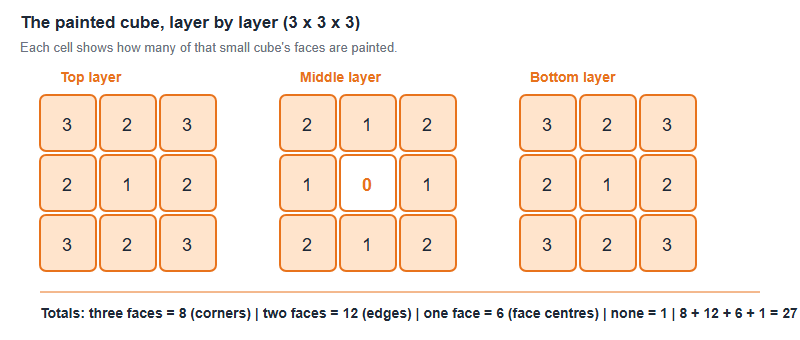
The classic is the painted cube. A large cube built from smaller unit cubes is painted on the outside and taken apart; how many small cubes have exactly three, two, one or no painted faces? The answer follows from position, not from counting one by one: the three-face cubes are the 8 corners, the two-face cubes sit along the 12 edges, the one-face cubes sit in the middle of the 6 faces, and the unpainted ones form a smaller cube hidden inside. For an n by n by n cube that gives 8 corners, 12(n − 2) edge cubes, 6(n − 2)² face cubes and (n − 2)³ interior cubes. The diagram below shows the 3 by 3 by 3 case laid out layer by layer.
Two further staples belong to this family. Cube nets: there are eleven distinct nets that fold into a cube, and questions usually ask which of several candidates does or does not fold — the reliable method is to fix one square as the base and track opposite faces, since opposite faces can never be adjacent in the net. Counting figures in a grid: how many rectangles are there in a 3 by 3 arrangement of squares? Rather than counting shapes, count lines. A rectangle is fixed by choosing two of the four vertical lines and two of the four horizontal lines, giving 6 × 6 = 36. Systematic counting beats visual counting every time, and it is the only method that survives a bigger grid.
The diagram protocol, and how to train it
The gap between students who score well on geometry and those who do not is usually not knowledge — it is drawing discipline. In the practice papers our tutors mark, most lost geometry marks trace back to a diagram that was too small, copied without markings, or never redrawn at all. Five steps fix the majority of that.
- Redraw it big. Never work on the printed figure. A diagram roughly a third of a page wide leaves room to write angles on it.
- Mark everything given. Equal sides get matching ticks, equal angles get matching arcs, right angles get squares, parallels get arrows. Marks on the page prevent the classic error of assuming a symmetry that was never stated.
- Name one unknown. Call the thing you want x and write it on the diagram. If a second unknown is needed, prefer expressing it in terms of x rather than introducing y.
- Write each deduction on the diagram, with its reason in three words. “Isosceles”, “straight line”, “same height”. The reason is what makes the chain repeatable next week.
- Sanity-check. Angles should look roughly like their values, areas should be smaller than the whole, and a second route to the same answer — as in the worked chain above — costs ten seconds.
| Family | Usual band | Core fact to automate | Classic trap |
|---|---|---|---|
| Angle chasing | Grades 4–10 | Triangle sum, exterior angle, parallel-line pairs | Assuming a triangle is isosceles because it looks it |
| Area decomposition | Grades 3–9 | Whole minus parts; same height gives base ratio | Hunting for a missing length that is never needed |
| Scaling | Grades 5–10 | Lengths × k, area × k², volume × k³ | Doubling a side and doubling the area |
| Spatial and counting | Grades 3–9 | Corners / edges / faces / interior; count lines not shapes | Counting one by one and losing track |
| Polygons | Grades 6–10 | (n − 2) × 180°; exterior angles total 360° | Using the regular-polygon formula on an irregular one |
A workable four-week block: week one on angle chasing only, ten minutes daily, every answer justified in three words; week two on area by subtraction and base ratios; week three on spatial counting, including one painted-cube and one net question a day; week four mixed and timed, with the diagram protocol enforced strictly. Geometry drills are the hardest of the three families for a parent to assemble alone; our preparation guide sets out how we structure practice, and you can ask us there for recommendations matched to your child’s grade. If your sitting falls in the window the organiser publishes for this cycle — SIU has listed a 2026 AMO testing period running from mid-October into November, with registration closing a set interval before the chosen date, and lists its own sittings as paper-based — a late-summer start leaves ample room. Confirm your own format, date and deadline on the official SIMCC / AMO pages, since these vary by country and registration route, and some regional routes run online sittings.
Frequently asked questions
Does AMO geometry require trigonometry?
The strand described here needs none of it. Upper-level scope follows the Common Core framework for that grade; confirm on the official AMO pages.
Are diagrams drawn to scale?
Never assume so. Use marked information only, and treat a figure that merely looks symmetric as unproven until the question states it.
My child is strong at arithmetic but weak at spatial questions. Normal?
Very. Spatial reasoning is a separate trainable skill, and painted-cube and net drills improve it faster than general practice does.
Is AMO geometry the same as AMC geometry?
No. AMO is run by SIMCC with SIU for Grades 2 to 12; the AMC is a separate MAA contest in the USA with its own syllabus and difficulty curve.
This site is an independent English-language guide for families preparing for AMO, operated by Hanlin Education. The American Mathematics Olympiad is organised by SIMCC (Singapore International Mastery Contests Centre) together with Southern Illinois University (SIU); we are not the official AMO or SIMCC organiser, we are not affiliated with them, and we do not set the rules. Formats, dates, fees, syllabus scope and award thresholds are decided by the organiser and change from cycle to cycle — for official registration, rules, dates and fees, always refer to the official organiser and confirm details on the official SIMCC / AMO pages. Factual errors are corrected within 7 working days of notice.