
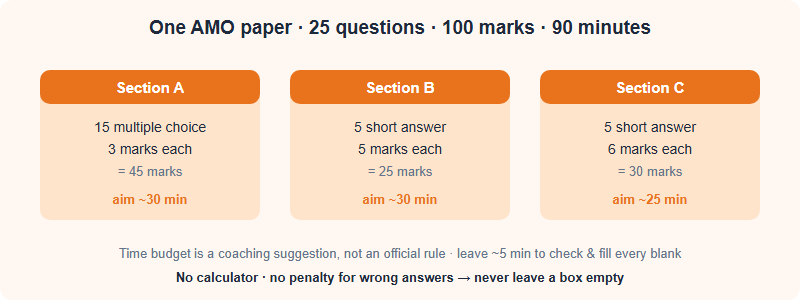
On AMO test day your child sits one 90-minute paper for their grade level, made of 25 questions across three sections, with no calculator allowed and no penalty for wrong answers. The American Mathematics Olympiad (AMO) is run by the Singapore International Math Contest Centre (SIMCC) together with Southern Illinois University (SIU) and may be delivered online or on paper depending on your test centre — so the single most useful thing a family can do is confirm the exact date, mode and log-in details with the official channel before the day.
The paper itself: one level, 90 minutes, 25 questions
Every AMO candidate sits the paper for their own grade, from Primary 2 through Junior College 2 (roughly grades 2 to 12). There is no combined paper and no choice of level on the day — the level is fixed when you register. The structure is the same across levels; only the difficulty of the questions changes. Understanding the shape of the paper in advance removes most test-day surprise.
| Part of the day | What it looks like | What to check beforehand |
|---|---|---|
| Level | One paper matched to your registered grade (Grade 2–12) | That the registered level matches your child's current school grade |
| Duration | 1 hour 30 minutes (90 minutes), single sitting | Start time in your local timezone — confirm on the official site |
| Questions | 25 total: Section A (15), Section B (5), Section C (5) | Marks per section, so time is spent where the points are |
| Total marks | 100 | — |
| Wrong answers | No penalty — a blank and a wrong answer score the same | Nothing; this is a fixed AMO rule |
| Calculator | Not allowed | That practice at home is also done calculator-free |
Because a wrong answer costs nothing, the correct test-day behaviour is to answer every question, even the hardest ones in Section C. Leaving a box blank is never better than an educated guess. If you want the full logic of how those 100 marks turn into Gold, Silver and Bronze, see our companion guide on how AMO scoring works.
Online or paper? Confirm your mode early
AMO is described officially as an online-or-paper contest, and the mode can differ by country, year and test centre. That means you should never assume — a family that prepares for a paper booklet and then meets an online platform (or the reverse) loses calm before the first question. Nail this down at registration.
- If it is online, ask the centre: what device and browser, whether the webcam must stay on for proctoring, how log-in credentials are sent, and what happens if the internet drops mid-test. Do a dry run of the login on the same device a day before.
- If it is on paper, ask: the venue and arrival time, what stationery is provided versus what you bring, and whether working must be shown on the answer sheet or on separate rough paper.
- Either way, confirm the exact start time in your timezone. AMO is a worldwide contest, so a time printed for one region is not automatically your local start.
These operational details — device rules, venue, proctoring, timezone — are exactly the kind of thing that changes year to year. Treat any figure you read online (including this article) as a prompt to verify, and take the final answer from the official SIMCC / AMO channel or your registering partner.
The no-calculator rule changes how you prepare
AMO does not permit calculators. For a student used to school tests where a calculator is allowed, this is the biggest adjustment of test day — and it is one you fix in the weeks before, not on the morning itself. Arithmetic that is slow or shaky under pressure quietly drains time from the thinking that AMO actually rewards.
- Rebuild mental-arithmetic speed. Times tables, quick addition and subtraction, fractions and percentages should be automatic so the brain is free for problem-solving.
- Practise the exact way you will sit. If your child normally reaches for a calculator on homework, do AMO practice papers with it put away entirely. The muscle memory of “work it by hand” has to exist before the day.
- Show working neatly for Sections B and C. These are short-answer, not multiple choice, so clear, checkable working reduces silly slips and makes it easy to review answers if time allows.
For younger candidates especially, this is why a gentle, arithmetic-strong foundation matters. If you are registering a Grade 2–4 child, our note on how the AMO grade levels work explains why each level sits its own paper and how to make sure the registered level is right.
A simple test-day checklist
Most test-day stress is logistics, not maths. Run this list the day before so the morning is calm.
| Before the day | On the day | Do not |
|---|---|---|
| Confirm date, start time (your timezone) and mode (online/paper) | Log in / arrive early with time to spare | Do not bring or open a calculator |
| Test the device, browser and login if online | Have pencils, eraser and rough paper ready (paper mode) | Do not leave any answer blank — guess if unsure |
| Sleep well; do a light warm-up, not cramming | Read each question fully before answering | Do not spend 20 minutes stuck on one hard question early |
| Know how results and certificates will be issued | Keep the time budget in mind; save minutes to check | Do not panic if one section feels hard — ranking is by percentile |
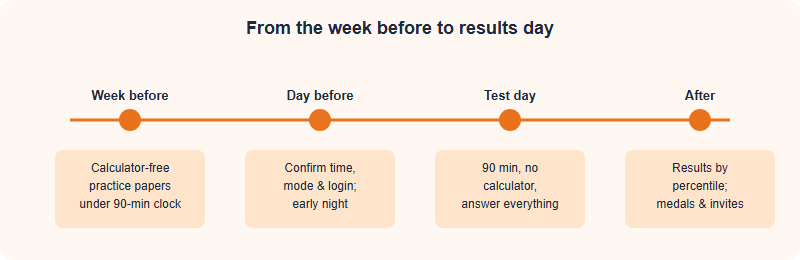
Five test-day habits that quietly protect marks. The maths is settled long before test day; what a child controls on the day is behaviour. These five habits cost nothing and repeatedly separate a student's real result from a frustrating one, and they apply whether the paper is delivered online or on paper.
- Bank the easy marks first. Section A is multiple choice worth 3 marks each. Move through it steadily and secure those 45 marks before wrestling with Section C. A confident early run also settles nerves.
- Don't get stuck. If a question resists after a reasonable attempt, mark it, move on, and return with time left over. One hard question is never worth a quarter of the paper.
- Fill every blank before the clock stops. Because there is no penalty, the last minute should be spent making sure no answer box is empty — a reasoned guess on a Section C item can only add marks.
- Read the whole question. Contest questions hide a condition in the last line. Slowing down for two seconds to read fully prevents the most common avoidable error.
- Keep working legible. For the short-answer sections, tidy working lets your child re-check quickly and avoids transcription slips when copying a final answer.
These are coaching suggestions, not official rules, but they map directly onto how the paper is built. Practising them on timed past papers — the same way our scoring guide describes the marks — means they are automatic when it counts, rather than something to remember under pressure.
After the paper: how results and next steps work
AMO ranks candidates by percentile rather than a fixed pass mark, which is why one hard-looking paper does not sink a strong performance — everyone sits the same difficulty, and awards are decided relative to the field. In broad terms the top 40% of candidates at each level receive a medal (Gold, Silver or Bronze) plus a certificate, with an Honourable Mention band below that. Medal winners may also be invited onward into the SIMCC ecosystem, such as SIMOC and, for higher awards, IJMO.
Because the exact percentages, invitation rules and timelines are set by the organiser and can be updated each cycle, take the definitive version from the official AMO results information rather than from memory. What matters on the day is simpler: sit the right level, use the full 90 minutes, work without a calculator, and answer every single question.
Frequently asked questions
Is AMO taken online or on paper?
Officially it can be either — AMO is described as an online-or-paper contest and the mode varies by centre and year. Confirm your specific delivery mode at registration; do not assume.
Are calculators allowed in AMO?
No. Calculators are not permitted, so practice should be done calculator-free and mental-arithmetic speed built up in advance. Always reconfirm rules on the official site.
How long is the paper and how many questions?
Each level is one 90-minute paper with 25 questions across three sections (15 + 5 + 5) for 100 marks, with no penalty for wrong answers.
Does guessing hurt my score?
No. There is no penalty for wrong answers, so a guess can only help. Never leave a question blank, especially the harder Section C items.
This site is operated by Hanlin Education as an authorized AMO registration partner for China. AMO (the American Mathematics Olympiad) is run by the Singapore International Math Contest Centre (SIMCC) together with Southern Illinois University (SIU); it is not the MAA's AMC in the United States. Formats, rules, delivery mode, dates and award bands are set by the organiser and can change — always confirm details on the official SIMCC / AMO pages. We do not claim to be the organiser. Any factual error will be corrected within 7 working days.