
On a US college application, AMO (American Mathematics Olympiad) belongs in the Common App Honors section if you earned an award, or the Activities section if you mainly took part — described in plain, accurate language: what it is (a SIMCC international maths contest for Grades 2-12), the level you sat, and the exact recognition you received. It is a credible signal of mathematical interest, but it is one line among many, not an admissions guarantee. Below is how to phrase it honestly. AMO is run by SIMCC in Singapore with Southern Illinois University — it is not the MAA’s AMC, and conflating the two on an application is a real risk.
First, be clear about what AMO is — and is not
Admissions officers read thousands of activity lists and many are mathematically literate. The single biggest mistake a student can make with AMO is to let the word “American” imply it is the AMC, the well-known contest run by the Mathematical Association of America for US high-schoolers. They are different competitions, run by different organisations, for different ages.
AMO is organised by the Singapore International Math Contests Centre (SIMCC) together with Southern Illinois University (SIU), it spans Grades 2-12, and its winners progress toward SIMCC events such as SIMOC and the IJMO. If you are at all unsure of these basics, read our explainers on what AMO is and the grade levels from Grade 2 to 12 before you write a single line. Getting the identity right is not pedantry — an application that misrepresents a competition, even unintentionally, undermines the student’s credibility.
It is worth pausing on why this distinction matters so much for Chinese international-school applicants in particular. Many US universities receive large numbers of applications that list maths competitions, and readers in STEM-heavy admissions offices often know the landscape well. An entry that quietly implies an AMC result when the student actually sat AMO can read, at best, as careless and, at worst, as an attempt to borrow another contest’s reputation. Neither helps. The fix is simple and costs nothing: state the real organiser and let the achievement stand on its own honest terms.
Where AMO goes on the Common App
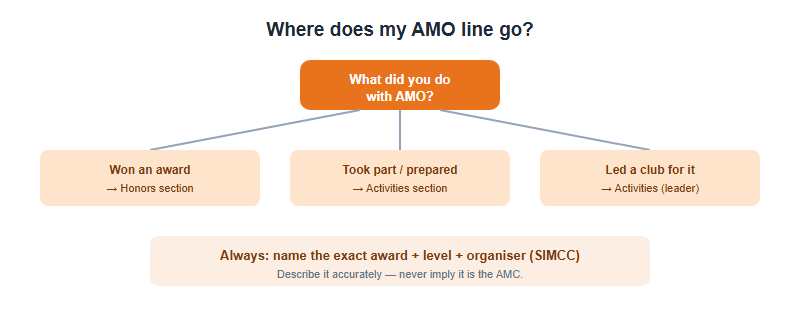
The Common App gives you a few places this can live. Pick based on what actually happened, not on which sounds most impressive.
| If you… | Put AMO in… | Why |
|---|---|---|
| Won a Gold / Silver / Bronze / Honourable Mention | Honors section | It is a distinction; name the exact award and level |
| Participated, or prepared seriously over time | Activities section | Shows sustained interest even without a top award |
| Led a school maths club that trained for AMO | Activities (leadership) | Initiative and impact on others matters more than the score |
| Have a genuinely strong, verifiable result | Optionally reference in an essay or supplement | Only if it carries a real story, not as a trophy drop |
A word on honesty regarding award tiers: AMO awards are ranked by percentile, with roughly the top 40% earning a medal (Gold ~8%, Silver ~12%, Bronze ~20%) and the next band an Honourable Mention. That means a Bronze, while a real achievement, is not a top-percentile result — describe it as what it is. If you want to understand exactly where your award sits, our guide to AMO scoring explains the percentile bands so you can characterise your result accurately rather than inflate it.
How to phrase the entry (with examples)
Common App space is tight — the Honors field is short, and Activities descriptions cap at 150 characters. Lead with the concrete, name the organiser, and avoid puffery. These are illustrative templates, not claims about any real student:
- Honors entry: “AMO (American Mathematics Olympiad, SIMCC) — Silver Award, Grade 8 division, 2026.” Clear, verifiable, correctly attributed.
- Activities entry: “Trained for and sat the AMO (SIMCC international maths contest); self-studied number theory and combinatorics over a term.” Shows real effort.
- Leadership entry: “Founded a Grade 7 maths-problem club; ran weekly sessions preparing 12 students for the AMO.” Impact on others, not just a personal score.
Notice what each avoids: no “prestigious”, no “world-renowned”, no implication that it is the AMC or a national-team selection. Admissions readers trust specific, modest, accurate descriptions far more than inflated ones.
What AMO actually signals — and its honest limits
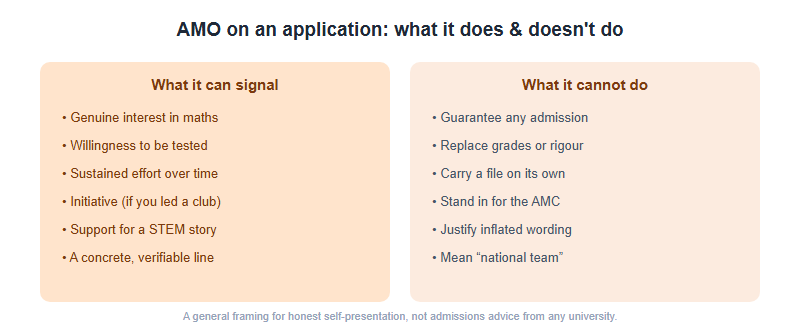
Used well, AMO communicates a few real things: sustained interest in mathematics, willingness to be tested against an international field, and — if you led a club — initiative. For a younger applicant or one whose school offers few maths contests, it can be a useful piece of evidence that a stated interest in a STEM major is genuine.
But keep its weight in perspective. A single contest line, especially a participation or Bronze line, does not by itself move a competitive admissions decision, and no competition guarantees an outcome. AMO is one supporting data point in a file that lives or dies on grades, the overall story, recommendations and essays. The students who get the most from it are usually those for whom it is part of a consistent mathematical narrative — years of contests, relevant coursework, maybe research or a club — rather than a one-off badge. Present it as a true and proportionate part of that story.
Does the grade you sat AMO at matter to admissions?
A fair question, since AMO runs all the way from Grade 2 to Grade 12. For US applications, what counts is recent, age-appropriate evidence. A Grade 11 Silver tells an admissions reader something current about a near-applicant; a Grade 4 award is sweet but says little about the student you are at seventeen. That does not make early participation pointless — it is often where a genuine love of problem-solving starts — but on the application itself, lead with your most recent and most senior results.
This is also why a single line rarely does heavy lifting on its own. A reader is looking for a trajectory: did the interest persist and deepen? A student who sat AMO across several years, moved up the divisions, and paired it with relevant coursework or a maths club is telling a far stronger story than one isolated certificate, however shiny. If AMO is one of your earliest contests, the honest move is to frame it as the start of a documented progression — and to make sure the rest of the progression is visible too.
None of this is advice from any particular university, and admissions criteria differ widely between institutions and change over time. Treat the guidance here as a way to describe AMO accurately and proportionately; for what any specific college values, read that college’s own published guidance.
Three honesty rules that protect the whole application
1. Never let “American” do misleading work. If there is any chance a reader could think AMO is the AMC, add the organiser (“SIMCC”) so the record is unambiguous. Misattribution, even accidental, is the kind of thing that erodes trust across an entire file.
2. State your exact award and level. “Bronze, Grade 6 division” is honest; vague phrasing like “award-winning mathematician” is not. List it precisely as printed on your certificate, and if you are unsure of the wording, confirm with the organiser.
3. Don’t claim what you can’t verify. Only list a result you actually received and could document if asked. Inflating a tier, inventing a ranking, or implying national-team status is both wrong and easy to catch. The whole point of an activity list is that it is true.
Frequently asked questions
Does AMO help with US college admissions?
It can be a useful supporting signal of mathematical interest, especially within a consistent STEM story. It is one line among many, not a guarantee of any admissions outcome.
Should AMO go in the Honors or Activities section?
Honors if you won an award (name the tier and level); Activities if you mainly participated or led a club preparing for it. Choose by what you actually did.
Can I write that AMO is the AMC on my application?
No. AMO is a SIMCC (Singapore) contest for Grades 2-12; the AMC is run by the MAA in the US. Always name SIMCC so the two are not confused.
Is a Bronze worth listing?
Yes, listed accurately — describe it as a Bronze at your grade division. AMO awards are percentile-ranked, so present the tier honestly rather than overstating it.
This site is operated by Hanlin Education as an authorized AMO registration partner for China. AMO (American Mathematics Olympiad) is run by the Singapore International Math Contests Centre (SIMCC) together with Southern Illinois University (SIU); it is a SIMCC contest from Singapore and is not the AMC run by the MAA in the United States. We are a registration partner, not the organiser. Award names, tiers and eligibility are set by SIMCC and can change — always confirm current details on the official SIMCC / AMO pages. Admissions outcomes depend on many factors and are never guaranteed by any competition. If you spot an error, we will correct it within 7 working days.