
AMO is designed on the US Common Core mathematics framework, but most students at international schools in China follow IB, British (IGCSE / A-Level) or AP pathways instead. The good news for parents: the core arithmetic, number sense, geometry and problem-solving that AMO tests overlap heavily with every mainstream curriculum — so your child is rarely “behind.” What differs is emphasis and phrasing, and a small set of topics that may appear a year earlier or later than in your school. This guide maps the fit so you can register at the right level with confidence.
What AMO is actually built on
The American Mathematics Olympiad (AMO) is run by the Singapore International Math Contest Centre (SIMCC) with Southern Illinois University (SIU), and its papers are written by educators working from the US Common Core standards. That matters for curriculum-fit in two ways. First, Common Core is a grade-by-grade framework, so each AMO level (Grade 2 through Grade 12) targets the skills a US student of that grade would be expected to have. Second, Common Core is not exotic — it covers the same big strands (number, algebra, geometry, data, and reasoning) that IB, British and AP curricula also cover, just organised differently.
So the real question is not “Does my child study the same syllabus?” It is “Where does my child's syllabus line up with the AMO level, and where might there be a small gap to bridge?” For the AMO-internal view of which topics appear at each level, our scoring and level overview and grade guide are useful companions; this article looks outward, at how AMO sits against the curriculum your child already follows.
It also helps to remember what AMO is not. Despite the “American” name, AMO is not the MAA's AMC in the United States and it is not tied to any single country's school system as an entry requirement — it is an international contest open to grades 2 to 12 worldwide, as our parent's guide to what AMO is explains. The Common Core framework is simply the design language the SIU educators use to pitch each level's difficulty; it is not a gate that IB, British or national-curriculum students must pass through. A child does not need to have “studied Common Core” to enter or to do well — they need the underlying mathematics, which almost every curriculum teaches.
How AMO lines up with each pathway
The table below is a broad orientation, not a promise about any individual school — scope and sequence vary by school and exam board. Use it to spot where to focus, then verify specifics against your own school's scheme of work and the official AMO past papers for the level.
| Curriculum | Natural overlap with AMO | Where a small gap can appear | Fit verdict |
|---|---|---|---|
| US Common Core (some AP/US schools) | Direct — AMO is written to this framework, grade for grade | Contest-style word problems are harder than routine class work | Tightest alignment |
| IB (PYP / MYP / DP) | Strong — number, algebra, geometry, data all shared; IB values reasoning, which suits AMO | Some arithmetic fluency (fast mental work) gets less drill in IB inquiry style | Good, with speed practice |
| British (IGCSE / A-Level) | Strong — British curricula are content-rich and often ahead on algebra and geometry technique | Phrasing and units differ (US terms, US notation); contest puzzles less common in class | Good, adjust to US phrasing |
| AP (US high school) | Strong at the senior levels — shared algebra, functions, geometry | AP allows calculators in places; AMO does not, so mental speed must be rebuilt | Good, go calculator-free |
| Chinese national curriculum (bilingual students) | Very strong on computation and algebra — often ahead of grade | English mathematical vocabulary is the main hurdle, not the maths | Strong, focus on English terms |
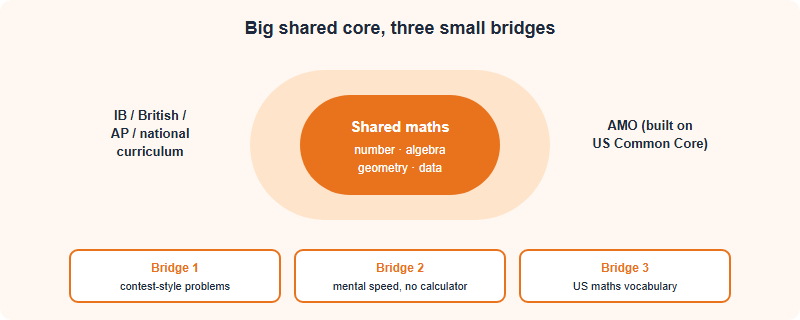
The pattern across almost every pathway is the same: the mathematical content your child needs for their AMO level is largely already in their school work. The friction points are three practical things — contest-style problem phrasing, mental-arithmetic speed (because there is no calculator), and US mathematical vocabulary. None of these is a curriculum gap; all three are trainable in a few weeks.
“Is my child behind?” Usually not — here is how to check
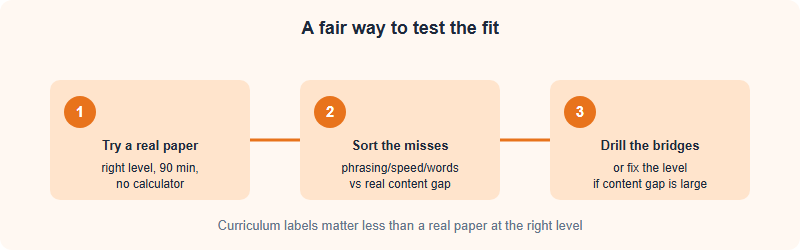
Parents often worry that a US-framework contest will expose a gap. In practice, students on British and Chinese national curricula are frequently ahead on algebraic and computational technique for their age, and IB students are strong on reasoning — exactly the kind of reasoning AMO rewards. The honest way to test fit is not to compare syllabus documents; it is to try a real paper at the right level.
- Download the past paper for your child's grade level and let them attempt it under the 90-minute clock, calculator-free. This single step tells you more than any curriculum table.
- Sort the misses into two piles. Pile A: “knew the maths, lost it on phrasing, speed or vocabulary.” Pile B: “genuinely hadn't met this topic.” For most students Pile A dwarfs Pile B.
- If Pile B is small, the fit is good and you simply drill the bridges. If Pile B is large, the child may be registered a level too high — check the level against their current grade before assuming a content gap.
Because AMO fixes the level at registration and ranks by percentile within that level, getting the level right is the highest-leverage decision a family makes. Our guide to AMO grade levels from Grade 2 to Grade 12 walks through how each level sits its own paper so you can match it to your child's school grade rather than their ambition.
Closing the three bridges (whatever your curriculum)
| Bridge | Why your school may under-drill it | How to close it in a few weeks |
|---|---|---|
| Contest-style problems | Class tests reward method marks; contests reward the final answer to a twisty problem | Work official past papers and sample problems weekly; discuss how to start an unfamiliar problem |
| Mental-arithmetic speed | IB inquiry and calculator-permitted courses drill fluency less | Daily short arithmetic sets; all AMO practice done with the calculator put away |
| US mathematical vocabulary | British and Chinese-national students meet different terms and notation | Learn the US terms that appear in questions so no mark is lost to wording |
The bottom line for China international-school families
One more reassurance for parents comparing systems: AMO ranks by percentile within a single grade level, so your child is only ever measured against others sitting the same paper — not against a US Common Core benchmark in the abstract. A student from an IB or British school is not scored against “what a US Grade 8 should know”; they are ranked against the field taking Grade 8 AMO worldwide. That framing removes most of the anxiety about curriculum origin. The paper is the same difficulty for everyone at the level, and the medal bands fall out of the field's performance, which is exactly why matching the level to the school grade — rather than to a syllabus label — is the decision that matters.
AMO being “American” and Common Core–based does not put IB, British, AP or national-curriculum students at a disadvantage. The mathematics is shared; the differences are surface-level and trainable. A student who studies any mainstream curriculum, registers at the level matching their school grade, practises calculator-free on real papers, and learns the US phrasing is well set up for AMO. If anything, the exposure to a different framing of familiar maths is part of the value — it stretches flexibility, which is exactly what strong problem-solvers develop.
As always, treat topic-scope specifics as things to verify against your own school's scheme of work and the official AMO past papers, and confirm the current level structure and rules on the official channel before you register.
Frequently asked questions
Is AMO based on the US Common Core?
Yes. AMO papers are written by educators working from the US Common Core mathematics framework, which is why each level targets that grade's expected skills. Confirm current details on the official site.
My child studies IB, not Common Core — are they at a disadvantage?
Generally no. The number, algebra, geometry and data content overlaps strongly. IB's emphasis on reasoning suits AMO; the main add-ons are speed and US phrasing.
British-curriculum students — is A-Level math enough for the senior AMO levels?
British curricula are often ahead on technique, so content is rarely the issue. Adjust to US notation and terms, and practise problems calculator-free.
How do I really know if the fit is right?
Have your child attempt the official past paper for their grade level under time, without a calculator, then see whether misses are about phrasing/speed or genuine content gaps.
This site is operated by Hanlin Education as an authorized AMO registration partner for China. AMO (the American Mathematics Olympiad) is run by the Singapore International Math Contest Centre (SIMCC) together with Southern Illinois University (SIU); it is not the MAA's AMC in the United States. Curriculum scope, level structure and rules are set by the organiser and vary by school and exam board — always confirm details on the official SIMCC / AMO pages and your own school's scheme of work. We do not claim to be the organiser. Any factual error will be corrected within 7 working days.