
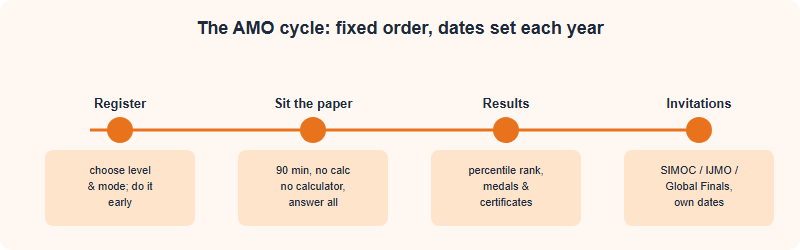
The AMO year runs as a cycle: you register in advance, your child sits one 90-minute paper at their grade level, results and medals are released by percentile, and higher awards then unlock invitations to the wider SIMCC events — SIMOC, IJMO and the Singapore Math Global Finals. Because the American Mathematics Olympiad (AMO) is run by the Singapore International Math Contest Centre (SIMCC) with Southern Illinois University (SIU) and dates are set each cycle, the practical takeaway is this: plan backwards from the sitting, register in good time, and treat the exact dates as something to confirm on the official channel rather than assume.
The four stages of an AMO year
Every cycle moves through the same four stages. The order is fixed and worth internalising even though the dates shift year to year and by region. Knowing the shape lets a family reserve preparation time in the right place instead of scrambling.
| Stage | What happens | What the family does |
|---|---|---|
| 1. Registration | Entries open for the cycle; you choose the grade level and (where relevant) the delivery mode | Register through an authorized partner or centre; lock in the correct level early |
| 2. The sitting | One 90-minute paper per level (question count varies by grade — confirm officially), no calculator, no penalty for wrong answers | Sit the paper on the set date at the confirmed start time in your timezone |
| 3. Results | Ranking by percentile; medals (Gold/Silver/Bronze) and Honourable Mention issued with certificates | Read the result by percentile, not against a fixed pass mark |
| 4. Onward invitations | Award winners invited into SIMOC, IJMO and/or the Singapore Math Global Finals | Decide whether to accept an onward invitation and plan for it |
Notice that stages 1 and 4 are the ones families most often mis-time. Registration closes before you feel ready if you wait; and the onward events in stage 4 arrive with their own separate dates, which is a pleasant surprise only if you have left room for it. For the mechanics of how medals are decided in stage 3, see how AMO scoring works.
When should a China family register?
Registration timing is a logistics decision, and the safe rule is early, not last-minute. Two things push families to register well ahead. First, the level is fixed at registration, so you want time to confirm it is right for your child's grade before entries close. Second, if AMO is delivered online at your centre, you may need to set up and test a device and login — not something to discover on the final day. Enter as soon as the cycle opens for your region and you have chosen the level.
We are deliberately not printing a specific registration deadline or contest date here, because those are set by the organiser each year and differ by country. Get the authoritative dates from the official AMO information or your registering partner, then work backwards from the sitting to plan preparation. The planning table below is about lead time, which is stable, rather than calendar dates, which are not.
| Counting back from the sitting | Sensible milestone | Why |
|---|---|---|
| ~3–4 months before | Confirm the cycle's dates; decide to enter; pick the level | Gives room to register early and shape a calm preparation runway |
| ~8–12 weeks before | Begin structured practice on the correct level | Enough time to build the strands and mental-arithmetic speed without cramming |
| ~2–3 weeks before | Full past papers under the 90-minute clock, calculator-free | Turns knowledge into test-day performance and pacing |
| Days before | Confirm time (your timezone), mode, login/venue; rest | Removes logistical surprises; see our test-day guide |
If you want the detailed week-by-week version of that preparation runway, this site has fuller prep roadmaps; this article's job is only to place them correctly in the year. The one non-negotiable is that the runway is counted back from a confirmed sitting date — so step one is always to verify that date officially. For choosing the right level to count back from, revisit AMO grade levels explained.
Stage 4 in detail: the onward invitations
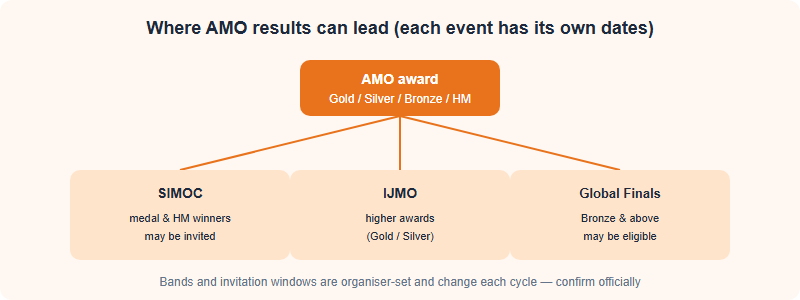
The part of the AMO calendar that catches families out is what happens after results. AMO sits inside the wider SIMCC competition family, and awards can open doors to further events, each with its own separate schedule. In broad terms:
- SIMOC (Singapore International Math Olympiad Challenge) — medal and Honourable Mention winners may be invited to compete in the following cycle's SIMOC.
- IJMO (International Junior Math Olympiad, under STEAM AHEAD) — higher awards (Gold/Silver) may be invited onward to IJMO.
- Singapore Math Global Finals — Bronze and above may be eligible for the Global Finals.
The exact eligibility bands, invitation windows and event dates are organiser-set and change each year, so treat the list above as orientation and confirm the specifics officially. What it means for planning is simple: if your child does well, a second and possibly third event may follow later in the year, so keep some calendar flexibility rather than treating the AMO sitting as the end of the road. For how these advancement paths connect, see our overview of what AMO is and where it leads.
Four calendar mistakes China families make
Most AMO regret is not about ability — it is about timing. Because the site sits between a Singapore-based organiser, worldwide dates and a China-based family, a handful of scheduling traps recur every cycle. Knowing them in advance is the whole point of thinking in a calendar.
| Mistake | What goes wrong | The fix |
|---|---|---|
| Waiting to register | Entries close before the family feels “ready,” and the level can no longer be adjusted calmly | Register as soon as the cycle opens and the level is chosen; readiness is built after, not before, entry |
| Reading a date in the wrong timezone | A start time printed for another region is misread as local, risking a late or missed login | Convert every date and start time into your own timezone and reconfirm with the centre |
| Cramming into the final week | Knowledge exists but pacing and calculator-free speed were never rehearsed under the clock | Reserve the last 2–3 weeks for full timed past papers, not new content |
| Treating the sitting as the finish line | An onward SIMOC / IJMO / Global Finals invitation arrives with no room left in the calendar | Keep some flexibility later in the year in case a higher award opens a next event |
All four fixes come back to one discipline: anchor the year to a sitting date you have confirmed officially, then plan outward from it — registration before, a preparation runway across, and flexibility after. Families who do that rarely feel rushed, even when the organiser's dates land differently from the year before.
Putting the year together
A well-run AMO year for a China international-school family looks like this: verify the cycle's dates officially; register early and at the correct grade level; count a calm 8–12 week preparation runway back from the confirmed sitting; sit one 90-minute, calculator-free paper; read the result by percentile; and leave room later in the year in case an onward SIMOC, IJMO or Global Finals invitation follows. Nothing here requires last-minute heroics — only that the whole thing is anchored to a sitting date you have confirmed rather than guessed.
Every specific date, deadline, eligibility band and delivery mode in this article should be checked against the official SIMCC / AMO information before you act on it, because those are set by the organiser and can change from cycle to cycle.
Frequently asked questions
When does AMO take place each year?
The sitting date is set by the organiser each cycle and can differ by region, so there is no fixed universal date. Confirm the current cycle's date on the official SIMCC / AMO channel.
How early should we register?
Register early, as soon as the cycle opens for your region and you have chosen the level. The level is fixed at registration, and online sittings may need device set-up.
How far ahead should preparation start?
A calm runway of roughly 8–12 weeks of structured practice before the sitting works well, counting back from the confirmed date, with full timed papers in the final weeks.
What happens after results?
Awards can bring invitations to SIMOC, IJMO or the Singapore Math Global Finals, each with its own dates. Bands and windows are organiser-set — verify them officially.
This site is operated by Hanlin Education as an authorized AMO registration partner for China. AMO (the American Mathematics Olympiad) is run by the Singapore International Math Contest Centre (SIMCC) together with Southern Illinois University (SIU); it is not the MAA's AMC in the United States. Dates, deadlines, delivery mode, award bands and onward-event eligibility are set by the organiser and change each cycle — always confirm details on the official SIMCC / AMO pages. We do not claim to be the organiser. Any factual error will be corrected within 7 working days.