
If your child is entering the Singapore maths family for the first time, the real question is not “which contest is best” but “which scoring rules fit this child right now.” SMC — the Singapore Math Challenge — is the gentle door: 90 minutes, no wrong-answer penalty, curriculum-anchored questions, with strong performers invited toward the SMGF global finals. SASMO — the Singapore and Asian Schools Math Olympiad — is the selective door: also 90 minutes, but Section A deducts marks for wrong answers, you start from a 15-point base, and medals feed the SIMOC and IJMO ladder that AMO families already know. Same family, different doors — and one of them also shares its initials with a completely unrelated UK competition, which we untangle below.
The family map first: three contests, two ladders
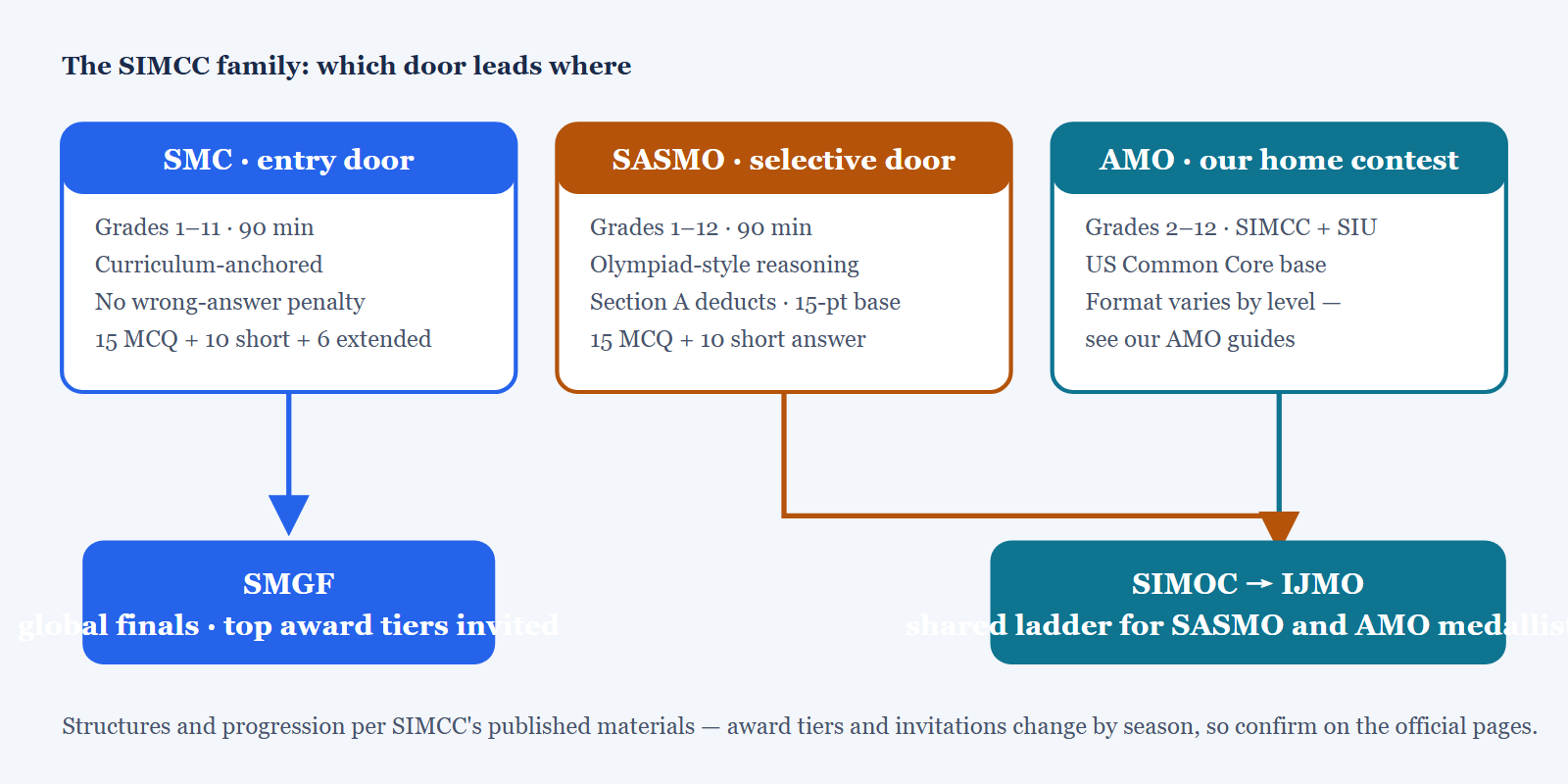
That shared right-hand ladder is the detail most parents miss: SASMO and AMO are siblings pointing at the same next step. Per SIMCC’s materials, SASMO medallists progress toward SIMOC (with higher tiers eligible toward IJMO) — exactly the route the SIMCC family map describes for AMO. So a child who has done AMO already understands SASMO’s world, and vice versa; SMC sits on its own gentler track toward the SMGF finals. Progression thresholds shift season to season, so treat the arrows as the shape, not a contract, and confirm current rules on SIMCC’s official pages.
The scoring rules are the real difference
Both papers run 90 minutes and open with 15 multiple-choice questions, so on the surface they look interchangeable. The scoring philosophy is where they split. SMC does not punish wrong answers: a child can attempt everything, guess where unsure, and the paper reads as an encouraging stretch beyond schoolwork — its six extended questions at the end supply the challenge ceiling. SASMO plays by sterner rules: per SIMCC’s materials, wrong answers in Section A cost marks, and every candidate starts from a 15-point base — so a child who cannot resist guessing bleeds points, and the contest quietly rewards the discipline of leaving a question blank. In our teaching team’s experience across the family, that one rule sorts children faster than any difficulty rating: careful, calibration-minded children often score better on SASMO than their raw ability suggests, while enthusiastic guessers do themselves an injustice there but flourish on SMC and AMO-style papers first.
Difficulty-wise, our coaches place SASMO between Math Kangaroo and the American AMC 8 — reasoning-first, but not yet proof-level — while SMC stays closer to an enriched school curriculum, with calculators permitted in some middle grades per SIMCC’s rules. If your child is mapping grades across systems (British Years, IB MYP, Chinese grades), our grade-mapping guide applies to the whole family.
Two name traps to clear before you register
Trap one: this SMC is not the UK’s SMC. The UK Mathematics Trust runs a famous “Senior Mathematical Challenge” — also abbreviated SMC — for sixth-form students, feeding the British Mathematical Olympiad. Same three letters, entirely different competition, country, age profile and organiser. If you are researching the Singapore Math Challenge and land on pages about the UK senior paper (or vice versa), you have crossed streams; for the UK path, see our sister guide at en.bmo.org.cn. Trap two: AMO is not the American AMC. Long-time readers know this one — AMO is run by SIMCC with Southern Illinois University, while the AMC series belongs to America’s MAA — but it bears repeating whenever the family tree is on the table.
A parent’s decision path
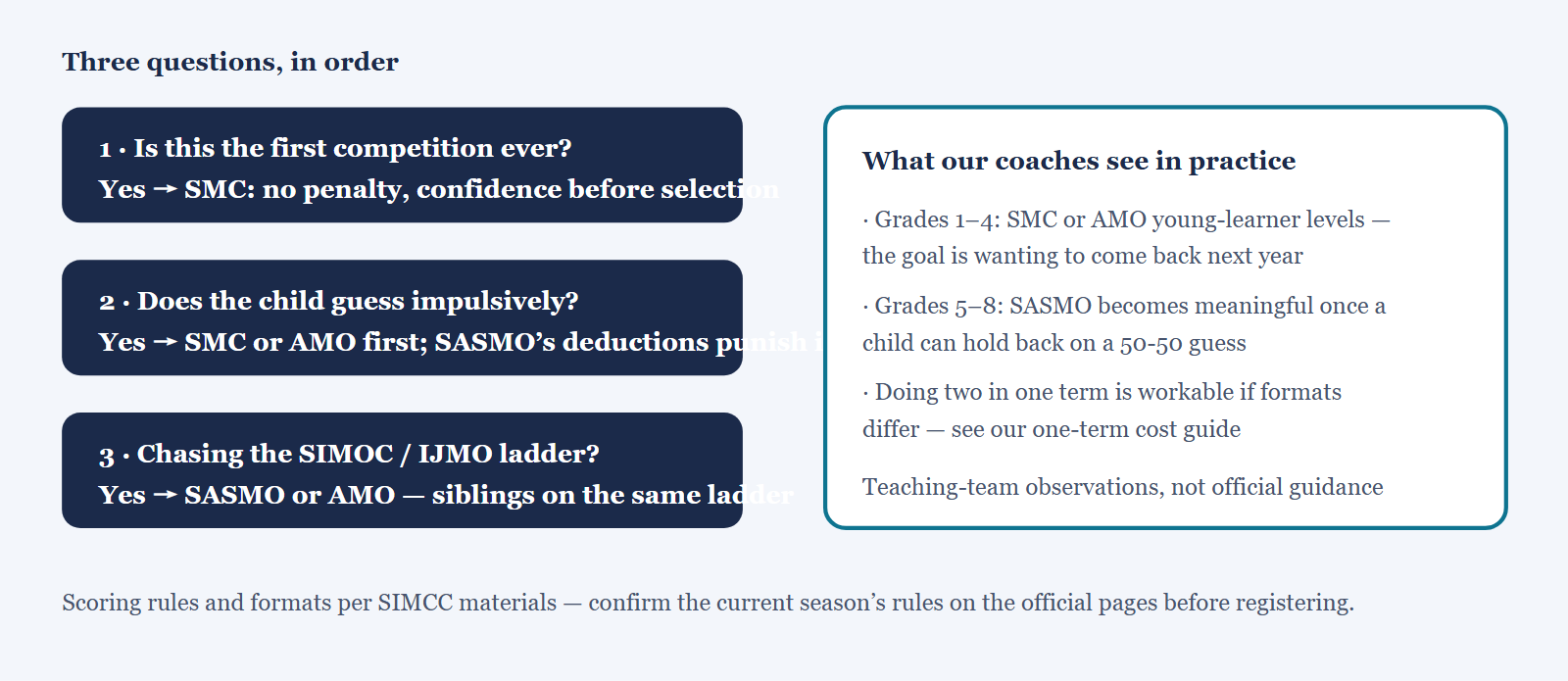
One practical note on stacking: a term with two contests is manageable when they stress different muscles — we costed this honestly in AMO plus another competition in one term — and SMC-then-SASMO is a natural such pair, gentle first, selective second. Whatever the choice, the preparation base is shared across the family; our guidance on choosing practice material applies to all three doors.
Frequently asked questions
What is the main difference between SMC and SASMO?
Scoring philosophy. Per SIMCC’s materials, SMC has no wrong-answer penalty and stays close to an enriched school curriculum, feeding the SMGF global finals; SASMO deducts marks for wrong Section A answers, starts every candidate on a 15-point base, and rewards olympiad-style reasoning, with medals feeding the SIMOC and IJMO ladder. Both run 90 minutes.
Is the Singapore SMC the same as the UK SMC?
No. The Singapore Math Challenge (SIMCC family, grades 1 to 11) and the UK Mathematics Trust’s Senior Mathematical Challenge (a sixth-form paper feeding the British Mathematical Olympiad) merely share initials. Different organisers, countries and age profiles — check which one a page is describing before you rely on it.
Which should come first for a young child — SMC, SASMO or AMO?
Our teaching team’s usual order: for a first-ever competition, SMC or AMO’s young-learner levels, because no-penalty scoring lets a child attempt freely and finish wanting more. SASMO becomes the right step once a child can deliberately skip a question rather than guess — its deduction rule punishes impulsive guessing. This is coaching observation, not official guidance.
Do SASMO and AMO lead to the same competitions?
Per SIMCC’s published progression, yes in shape: both feed the SIMOC ladder, with higher award tiers eligible toward IJMO. Thresholds and invitations change by season, so confirm the current season’s progression rules on SIMCC’s official pages before treating the ladder as a plan.
Contest structures, scoring rules and progression are per SIMCC’s published materials and our teaching notes; seasons vary, so confirm current rules on SIMCC’s official pages before registering. AMO is organised by SIMCC with Southern Illinois University and is not the American AMC (run by the MAA). We assist with AMO registration as an authorised channel. Corrections within 7 working days of notice.