
For AMO Probability preparation, a reliable first move on an “at least one” question is to compute the probability of “none” and subtract from 1. Then check the draw rule. With replacement, the second draw keeps the original counts. Without replacement, both the numerator and denominator can change. The two teaching illustrations below use the same bag—3 red and 2 blue counters, draw 2—so the contrast is explicit. This is a Hanlin teaching perspective, not an official AMO rule sheet.
For AMO preparation, the practical context is a timed paper; clear method matters under time pressure. Hanlin’s internal AMO site project notes (2026; source title translated as “AMO Site”) describe a Grade 2–12 paper with 25 questions in 90 minutes: 15 multiple-choice questions at 3 points each, 5 open questions at 5 points each, and 5 open questions at 6 points each, for 100 points total. The same notes state that the paper has no negative marking. Those preparation-context facts come from the site notes, not from a new official regulation claim. They explain why a shorter, safer complement can be worth choosing over a long case split.
Why “at least one” is usually a complement question
“At least one” means one or more successes. Its complement is “none.” If A is the event “at least one red,” then the complement is “no red.” Every possible outcome belongs to exactly one of those two descriptions, so P(A) = 1 − P(no red). This is not a trick or a special shortcut; it is a partition of the sample space.
For two draws from red and blue counters, the positive event “at least one red” has three cases: red then blue, blue then red, and red then red. The complement “no red” has one case: blue then blue. That is why the complement is often shorter. If the question asks for exactly one red, however, the complement is “none or two,” which has two cases. In that situation direct addition may be clearer. The decision is case count and description, not a slogan.
In a timed paper, method choice is part of the skill. A complement that fits on one branch can save time and reduce case-omission errors when the positive event has many cases. Probability questions are similar to other efficient-method choices: the right method is the one whose cases you can describe completely and check quickly.
When the complement is shorter—and when it is not
Use the complement when the positive phrase has many cases and the negative phrase has one clean description. “At least one red in two draws” has three positive cases; “no red” has one. “Both dice show the same number” with two dice has six positive outcomes; “the dice are different” has thirty. As a teaching illustration, not an AMO problem, the probability of at least one double with two dice is 1 − 30/36 = 6/36 = 1/6.
Do not use the complement automatically. If the event is “exactly one red,” the complement is “no red or two red.” That may require two calculations instead of one. If the event is “at least one red and at least one blue” in four draws with only red and blue counters, the complement is “all red or all blue,” which is still compact, but the positive case split may be more complex. The useful question is: which description has fewer branches and fewer places to lose a case?
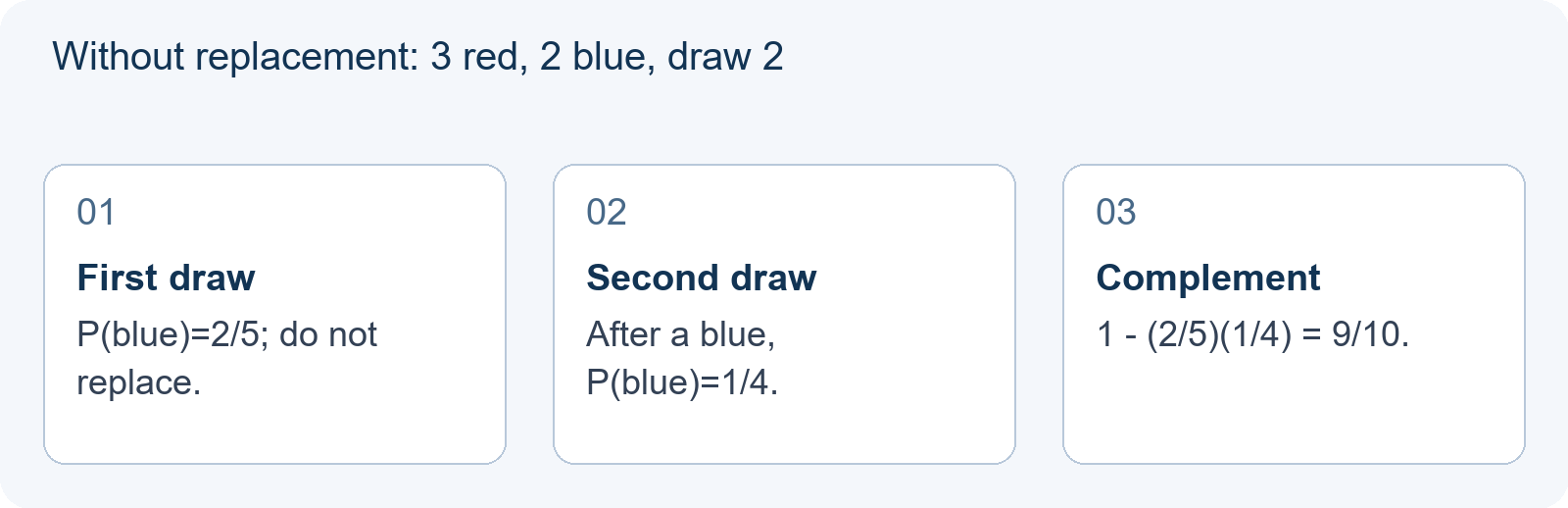
Teaching illustration 1: draw two without replacement
This is a teaching illustration, not an actual AMO problem. A bag contains 3 red and 2 blue counters. Draw two counters without replacement. Find the probability of at least one red.
Complement: both counters are blue. On the first draw, P(blue) = 2/5. Given that the first counter is blue, one blue remains among 4 counters, so P(second blue | first blue) = 1/4. Therefore P(no red) = 2/5 × 1/4 = 2/20 = 1/10. Hence P(at least one red) = 1 − 1/10 = 9/10.
A direct check confirms the complement. Exactly one red means red then blue or blue then red: (3/5)(2/4) + (2/5)(3/4) = 6/20 + 6/20 = 12/20 = 3/5. Both red is (3/5)(2/4) = 6/20 = 3/10. The sum is 3/5 + 3/10 = 6/10 + 3/10 = 9/10. The three positive cases—red-blue, blue-red, red-red—are covered by exactly one red plus both red. The complement blue-blue is the fourth branch. If a student adds only red-blue and blue-red, the reported answer is 3/5, so the red-red case is missing.
The denominator change is the key. After one counter leaves, there are only 4 counters for the second draw. The first blue removes a blue from the bag, so the second blue probability is 1/4, not 2/5. This without-replacement mechanic is what many students miss when they multiply 2/5 by 2/5.
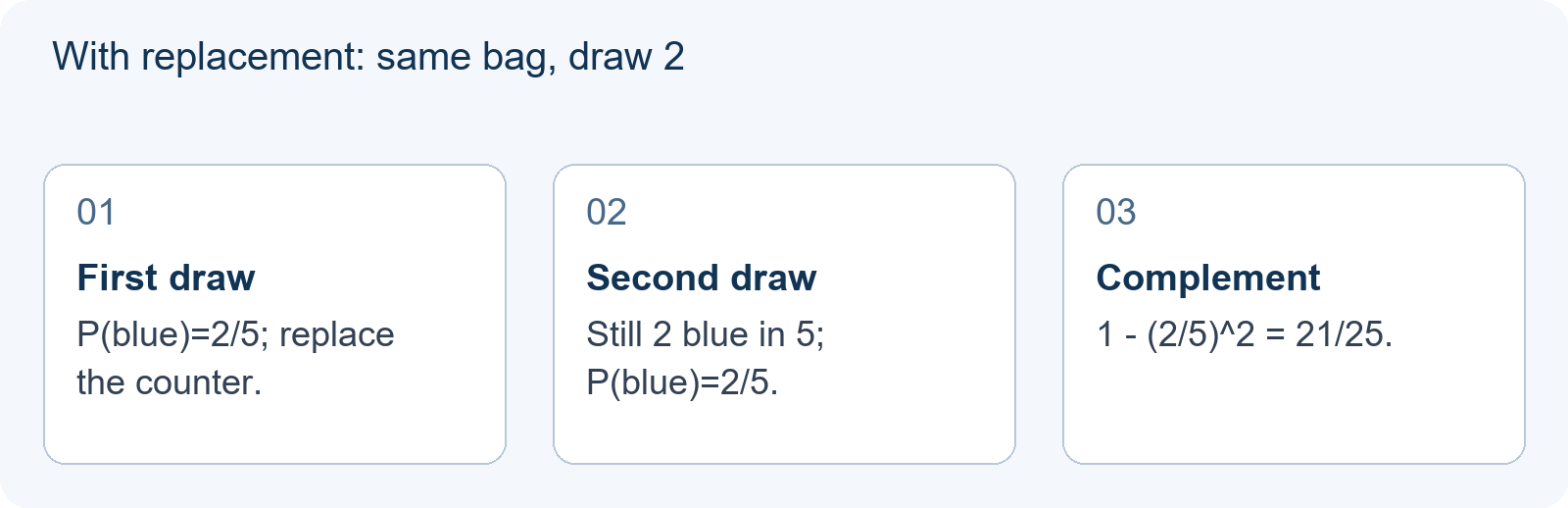
Teaching illustration 2: draw two with replacement
This is also a teaching illustration, not an actual AMO problem. Use the same bag of 3 red and 2 blue counters, but replace the first counter before drawing the second. Find the probability of at least one red.
Complement: both draws are blue. The first blue probability is 2/5. Because the counter is replaced, the bag is restored, so the second blue probability is again 2/5. Thus P(no red) = (2/5)² = 4/25, and P(at least one red) = 1 − 4/25 = 21/25.
Direct check: exactly one red is red-blue or blue-red, which is (3/5)(2/5) + (2/5)(3/5) = 6/25 + 6/25 = 12/25. Both red is (3/5)(2/5) = 9/25. The sum is 12/25 + 9/25 = 21/25. The with-replacement answer is lower than the without-replacement answer of 9/10 = 22.5/25. The reason is that replacement keeps both blue counters available for the second draw, making the all-blue complement more likely.
The complement is still one branch, but the branch probability changes. With replacement, the two draws are independent for colour. Without replacement, the second draw is conditional on the first. That single distinction explains why the denominator stays at 5 in one version and drops to 4 in the other.
A diagnostic table for exactly one versus at least one
| Question wording | Draw rule | Complement or direct? | Denominator after first draw | What to check |
|---|---|---|---|---|
| At least one red in two draws | Without replacement | Complement: both blue | 4 counters remain | Second blue probability is 1/4 |
| At least one red in two draws | With replacement | Complement: both blue | 5 counters remain | Second blue probability is 2/5 |
| Exactly one red in two draws | Without replacement | Usually direct: red-blue plus blue-red | 4 counters remain | Do not include red-red |
| Exactly one red in two draws | With replacement | Usually direct: red-blue plus blue-red | 5 counters remain | Do not include red-red |
| Both dice show the same number | Independent rolls | Complement: dice are different | 6 faces each roll | There are 30 different pairs |
The table is deliberately narrow. It does not try to list every AMO probability pattern. It separates three choices students often merge: the target event, the replacement rule, and the denominator for the second draw. If the wording says “at least one,” ask what “none” means. If the wording says “exactly one,” ask whether “none” and “both” are easier than the direct cases.
Common errors that the complement exposes
The first error is multiplying the first draw twice without replacement. In the 3-red, 2-blue bag, both blue is 2/5 × 1/4 = 1/10, not (2/5)² = 4/25. The square is correct only when the bag is restored. Students who memorise “multiply along the branch” sometimes forget that the second fraction depends on what was removed.
The second error is adding every “at least one” case but stopping too early. For at least one red in two draws, red-blue and blue-red give exactly one red; red-red also belongs. The complement prevents this omission because blue-blue is a single branch. If a student’s positive-case list and complement do not add to 1, one of them is incomplete.
The third error is treating “at least one” as “exactly one.” These are different events. Exactly one red excludes red-red. At least one red includes red-red. A useful check is that, for two draws, exactly-one plus both-events equals at-least-one when those are the only cases. In the without-replacement example, 3/5 + 3/10 = 9/10. In the with-replacement example, 12/25 + 9/25 = 21/25.
The fourth error is using the wrong complement. The complement of “at least one red” is “no red,” not “at least one blue.” Those are different events. If the question asks for at least one red and at least one blue, with only red and blue counters the complement is more involved: all draws are one colour. Writing the complement in words before calculating is a cheap safeguard.
Case-omission errors often look like counting errors. The AMO Grid Counting: Avoiding Double Counts in Rectangles and Paths makes the same point in a different setting: a complete partition is more reliable than an unstructured list. Recording the cause of a missed probability question in The AMO Error Log: A Four-Cause System That Turns Lost Marks Into Points (2026) can turn one lost mark into a reusable rule. If the confusion is about overlapping events rather than sequential draws, the AMO Venn Diagrams: A Two-Circle and Three-Circle Clinic for Overlapping Sets is the closer reference.
A 30-second check before you move on
First, every probability must lie between 0 and 1. If a complement calculation gives a negative number or a number greater than 1, the error is usually in the branch probability or the subtraction. Second, the target probability plus the complement probability should equal 1. Third, if the problem is without replacement, the second denominator should be smaller unless the wording says otherwise. With replacement, the second denominator stays the same.
Fourth, check whether “exactly one” has been confused with “at least one.” For two draws, exactly one red plus both red equals at least one red. If the two probabilities do not add to the complement of no red, recheck the cases. Fifth, for independent repeated trials with the same success probability p, “at least one success” has complement probability (1 − p)^n. This is only a check; the problem must actually state independence, and replacement is one common way to create it.
A short teaching illustration: a bag has 4 green and 1 yellow counter. Draw two without replacement. At least one yellow has complement both green: (4/5)(3/4) = 12/20 = 3/5, so the answer is 2/5. Directly, exactly one yellow is yellow-green or green-yellow: (1/5)(4/4) + (4/5)(1/4) = 1/5 + 1/5 = 2/5. Both yellow is impossible because only one yellow exists. The check agrees.
How to prepare a focused question for a tutor
Do not ask for a general probability lesson before isolating the error. Bring one missed “at least one” question and label five things: the exact wording, whether the draw was with or without replacement, your tree or case list, whether you used the complement or direct addition, and the answer you obtained. Then compare your branch probabilities with the correct denominator at each stage. This preparation makes a tutorial conversation specific: the tutor can see whether the problem is the complement idea, a conditional denominator, or a missing case.
If you request practice resources, ask for a small set of selected-year problems with worked solutions and a stated topic focus, not a vague “more probability.” A useful request is: “Please show one at-least-one problem with replacement and one without replacement, and mark where the denominator changes.” That is a preparation aid, not a claim about a fixed programme or a promise of a particular outcome. The goal is to leave with one reusable decision rule, not a page of unrelated exercises.
For AMO Probability, the reusable decision is short: when a question says “at least one,” try 1 minus “none” first. Then check whether the bag, deck, or set is restored. If it is not, change the denominator and the count on the second draw. If the complement is not shorter, use direct cases—but write the partition first so that no case disappears.
General event background is available at Event background.
Frequently Asked Questions
Does the complement rule work for every ‘at least one’ probability question in AMO preparation?
The complement rule always applies in the sense that P(at least one) = 1 – P(none). It is most useful when ‘none’ is a single clean case. For some questions, such as exactly one, direct addition may be shorter. The method choice depends on the case structure, not on the word ‘probability’ alone.
What is the difference between exactly one and at least one in a two-draw problem?
Exactly one means one success and one failure, such as red then blue or blue then red. At least one means one or more successes, so it also includes two successes. In a two-draw problem, exactly-one plus both-events equals at-least-one when those are the only cases.
Why does with replacement change the denominator in the second draw?
With replacement, the first item is returned before the second draw, so the original counts remain. The second denominator stays the same. Without replacement, the first item stays out, so the second denominator and the relevant numerator can change. This conditional change is the main source of error in the counter examples.