
Quick answer: a guarantee needs a worst case, not a lucky example
If an AMO-style question asks how many objects guarantee a match, do not draw one arrangement and stop. Name the boxes, name the items, construct the most spread-out arrangement that avoids the match for as long as possible, count what happens when one more item arrives, and check the boundary. The answer is the first number that forces a repeat. The wording matters: “must” and “guarantee” ask for a proof over all allowed arrangements; “can” asks only for one arrangement.
In this Hanlin preparation guide, that distinction is worth practising early. Hanlin’s internal AMO site project notes (reviewed 2 November 2026) record the American Mathematics Olympiad paper as Grades 2–12, 25 questions in 90 minutes: 15 multiple-choice questions worth 3 points each, five open questions worth 5 points each, and five open questions worth 6 points each, for 100 points total. There is no negative marking. Those are paper-format facts; they do not by themselves tell you which proof move a question needs. The illustrations below are teaching illustrations, not actual AMO problems, and this article does not claim a published pigeonhole syllabus.
Possible versus guaranteed: the sentence pattern to notice
A single example can refute a “must” claim, but it cannot prove one. If someone asks “Must two people in this group share a birth month?”, finding two who do is irrelevant. The proof must show that every allowed group has a repeat. Conversely, if the claim is “Can two people share a birth month?”, one example settles it. Guarantee questions usually contain words such as must, guarantee, always, at least, or no matter how. Possible questions contain can, is it possible, or find an arrangement.
| Wording | What one example shows | What a complete answer needs |
|---|---|---|
| Can two people share a birth month? | That such a pair exists | One valid arrangement is enough |
| Must two people share a birth month? | Nothing about all cases | A worst-case argument covering every arrangement |
| How many people guarantee a shared month? | Not a guarantee | A threshold plus a boundary check |
The same sentence pattern appears in multiple-choice and open-response sections. In a multiple-choice question, elimination can remove answers that are too weak or too strong, but the final choice still needs a reason. In an open question, the reason is the mark-earning part. The AMO Section C: How to Write Open-Ended Solutions That Show Your Reasoning is a useful companion for that writing step.
Teaching illustration: socks, a matching pair, and the boundary
Suppose a drawer contains 5 red, 5 blue and 5 green socks. All socks of one colour are identical for this question; left and right are irrelevant. In the dark, how many socks must you take to guarantee a matching pair, meaning two socks of the same colour?
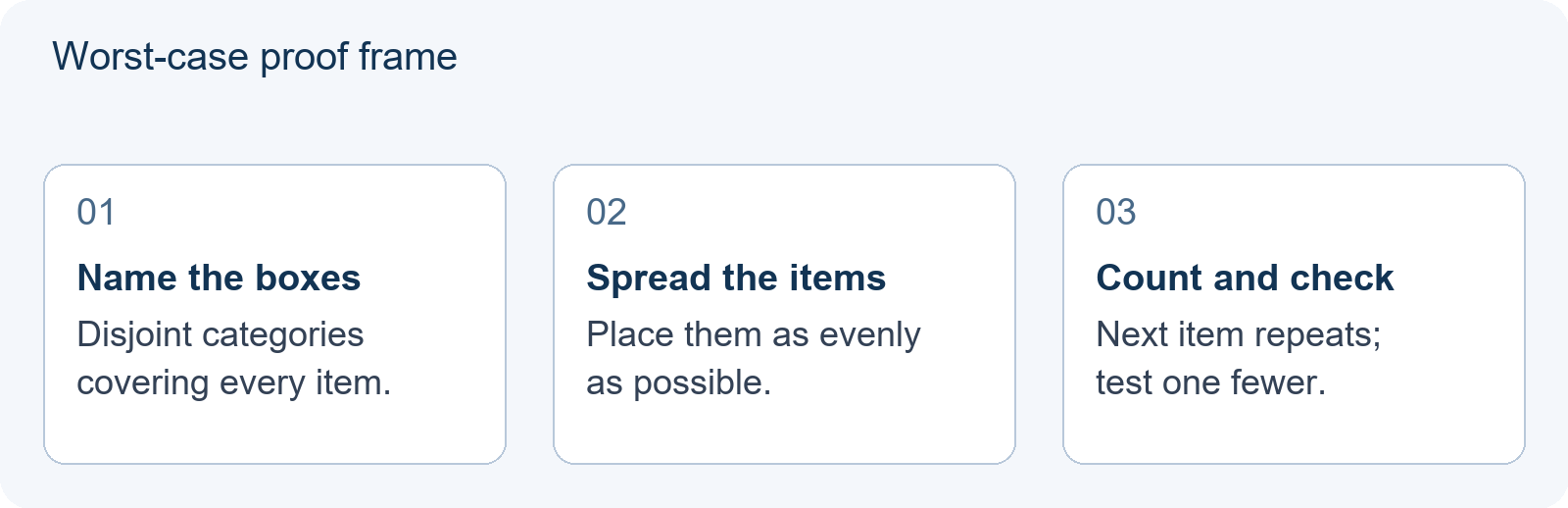
The boxes are the three colours. The items are the socks drawn. The worst case is to spread the draws across colours: take one red, one blue and one green. That is 3 socks with no matching pair. The fourth sock must be red, blue or green, so it matches one sock already drawn. Therefore 4 socks guarantee a matching pair.
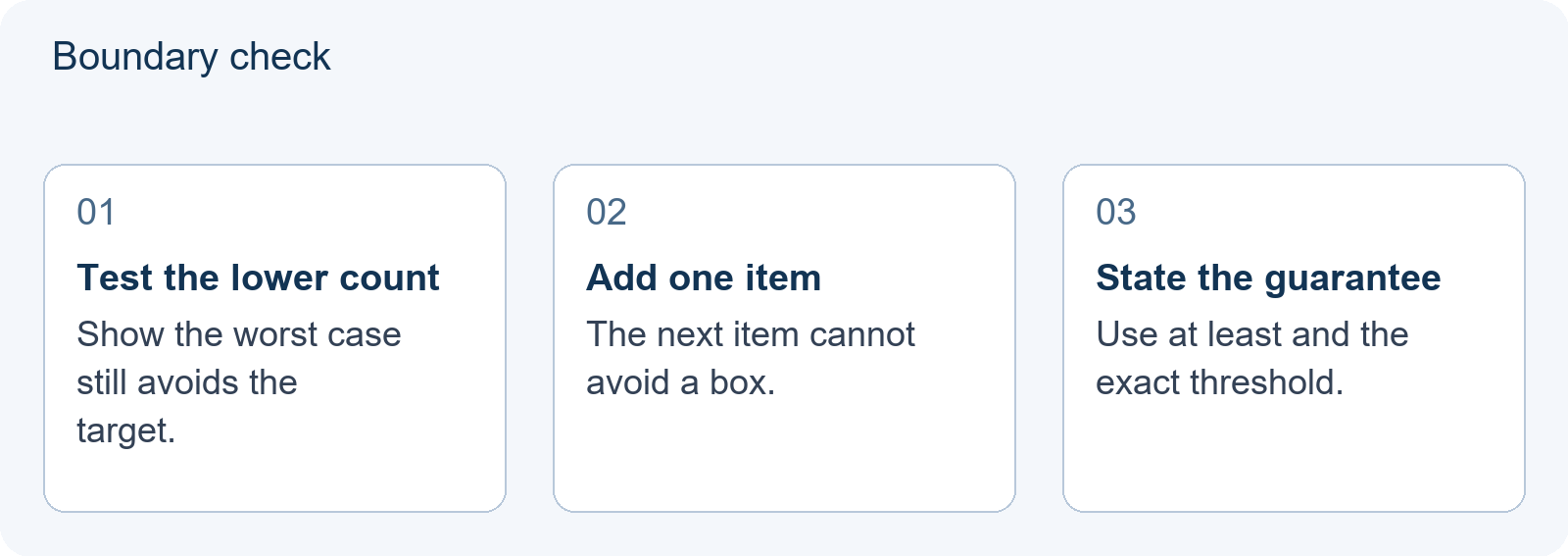
Now check the boundary. Does 3 guarantee a pair? No: red, blue and green is a valid draw of 3 with no pair. Does 4 guarantee a pair? Yes: every fourth draw repeats a colour. The answer is 4, not because a random draw of 4 happened to contain a pair, but because no arrangement of 4 can avoid one. This boundary check is the part students most often skip.
Teaching illustration: 13 people and 12 birth months
Suppose 13 people are in a room, and each person has exactly one birth month among the 12 months of the year. The boxes are the 12 birth months. The items are the people. The most spread-out arrangement puts at most one person in each month. Twelve people can occupy twelve different months, so 12 people do not guarantee a shared month. The thirteenth person has no empty month left, so at least two people must share a birth month.
The conclusion is “at least two,” not “exactly two.” The proof does not say that only one pair shares a month, and it does not identify which month repeats. It says that a repeat is unavoidable. This is why the answer to a guarantee question should preserve the phrase at least. A student who writes “two people share a month” may be describing an example; a student who writes “at least two people must share a month” is stating the guarantee.
Diagnostic: five ways a guarantee proof goes wrong
- Testing one arrangement and stopping. One arrangement can show possibility; it cannot show necessity.
- Reading “at least” as “exactly.” A guarantee of at least two does not rule out three or more in the same box.
- Using overlapping boxes. If a blue sock can be counted in both a “red or blue” box and a “blue or green” box, the pigeonhole count is invalid. Boxes must be disjoint and must cover every item.
- Mistaking an average for a worst case. An average can suggest a threshold, but the proof needs the most spread-out integer arrangement.
- Omitting the boundary check. Without showing that one fewer item fails, the answer may be too large or unsupported.
The boxes-and-items frame, step by step
Use the same five moves each time. First, name the boxes. They must be categories that do not overlap and that cover every possible item. Second, name the items being placed. Third, state the most spread-out arrangement: at most one item per box when that is the target, or as even a distribution as possible when the target is a larger repeat. Fourth, apply the counting step. If n items are placed in k boxes, with n and k positive integers, some box has at least ceil(n/k) items. Fifth, check the boundary by showing that n−1 items can avoid the target or by showing that the proposed threshold is exact.
For a target of at least r items in one box, the useful threshold is k(r−1)+1. With k boxes, you can put r−1 items in each box, using k(r−1) items, without reaching r in any box. The next item must push some box to r. This is the same logic as the sock and birth-month examples, written in general form.
This frame is different from ruling out impossible moves. The AMO Invariants: Use Parity and Colouring to Rule Out Impossible Moves asks how to prove that a state cannot be reached. A pigeonhole guarantee asks how to prove that a repeat or concentration must occur. Both need a worst-case sentence, but they answer different questions.
Why an average is not a worst case
Suppose 17 students each choose exactly one of four activities. The boxes are the four activities. The counting step gives ceil(17/4)=5, so at least five students must choose the same activity. Is 17 the boundary? Check 16: four activities can receive 4, 4, 4 and 4 students, with no activity reaching 5. So 16 does not guarantee 5, and 17 does. The average 17/4=4.25 is not the proof; the integer ceiling and the failing case at 16 are.
A smaller contrast makes the same point. With 12 items in 4 boxes, each item in exactly one box, the ceiling is 3. The arrangement 3, 3, 3, 3 shows that 12 does not guarantee 4. With 13 items, the ceiling is 4, so 13 guarantees 4. The AMO Grid Counting: Avoiding Double Counts in Rectangles and Paths reinforces the same discipline: before counting, make sure each item belongs to exactly one category. A double-counted item can make a false guarantee look convincing.
A second boundary: 11 students and 5 clubs
Suppose 11 students each join exactly one of five clubs. The boxes are the five clubs, and the items are the students. Can we guarantee that some club has at least three students? Yes. If every club had at most two students, the total would be at most 5×2=10. With 11 students, some club must have at least three. The boundary is sharp: 10 students can be split as 2, 2, 2, 2, 2, so 10 does not guarantee a club with three. This example matters because the target is not merely “a repeat”; it is a repeat count. State the target before choosing the worst case.
Writing the proof for an open-response question
In an open-response setting, write the proof so a reader can see the worst case without asking for it. A useful template is: “Let the boxes be ____. Let the items be ____. In the most spread-out arrangement, ____. Since ____, at least one box contains ____. The number ____ is sharp because ____ without the required repeat.” Fill the blanks with the actual categories and counts. The open questions on the AMO paper carry 5 or 6 points each, according to Hanlin’s internal AMO site project notes, so a clear proof sentence is not decoration; it is the answer.
For the sock example, the template becomes: “Let the boxes be the three colours. Let the items be the socks drawn. The most spread-out arrangement without a pair has one sock of each colour, which is 3 socks. Since a fourth sock must be one of the three colours, at least two socks share a colour. The number 4 is sharp because 3 socks can be one red, one blue and one green.” That is short, complete and checkable.
A practice drill and what to bring to a review
Before solving a guarantee question, rewrite it in four lines: Boxes = ____; Items = ____; Worst case = ____; Boundary = ____. Then solve. This drill slows the first minute and protects the rest of the attempt. If the question says “at least,” keep that phrase in the final sentence. If the question says “exactly,” check whether the problem really means exactly; many guarantee questions do not.
If you ask a teacher or Hanlin for a review, bring those four lines and your final proof sentence, not just the final number. A review can then focus on whether the boxes are disjoint, whether the worst case is genuinely the most spread-out arrangement, and whether the boundary is proved. That is a preparation habit, not a claim that any particular checklist is a Hanlin service. The takeaway is simple: guarantee questions are won by constructing the worst case and proving the first forced repeat.
General event background is available at Event background.
Frequently Asked Questions
Does one example prove a pigeonhole guarantee?
No. One example can show that a match is possible, or refute a must-claim, but a guarantee needs an argument covering every allowed arrangement, usually through the worst case.
What is the worst case in a pigeonhole problem?
It is the most spread-out arrangement that avoids the required repeat for as long as possible. For socks in three colours, the worst case without a pair is one sock of each colour.
How do I check the boundary of a guarantee answer?
Show that the number one lower does not guarantee the result, then show that the stated number does. For example, 3 socks do not guarantee a matching pair, but 4 socks do.