
Receiving your AMO results is a significant milestone for students in Grades 2–12. Whether you achieved Gold, Silver, Bronze, or simply completed the challenge, these results provide valuable data on your mathematical strengths and areas for growth. However, interpreting these scores correctly requires understanding where AMO sits within the broader competitive landscape.
Where Do AMO Results Lead?
A common misconception is that AMO results directly qualify students for a specific single event like the Singapore International Math Olympiad Challenge (SIMOC). This is inaccurate. The American Mathematics Olympiad (AMO) is part of the SIMCC (South East Asian Mathematics Competition Council) competition family. While high performance in AMO can open pathways to various international events hosted under the SIMCC umbrella, it does not automatically grant entry to every associated contest. Each subsequent competition typically has its own registration process and eligibility criteria.
For families navigating this system, the key takeaway is that AMO serves as a robust benchmark. It tests core skills in arithmetic, algebra, geometry, and combinatorics under timed conditions. Your result indicates readiness for more advanced challenges, but you must research specific upcoming contests individually rather than assuming automatic progression.
Interpreting Your Medal Band
AMO awards medals based on percentile rankings among participants. Understanding these bands helps you set realistic goals:
| Medal Type | Percentile Rank | Preparation Focus |
|---|---|---|
| Gold | Top 8% | Maintain speed; tackle complex multi-step problems. |
| Silver | Next 12% | Reduce careless errors; deepen conceptual understanding. |
| Bronze | Next 20% | Strengthen fundamentals; practice time management. |
| Certificate | Remaining | Identify weak topics; build confidence through easier sets. |
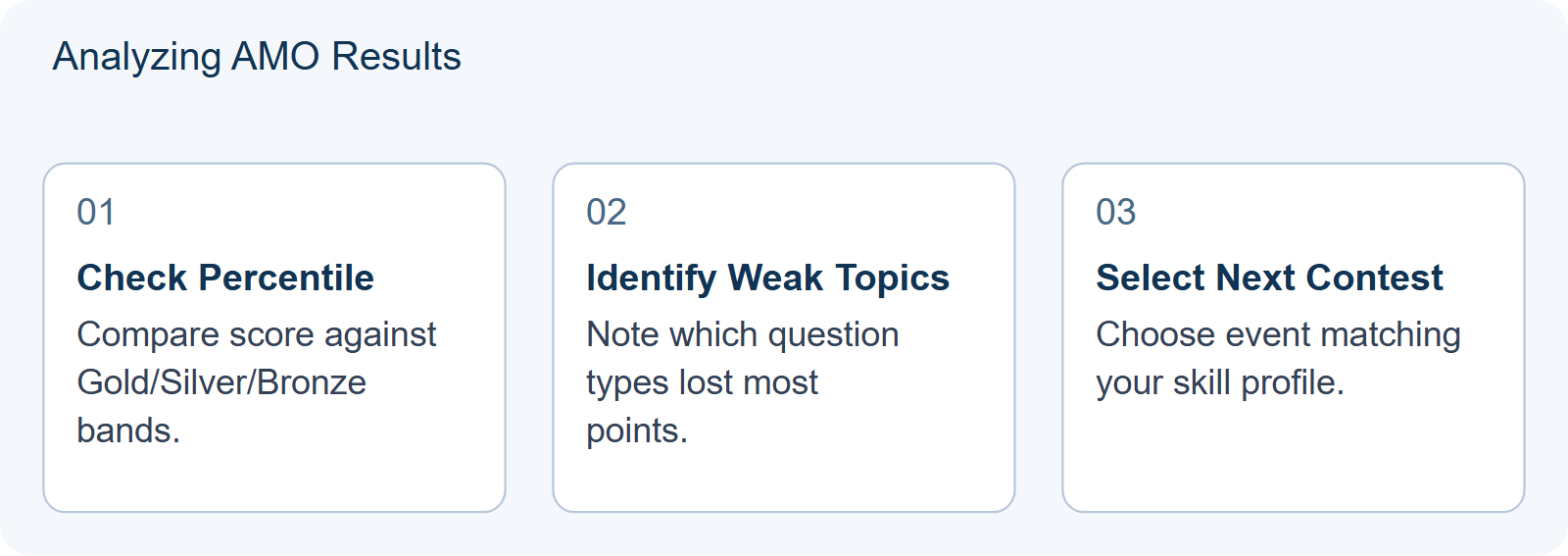
Note that approximately the top 40% of participants receive some form of recognition. If you missed a medal, analyze which question types caused the most lost points. Was it the multiple-choice section or the open-ended questions? This diagnostic approach turns a simple score into a strategic roadmap.
Choosing Your Next Competition
After reviewing your AMO results, consider these factors when selecting the next competition:
- Difficulty Match: If you scored well on the final 5 open-ended questions, look for contests with higher weight on proof-based or complex problem-solving tasks.
- Format Familiarity: Some students thrive in multiple-choice environments, while others excel in written responses. Choose a format that aligns with your demonstrated strengths.
- Regional Availability: Ensure the next target competition is accessible in your region and allows registration for your grade level.
For students interested in Singapore-based contests, note that SMC (Singapore Mathematical Olympiad Committee) and SASMO (Singapore and Asian Schools Math Olympiad) are distinct entities. While they share regional proximity, their structures differ. AMO’s connection to SIMCC provides a bridge to certain international rounds, but always verify current year requirements directly with organizers.
Targeted Preparation Strategies
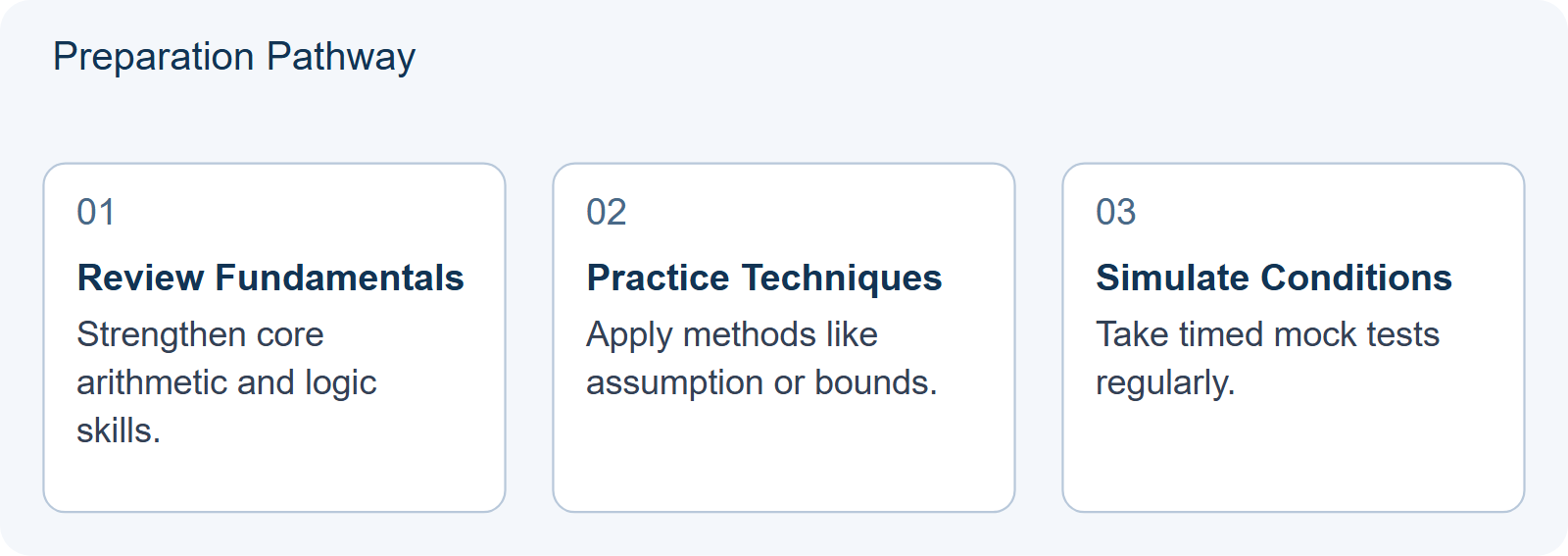
Generic practice often yields diminishing returns. Use your result breakdown to tailor your study plan. For example, if you struggled with word problems, focus on specific techniques like the assumption method or working backwards. Our site offers detailed guides on these topics to help you refine your approach.
Consider exploring our resource on The Assumption Method for AMO Word Problems. This technique is particularly effective for heads-and-legs style questions and excess-and-shortage scenarios, which frequently appear in the middle difficulty tiers of AMO papers.
If your results showed strength in basic calculations but weakness in optimization problems, review strategies for finding maximum and minimum values. These concepts are central to many upper-grade questions. Our article on AMO Maximum and Minimum Problems breaks down the bound-and-build method, helping you visualize constraints and identify optimal solutions efficiently.
Finally, remember that consistency matters more than intensity. Short, focused sessions targeting your weakest topic areas will yield better improvements over time than sporadic long cramming sessions. Track your progress by re-attempting similar problems after a few weeks to ensure retention.
Leveraging Past Papers Effectively
Many students finish past papers quickly and then feel stuck. The real value lies in deep analysis. Instead of just checking answers, try transforming one problem into ten variations. Change numbers, swap conditions, or ask “what if” questions. This active engagement builds flexible thinking.
Our guide on How to Turn One AMO Problem Into Ten provides practical exercises for extending your learning from each solved question. This method ensures that your preparation evolves alongside your growing skill set, making your next competition attempt significantly stronger.
HYPOTHETICAL/ILLUSTRATIVE: The Silver Medalist’s Strategic Pivot
To demonstrate how to apply the diagnostic framework outlined above, consider a hypothetical student named Alex. Alex is in Grade 5 and recently received an AMO Silver medal, placing in the top 12% of participants. While this is a commendable achievement, Alex’s score breakdown reveals a specific pattern: near-perfect accuracy on multiple-choice questions but significant point loss on the final three open-ended problems due to incomplete reasoning or time exhaustion. This data suggests that while Alex has strong computational speed, there is a gap in deep conceptual application under pressure.
Alex faces two plausible preparation paths for the next competition cycle. Option A involves continuing with high-volume practice of similar multiple-choice drills to maintain current speed and confidence. Option B requires shifting focus entirely to structured problem-solving techniques for open-ended questions, specifically practicing how to articulate logical steps clearly within a limited timeframe. Many students instinctively choose Option A because it feels productive and reinforces existing strengths. However, based on the article’s advice regarding “Difficulty Match” and “Format Familiarity,” Option A fails to address the primary source of lost points. If Alex continues down Path A, they may remain stuck at the Silver level, unable to break into the Gold percentile which demands mastery of complex, multi-step tasks.
Option B, though initially slower and more frustrating, aligns directly with the diagnostic insight. By dedicating sessions to deconstructing past open-ended questions—analyzing not just the answer, but the *path* taken to reach it—Alex builds the flexible thinking required for higher-tier competitions. This approach mirrors the “Leveraging Past Papers Effectively” strategy, where transforming one problem into variations helps solidify understanding. For instance, instead of solving ten new multiple-choice questions, Alex solves one difficult geometry proof and then attempts to modify its constraints to see how the solution changes. This active engagement yields deeper learning than passive repetition.
The decision changes when we consider the long-term goal. If Alex aims for international rounds that heavily weight written proofs, the ability to communicate mathematical logic is non-negotiable. Speed without depth becomes a liability in these formats. Therefore, the strategic pivot from breadth (many easy questions) to depth (fewer hard questions analyzed thoroughly) is essential. This choice is not about abandoning strength in calculation but about balancing it with rigorous reasoning skills.
Reusable Self-Check: Before selecting your next preparation focus, ask yourself: “Does my current study plan target my biggest point-loss category, or does it reinforce what I already do well?” If you are consistently losing points on a specific question type, prioritize that weakness over maintaining comfort zones. Track whether your error rate in that specific area decreases over four weeks; if not, adjust your method, perhaps by seeking different explanatory resources or changing the difficulty level of practice sets. Remember, growth happens at the edge of your competence, not in the center of your comfort.
Frequently Asked Questions
Does a good AMO result guarantee entry to other international math competitions?
No. AMO is part of the SIMCC family, and while it may offer pathways to certain international events, each competition has its own separate registration and eligibility requirements. You must apply independently for subsequent contests.
What do the medal percentages mean for my child's future applications?
Medals indicate strong performance relative to peers. Gold (top 8%) shows exceptional ability, while Silver and Bronze demonstrate solid proficiency. These achievements can support school applications, especially for international schools, but should be presented alongside other academic records.
How soon should we start preparing for the next competition after receiving results?
Start immediately with a diagnostic phase. Spend 2-3 weeks analyzing errors from the AMO paper, then begin targeted practice on weak areas. Consistent weekly practice is more effective than last-minute cramming before the next event.