
An AMO award does not act as a score in a school application. It acts as a claim that a reader then checks against everything else in the file. Admissions staff at international schools in China read a competition line beside the transcript, their own entrance maths paper and the interview. Where those four agree, the whole file becomes more believable. Where they disagree, the award is quietly discounted. Understanding that mechanism changes how you enter AMO, and how you write it down.
The mechanism: corroboration, not credit
Families often picture school admissions as an accumulation exercise: collect certificates, add them up, present the pile. Readers do not work that way, and for a practical reason. A school receiving applications from public schools, bilingual schools and international schools across several provinces cannot compare the transcripts directly. An A from one school and an A from another do not mean the same thing, and the reader knows it.
What a reader can do is look for agreement. A student whose transcript says “strong in mathematics”, whose entrance paper performance matches, whose teacher reference mentions independent problem-solving, and who holds an externally-marked competition result in the same subject, is telling one consistent story from four directions. That consistency is what makes the file credible. A competition award is valuable in an application precisely because it comes from outside the school and is marked on a scale the school did not set — it is an independent check on a claim the family is already making.
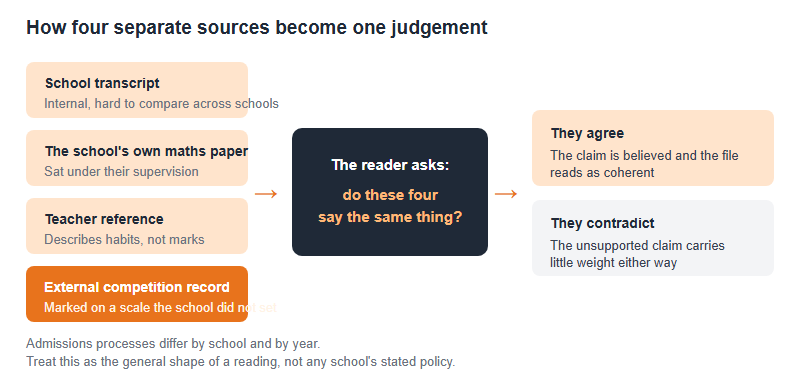
This is also why a family should be relaxed about the medal colour and careful about the fit. A Silver that sits comfortably alongside a strong entrance paper reads better than a Gold that appears next to shaky in-school performance, because the second combination raises a question rather than answering one.
What is checkable about an AMO line, and what is not
Some parts of an AMO record can be verified by anyone who cares to look. Others rest entirely on your description. Knowing which is which tells you how to write the entry.
| Element of the entry | Independently checkable? | What a reader concludes |
|---|---|---|
| Organiser: SIMCC, Singapore, with Southern Illinois University | Yes — published on the organiser's site | Establishes what the contest actually is |
| Award tier: Gold, Silver or Bronze (Honourable Mention sits below the medal threshold) | Yes — the certificate states it | Positions the student inside a defined band |
| Grade level sat, and the year | Yes — on the certificate | Shows whether the level matched the student's age |
| That awards are percentile-based rather than fixed cut-offs | Yes — organiser's published scheme | Explains what the tier means without inflating it |
| "Top of the region", "national level", "elite" | No — these are your words | Treated as marketing unless documented |
| Hours of preparation, effort, dedication | No | Ignored; every applicant claims it |
The percentile structure is worth stating plainly in the entry rather than hiding. Per the organiser's published scheme, AMO awards are distributed by percentile band — broadly Gold to around the top 8 per cent, Silver to the next 12 per cent and Bronze to the next 20 per cent, so roughly the top 40 per cent of the field receives an award, with the exact cut-offs floating according to how the field performs that season. Our guide to how AMO scoring works sets this out in full. Writing “Silver, awarded to approximately the top 20 per cent of the field at this level” is both more honest and more persuasive than “Silver medal winner”, because it hands the reader the yardstick instead of asking them to guess at one. Bands are set each season by SIMCC, so confirm the current scheme on the official AMO pages before quoting figures in an application.
The mislabelling trap: AMO is not the AMC
This is the single most damaging avoidable error we see, and it is worth its own section.
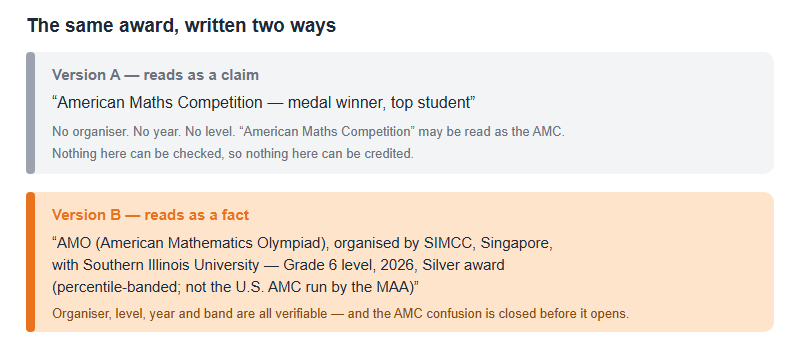
AMO is the American Mathematics Olympiad, organised by SIMCC in Singapore together with Southern Illinois University, for grades 2 to 12. The AMC is the American Mathematics Competitions, run by the Mathematical Association of America in the United States, aimed principally at high-school students and leading toward AIME and the U.S. olympiad selection route. They are different contests with different organisers, different age ranges and different purposes. Our introduction to AMO covers the distinction in detail.
The trap opens when an entry is written loosely — rendered into Chinese as a generic “American maths competition”, or shortened on a form to something a reader could mistake for the AMC. A head of mathematics at an international school very often knows the AMC well. If the entry reads as an AMC claim and the accompanying detail does not fit an AMC record, the reader does not conclude that they misread. They conclude that the family stretched the truth, and the damage spreads: once one line looks inflated, the rest of the file gets read with suspicion. Naming the contest and organiser in full costs eight words and removes the risk entirely.
Timing: the certificate has to exist when the file is assembled
The practical failure we see most often has nothing to do with mathematics. A family decides in the application autumn that a competition record would help, registers, and discovers the result will not arrive until after the school's deadline. An award that lands two months late is worth nothing to that application.
The AMO year runs on an autumn-to-spring shape: registration opens in the autumn, students sit the paper, and results and certificates follow in the spring. That means a result is normally in hand for an application round assembled the following autumn — in other words, you generally need to have entered a full year before the file is due, not in the same season. Registration windows, sitting dates and result dates are set by the organiser and move from season to season, so check the current dates on the official AMO pages and do not plan against last year's calendar.
Two further timing points are worth building into the plan:
- Sit at the correct level. An award at a level well below the student's school year invites a question rather than settling one. Our AMO grade levels explained guide maps grades 2 to 12 onto contest levels, including how British Years and IB MYP years line up.
- One clean record beats three scattered ones. A single contest sat properly, with preparation that shows up in the student's ordinary schoolwork, corroborates the file. Three half-prepared entries in one term mostly demonstrate that the family collects entries.
What an AMO award will not do
Being honest about the ceiling is part of using the tool well.
- It does not replace the school's own assessment. Most selective international schools in China set their own maths paper and interview, and those carry the decision. A competition record can make a reader expect a strong paper; it cannot substitute for one.
- It does not guarantee an outcome, and nobody can promise one. Any organisation telling you a particular award secures a place is describing a hope, not a process. Admissions decisions rest on the whole file, on the year's applicant pool and on places available.
- It does not rescue a weak academic record. Cross-validation cuts both ways: a strong external result beside a weak transcript reads as an inconsistency to be explained, not as a counterweight.
- It does not travel unchanged into university applications. A primary or middle-school award is context for a trajectory rather than a headline credential later on; how to present competition work in a university file is a separate discipline.
What it does do is give a reader one externally-marked, comparable data point in a system where almost nothing else is comparable across schools — and, if the preparation was real, a student who is visibly better at unfamiliar problems than they were a year ago. From what we see working with families in China, that second effect is the one that shows up in an entrance paper and an interview, and results vary by student. The award is evidence of the work; the work is what the school is actually buying.
Frequently asked questions
Does an AMO award help with international-school admissions in China?
It can corroborate a maths claim already in the file, but it cannot replace the school's own entrance paper, and no award guarantees a place.
How should I write AMO on an application form?
Name it in full with the organiser: AMO (American Mathematics Olympiad), SIMCC with Southern Illinois University, plus level, year and award tier.
Is AMO the same as the American AMC?
No. AMO is run by SIMCC in Singapore with SIU for grades 2 to 12; the AMC is run by the MAA in the United States. They are different contests.
When should my child sit AMO if we are applying next year?
Generally a full season ahead, since registration runs in autumn and results follow in spring. Confirm the current dates on the official AMO pages.
This site is operated by Hanlin Education as an authorized AMO registration partner for China; we are not the organiser. AMO is run by SIMCC (Singapore International Math Contest Centre) with Southern Illinois University, and is not the American AMC run by the MAA. Award bands, registration windows and result dates are set by the organiser and change between seasons, so confirm all details on the official SIMCC / AMO pages. Admissions observations here are our own editorial view from working with families in China, not any school's stated policy, and no competition result guarantees an admissions outcome. Corrections made within 7 working days of notice.