
Time problems look like measurement questions and behave like number theory questions. A clock face is a circle divided into 360 degrees and a cycle of 12; a calendar is a cycle of 7 with an irregular correction every four years. Once a student sees them as cycles rather than as clock-reading, three tools cover almost the whole family: the hand-angle formula, the fast-or-slow ratio, and remainders on division by 7.
Why time questions trip up students who are good at arithmetic
Most children meet clocks and calendars in Year 2 or 3, decide they are easy, and never revisit them. Then a competition paper asks for the angle between the hands at 3:40, or what day of the week a date 73 days away falls on, and the familiar topic turns unfamiliar. The arithmetic is not the obstacle. The obstacle is that the student is still reading a clock instead of computing with one.
Three structural features cause the difficulty:
- Two moving objects, not one. The hour hand does not sit still while the minute hand travels. Students who forget this get every hand-angle question slightly wrong, which is worse than getting it obviously wrong, because nothing looks suspicious.
- Base 60 and base 12 in the same object. Minutes wrap at 60, hours wrap at 12 or 24, and degrees wrap at 360. Time problems are the first place many students meet mixed-base arithmetic.
- An irregular cycle. A week is a clean cycle of 7. A year is 365 days, which is 52 weeks plus one leftover day, corrected by a leap day on a rule with two exceptions. That leftover day is the entire content of most calendar questions.
Our site’s introduction to AMO explains that the contest is built on the U.S. Common Core framework, where time and elapsed time sit inside the measurement strand while remainder thinking sits inside number and operations. Time problems draw on both, which is exactly why they feel like a different subject from either. How much weight this family carries varies by level and by season, and the current syllabus is set by SIMCC, so confirm the topic list for your child’s level on the official AMO pages before planning a whole term around it.
One point of housekeeping before the mathematics: AMO is the American Mathematics Olympiad organised by SIMCC in Singapore with Southern Illinois University, for grades 2 to 12. It is not the AMC, which is run by the Mathematical Association of America in the United States. The two contests share three letters and almost nothing else, and the topic emphasis differs accordingly.
Clock-hand geometry: one formula instead of ten special cases
Everything about hand positions follows from two speeds. The minute hand covers 360 degrees in 60 minutes, so it moves 6 degrees per minute. The hour hand covers 360 degrees in 12 hours, so it moves 30 degrees per hour, which is 0.5 degrees per minute. Subtract them and the minute hand gains on the hour hand at 5.5 degrees per minute.
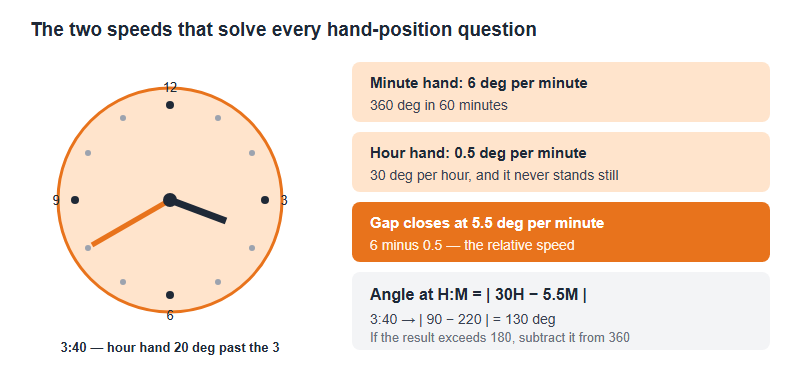
Measuring both hands clockwise from 12, the hour hand sits at 30H + 0.5M degrees and the minute hand at 6M degrees. Subtract, take the absolute value, and you get the standard formula: angle = | 30H − 5.5M |, with the convention that if the answer exceeds 180 you subtract it from 360, because a question asking for “the angle between the hands” usually wants the smaller one.
At 3:40 that gives | 90 − 220 | = 130 degrees. The common wrong answer is 120, produced by treating the hour hand as parked on the 3. That 10-degree error is the single most frequent loss in this topic, and it comes from a picture, not from arithmetic.
The same relative speed answers the questions that look harder:
- When do the hands overlap between 4 and 5? At 4:00 the hour hand leads by 120 degrees; the minute hand closes that gap at 5.5 degrees per minute, so it takes 120 ÷ 5.5 = 21 and 9/11 minutes. The answer is 4:21 and 9/11.
- How often do the hands overlap? The minute hand laps the hour hand 11 times in 12 hours, so overlaps occur every 12/11 hours, which is 65 and 5/11 minutes — not every 65 minutes, and not 12 times per 12 hours.
- How many times are the hands at right angles in 12 hours? Twice per lap, so 22.
- When are the hands at right angles between 3 and 4? Set | 90 − 5.5M | = 90. That gives M = 0 or M = 180 ÷ 5.5 = 32 and 8/11, so 3:00 and 3:32 and 8/11.
Notice how many answers are fractions with denominator 11. That denominator is a useful self-check: if a hand-overlap answer comes out as a whole number of minutes, it is almost certainly wrong.
Broken clocks: convert everything into a ratio
A second family gives you a clock that runs fast or slow and asks for the true time. Students often try to add or subtract the error repeatedly, which works for one hour and collapses over a long interval. The reliable method is a ratio between shown time and true time.
A clock that loses 5 minutes every hour displays 55 minutes for every 60 true minutes, so shown : true = 55 : 60 = 11 : 12. If it was set correctly at 09:00 and now shows 14:30, the shown elapsed time is 330 minutes, so the true elapsed time is 330 × 12/11 = 360 minutes, and the true time is 15:00. A clock that gains 4 minutes per hour displays 64 for every 60, so shown : true = 16 : 15; after 15 true hours it shows 16 hours.
Two habits make this reliable under time pressure: write the ratio down before touching any numbers, and check the direction of the answer at the end. A slow clock must show a time earlier than the truth; a fast clock must show a later one. Students who lose marks here have usually inverted the fraction, and the direction check catches it in two seconds. The same “state the check before you compute” discipline is what our guide to how AMO scoring works describes as the difference between a near miss and a banked mark.
Calendar arithmetic: one leftover day does all the work
A common year has 365 days. Since 364 is exactly 52 weeks, 365 leaves a remainder of 1 on division by 7. That single leftover day is the engine of every day-of-week question: the same date one year later moves forward one weekday, or two if a 29 February falls inside the interval.
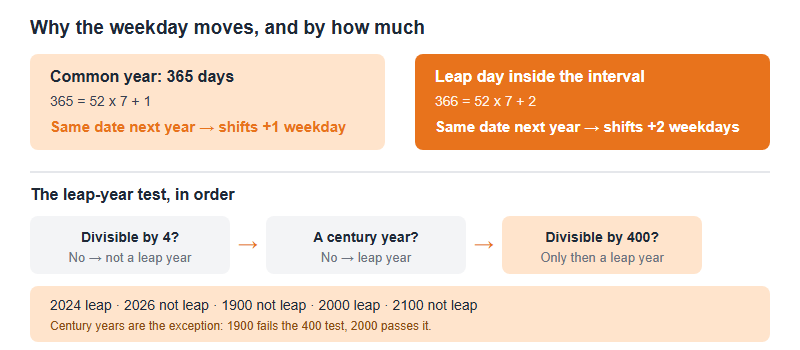
Work the direction carefully. If 1 March is a Sunday this year, then 1 March next year is a Monday whenever no 29 February falls between the two dates. A student who applies “+1 for a common year, +2 for a leap year” to the year label rather than to the interval gets February and March questions wrong roughly half the time.
For questions that count days rather than years, convert to a remainder. From 5 March to 17 May is 26 remaining days in March, plus 30 in April, plus 17 in May, which is 73 days. Since 73 = 70 + 3, the weekday advances by 3: a Tuesday becomes a Friday. And a pleasing consequence of the leftover-day rule: in a common year, 31 December falls on the same weekday as 1 January, because 364 days separate them.
The five question shapes, and a twenty-minute weekly routine
| Question shape | What it is really testing | The move | Most common lost mark |
|---|---|---|---|
| Angle between the hands at a stated time | That the hour hand moves continuously | | 30H − 5.5M |, then 360 − answer if over 180 | Parking the hour hand on the hour mark |
| When hands overlap, align or form a right angle | Relative speed | Gap at the hour, divided by 5.5 | Answering in whole minutes instead of elevenths |
| A clock that runs fast or slow | Proportional reasoning | Fix shown : true as a ratio, then scale | Inverting the ratio; no direction check |
| Day of the week N days or Y years later | Remainders on division by 7 | Count days, take the remainder mod 7, add | Miscounting the start day, or missing a leap day |
| Elapsed time crossing midnight or noon | Mixed-base subtraction | Step to the next whole hour, then add the rest | Borrowing as if minutes were base 10 |
That last row deserves its own warning. Elapsed time questions are the quiet mark-loser of this family because they look trivial. From 09:47 to 14:12 is not 5 hours 65 minutes and not 4 hours 65 minutes; step from 09:47 to 14:47 to get 5 hours, then step back 35 minutes to get 4 hours 25 minutes. Crossing midnight is worse: a train leaving at 23:40 on a journey of 6 hours 50 minutes arrives at 06:30 the following morning, and students who subtract inside a single day lose the whole mark on an otherwise easy question.
Time problems reward short, frequent contact rather than a single long session, because the failure mode is a wrong mental picture rather than missing knowledge. A routine we use with students works in four steps and fits into one weekly slot:
- Two minutes on the two speeds. Ask the child to state 6, 0.5 and 5.5 and what each one means, out loud, until it is automatic. Almost every hand-position error traces back to this.
- Five minutes on angles. Four times chosen at random, angle each one, then verify one of the four by drawing it. The drawing is the correction mechanism.
- Five minutes on ratios. Two fast-or-slow clocks, and a spoken direction check on each: “slow clock, so the truth is later.”
- Eight minutes on calendars. One day-count question, one same-date-next-year question straddling February, and one that includes a century year, which is where the 400 rule earns its place.
Keep the difficulty appropriate to the level your child will actually sit — a Grade 3 candidate needs elapsed time and simple day counting, while hand-overlap fractions and century-year rules belong further up the ladder. Our AMO grade levels explained guide sets out how grades 2 to 12 map onto contest levels, and it is worth checking before choosing practice material, since a paper aimed two levels too high teaches frustration rather than technique.
One honest caveat to close on. The topic weighting on any given AMO paper is decided by SIMCC and can differ by level and by season, so treat this as a family of techniques worth owning rather than as a guaranteed feature of your child’s paper. Confirm the current syllabus and format on the official SIMCC and AMO pages. The techniques themselves are durable in a way exam formats are not: relative speed, ratio reasoning and remainders will keep paying out long after the clock question that introduced them.
Frequently asked questions
What is the fastest way to find the angle between clock hands?
Use the absolute value of 30H minus 5.5M, then subtract from 360 if the result exceeds 180. At 3:40 this gives 130 degrees, not 120.
Why do clock-overlap answers involve elevenths?
The minute hand gains on the hour hand at 5.5 degrees per minute and laps it 11 times in 12 hours, so gaps divided by 5.5 produce denominators of 11.
How do I work out a day of the week without a calendar?
Count the days between the dates, take the remainder on division by 7, then move that many weekdays forward. Add one if a 29 February falls inside.
Does AMO always include clock and calendar questions?
Topic weighting is set by SIMCC and varies by level and season, so confirm the current syllabus on the official AMO pages.
This site is operated by Hanlin Education as an authorized AMO registration partner for China; we are not the organiser. AMO is run by SIMCC (Singapore International Math Contest Centre) with Southern Illinois University, and is not the American AMC run by the MAA. Syllabus weighting, paper format and scoring rules are set by the organiser and change between seasons, so confirm all details on the official SIMCC / AMO pages before relying on them. Worked examples above are our own teaching material. Corrections made within 7 working days of notice.