
A student who has already done years of olympiad-style maths coaching arrives at AMO with most of the hard part done. In our experience the reasoning transfers almost intact; what costs marks is everything around it — English wording, the breadth of topics in one paper, the habit of writing long solutions when the paper wants answers, and pacing built for depth rather than a 90-minute sweep. Fixing that is quick, but it must be deliberate.
What transfers almost intact
The valuable part of any olympiad training track is not the topic list. It is a disposition: the student expects a question to look unfamiliar at first, and does not treat that as a sign of failure. That single habit is the largest gap between a competition entrant and a strong school-maths student, and a student who already has it starts a long way up the hill.
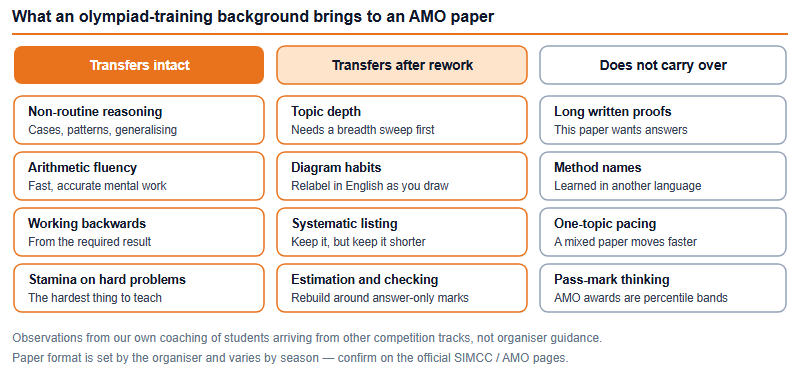
Four things travel with almost no loss. Non-routine reasoning — the willingness to try a case, spot a pattern and generalise — is the core skill AMO tests, whatever language it was learned in. Arithmetic fluency under time transfers completely; students from an intensive track are often noticeably faster on mental calculation than peers of the same age. Working backwards from a required result is a technique these students have usually met many times. And stamina on a hard problem — sitting with something for five minutes without panicking — is the thing that cannot be taught in eight weeks, and they already have it.
What has to be reworked, and why
The losses cluster in four places, and none of them are about mathematical ability. That is the frustrating part for these students: they are the strongest reasoners in the room and can still finish behind classmates with weaker mathematics.
| Habit brought in | What happens on an AMO paper | The rework |
|---|---|---|
| Depth before breadth | Very strong on two topics, thin on the rest; a mixed paper punishes gaps more than it rewards peaks | Run a light sweep across every topic band before adding any more depth |
| Writing a full solution | Time drains into presentation on a paper that rewards a correct answer | Practise stopping the moment the answer is secured; keep working notes brief and legible to yourself only |
| Concepts learned in another language | The student knows the idea but not the English trigger word, so the question is not recognised as familiar | Build a personal term list mapping each known method to its English name |
| Pacing built for few, long problems | Over-invests in one question, then meets easy marks in the last stretch with no time left | Timed mixed sets with a hard stop per question and a deliberate second pass |
| Chasing a pass mark | Misreads a modest raw score as failure when the percentile band may be strong | Read results as ranks, not marks — see how the bands work |
The last row is worth dwelling on, because it changes how a family reads the whole season. AMO recognition is percentile-based within each grade level worldwide: broadly Gold around the top 8 percent, Silver the next 12 percent and Bronze the next 20 percent, so roughly the top 40 percent are medal-recognised, with any further recognition bands set by the organiser. A student used to fixed cut-offs can look at a raw score, decide it was a bad day, and be wrong. How AMO scoring works sets that out, and there is a practical consequence too: with no deduction for a wrong answer under the scoring rules the site documents, leaving a question blank is never the safe option it feels like. Confirm the current award structure and marking rules on the official SIMCC / AMO pages.
The language layer: knowing the maths and missing the word
This is the most under-estimated part of the transition, and it is a narrow problem rather than a general one. These students are not weak readers of English. What they lack is a mapping: they know exactly what to do with a remainder, and have never seen the word "remainder" attached to it. The gap is between a mastered method and its English trigger.
The repair is a one-page personal glossary, built the right way round. Do not start from a list of English maths words. Start from the methods the student already owns — the twenty or thirty techniques they would name if asked what they can do — and write the English term next to each. Anything with no English label attached is a mark waiting to be lost. Our coaching team finds this exercise usually takes two sessions and pays back more than any amount of extra problem practice in the same fortnight, because it converts existing ability into recognised questions.
The level trap: being ahead is not a reason to enter above the school year
Families in this situation almost always ask the same question: my child is two years ahead in content, should they enter a higher level? Slow down here, because the answer depends on how ranking works rather than on how strong the student is.
AMO ranks students within each grade level. A student entered above their school year is compared against older students, which surrenders exactly the advantage the extra training bought — and does so before anyone has seen whether the breadth, language and pacing issues above have actually been fixed. Level eligibility is set by the organiser, so the decision belongs to the grade level rules and to the official AMO pages, not to a coaching instinct. Settle the level first; build the plan second.
There is a better outlet for a student who genuinely needs more stretch. Strong results open the SIMCC progression, with selection routes toward SIMOC and IJMO under criteria the organiser publishes — confirm the current criteria officially. Depth has somewhere to go later. The first paper is not the place to prove it.
An eight-week bridge
This is the shape our coaching team uses for a student with a strong training background and no AMO experience. It is a working plan from teaching rather than an organiser recommendation, and it assumes a few hours a week alongside school.
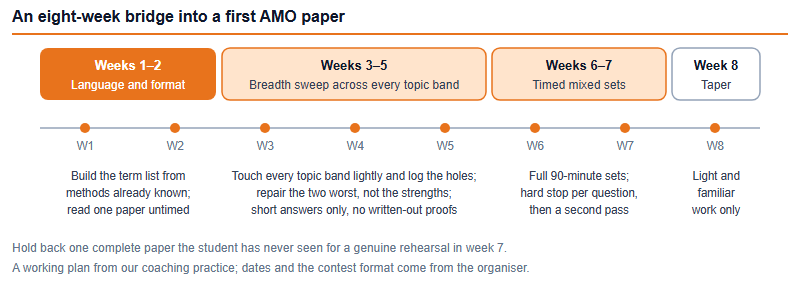
The counter-intuitive instruction is in weeks 3 to 5: resist going deeper on the strong topics. Every hour spent there is an hour not spent closing a gap, and on a mixed paper the gaps are what set the score. Students dislike this because deep work in a favourite topic feels like real mathematics and a light sweep feels like revision. Say so out loud, and agree the trade in advance.
One naming point that catches families out
Because the word "American" is in the name, families arriving from another system frequently assume they are entering the well-known American high-school competition sequence. They are not. AMO is the American Mathematics Olympiad, organised from Singapore by SIMCC together with Southern Illinois University, running from grade 2 through grade 12 on a US Common Core content basis. The American Mathematics Competitions — the AMC — are run by the Mathematical Association of America in the United States and are a separate contest with a separate entry route.
This matters practically, not just pedantically. It determines which past papers to work from, which progression a strong result feeds into, and what a medal in this contest actually names when a student later lists it. Get the identification right at the start and everything downstream — material, level, expectations — lines up behind it.
Frequently asked questions
Does olympiad training in another system help with AMO?
Most of the reasoning transfers. The losses are in English wording, breadth of topics and answer speed.
Should a strong student enter a higher grade level?
Ranking is done within each grade level, so entering above the school year gives that advantage away. Check the level rules.
Is AMO the same as the American Mathematics Competitions?
No. AMO is organised from Singapore by SIMCC with SIU. The AMC is run by the MAA in the United States.
How long does the bridge usually take?
Our coaching team plans about eight weeks: two on language and format, three on breadth, two timed, one light.
This site is operated by Hanlin Education as an authorized AMO registration partner for China. AMO is run by the Singapore International Mastery Contests Centre (SIMCC) together with Southern Illinois University; we are not the organiser, and AMO is not the American Mathematics Competitions (AMC) run by the MAA in the United States. The transfer observations and the eight-week plan above are our own coaching judgement, not organiser guidance, and outcomes vary by student; eligibility, level structure, format, dates, fees, award bands and progression criteria are set by the organiser — always confirm current details on the official SIMCC / AMO pages before registering. If you spot an error in this article, tell us and we will correct it within 7 working days.