
Every serious AMO family hits the same wall: the past papers are finished, and re-doing them mostly measures whether the student remembers their own solution. The fix is not to hunt for more papers. It is to take one problem the student got wrong and rebuild it five ways. Variation trains the thing the paper actually rewards — recognising a method inside unfamiliar wording — and it costs about five minutes per problem.
Why running out of papers is a good problem to have
There is a real difference between two students who both score well on a paper they have seen before. One reconstructs the method from the mathematics. The other recognises the question and replays a stored answer. On the day, in a timed paper with wording nobody has seen, only the first student is safe.
Re-doing a completed paper measures recall. Solving a variant of it measures transfer: can this student still find the method when the numbers move, the unknown moves, or the constraint is stated the other way round? That distinction is the whole reason AMO is built around non-routine questions rather than exercise sets. Because AMO is ranked by percentile within each grade level rather than against a fixed mark, the marginal point almost always comes from a question that looked unfamiliar — which is precisely what variation rehearses.
There is a second, quieter benefit. Writing a variant forces the student to say what the problem was really about. A child who cannot vary a problem has not understood it, and that failure surfaces in about ninety seconds instead of at the next mock.
The five variation moves
These are the five moves our coaching team uses. They are deliberately mechanical, because the point is that a student can run them alone, without a teacher inventing anything.
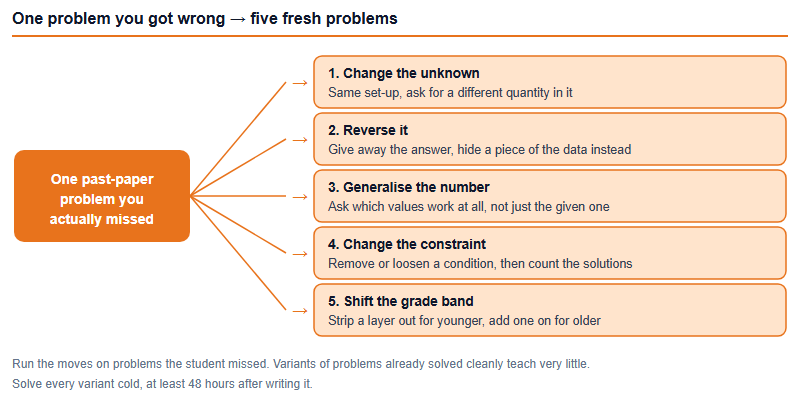
A worked example: one stem, ten problems
Here is an original stem written for this article, at roughly an upper-primary level. Use your own missed problem in its place; the mechanics are identical.
Original. A shop sells pencils in packs of 6 and pens in packs of 4. Mia buys 9 packs altogether and ends up with 46 items. How many packs of pencils did she buy?
The method: two conditions, one about packs and one about items. If she buys a pencil packs then she buys 9 − a pen packs, so 6a + 4(9 − a) = 46, giving 2a + 36 = 46 and a = 5. Now run the moves.
| # | Move | The variant | What it trains |
|---|---|---|---|
| 1 | Original | How many pencil packs? (answer 5) | Setting up two conditions |
| 2 | Change the unknown | How many pen packs? (answer 4) | Not stopping at the first quantity you find |
| 3 | Change the unknown | How many pens does she have? (answer 16) | Packs vs items — the classic careless slip |
| 4 | Change the unknown | How many more pencils than pens? (answer 14) | Reading the question to the last word |
| 5 | Reverse it | She buys 5 pencil packs of 6 and 4 pen packs, 46 items in all. How many pens per pack? (answer 4) | Working backwards from a known total |
| 6 | Reverse it | Packs of 6 and 4, she has 46 items and 5 pencil packs. How many packs altogether? (answer 9) | Choosing which relation to use first |
| 7 | Generalise | She still buys 9 packs. Which item totals are possible? (every even number from 36 to 54) | Seeing the structure behind one answer |
| 8 | Change the constraint | Drop the 9-pack rule. How many ways can she get exactly 46 items? (4 ways) | Systematic listing instead of one equation |
| 9 | Shift down | Packs of 2 and 5, she buys 6 packs and gets 21 items. How many packs of 5? (answer 3) | Same method, smaller load for a younger sibling |
| 10 | Shift up | Pencil packs cost $3, pen packs cost $5; 9 packs cost $35 in total. How many pencil packs? (answer 5) | Same skeleton, a second unit to keep straight |
Notice what happened. Ten problems came out of one, none of them are copies, and every one of them is answerable with the same core idea. Variant 3 in particular is worth its weight: confusing packs with items is one of the most common ways a strong student loses a mark, and it cannot be drilled by doing more different problems — only by meeting the same set-up with the question pointed somewhere else.
How to check your variant is still a fair question
Home-made problems fail in predictable ways. Four checks catch nearly all of it, and a student should run them before solving, not after.
- One answer, unless you meant otherwise. If you loosen a constraint you often create several solutions. That is fine when the question asks "how many ways", and broken when it asks "how many packs". Variant 8 above is legitimate only because the wording was changed to a counting question.
- Whole numbers where the context demands them. Half a pack of pens is a sign that the numbers need adjusting, not that the student has gone wrong. Change one figure and re-check.
- Reachable with this student's toolkit. A variant that quietly needs an unfamiliar technique is a new topic, not practice. Park it and come back after the topic has been taught.
- It still reads as English. Read the variant aloud. If the sentence has become ambiguous — two readings, two answers — rewrite it. This check has a bonus: it is the same skill the real paper tests when a student has to parse unfamiliar wording under time.
Getting a variant wrong is not a wasted session either. A problem the student wrote and cannot solve tells you exactly where the understanding stops.
Building a variant bank and using it weekly
Variation only compounds if the variants are stored and revisited. One notebook or one spreadsheet is enough: the original problem, the three variants, the date written, the date solved cold, and whether it was right. The rule that makes it work is the 48-hour gap — solving a variant you wrote an hour ago is still recall.
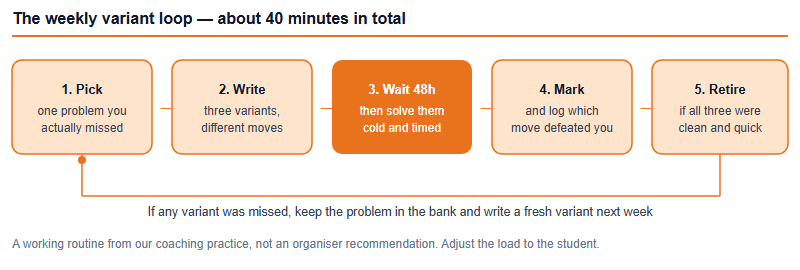
Three variants a week is a realistic load for most students alongside school. A problem earns retirement when all three variants come out clean and quickly; anything else goes back in the bank. Over a term that produces a personal problem set built entirely out of the student's own weak points, which is something no published book can supply.
What variation does not fix
Be honest about the limits, or this becomes another comfortable routine that feels like work.
Variation cannot teach a topic that was never learned. If a student misses a question because they have not met the idea, writing five versions of it just repeats the gap in five voices; teach the topic first, then vary. Variation also does not build pacing. The contest gives 90 minutes per level and the ability to move on from a stuck question is a separate skill that only timed mixed sets develop, so keep at least one timed set in the routine even in a variation-heavy month. And variants are never a substitute for genuinely unseen material in the final weeks — hold back one complete paper the student has never touched for a true rehearsal.
One last point on level. Move 5 tempts families into treating variants as evidence that a student should sit a higher level. It is not that; ranking happens within the level entered, so the entry decision should be made on the grade level rules and confirmed against the official SIMCC / AMO pages, not on how well a home-made harder variant went on a good afternoon. If any of the underlying set-up is unfamiliar, start with what AMO actually is before building a plan.
Frequently asked questions
Why not just redo the same past paper?
Redoing a paper mostly measures recall of your own solution. A variant tests whether the method survives new wording.
How many variants per problem is sensible?
Three is usually enough: one easier, one at level, one harder. Ten is for problems that keep coming back.
Will writing variants take too long?
About five minutes each once you know the moves. Solving them cold two days later is where the training happens.
Does variation replace timed full papers?
No. Keep timed sets for pacing. Variation builds the method, timing builds the ninety-minute habit.
This site is operated by Hanlin Education as an authorized AMO registration partner for China. AMO is run by the Singapore International Mastery Contests Centre (SIMCC) together with Southern Illinois University; we are not the organiser, and AMO is not the American Mathematics Competitions (AMC) run by the MAA in the United States. All example problems above were written by us for this article and are not reproductions of contest questions; the study routine described is our own coaching practice. Eligibility, level structure, format, dates, fees and award bands are set by the organiser — always confirm current details on the official SIMCC / AMO pages before registering. If you spot an error in this article, tell us and we will correct it within 7 working days.