
Usually yes, you can — because maths competitions are run by different organisations on separate calendars, so two sitting days rarely collide. The real cost is not the exam day. It is the preparation weeks either side, which overlap with each other and with your school assessment block. Budget those weeks honestly before you register, not in week six when you are already behind.
This is a scheduling article, not a comparison. It assumes you have already decided that two competitions are attractive, and asks the harder question: what does the second one actually take out of the term, and how would you know in advance whether you have it to give?
The exam days are not the problem
Families almost always start by checking for a date clash, and almost always find there is not one. That is unsurprising. AMO is jointly organised by SIMCC in Singapore and Southern Illinois University Carbondale; every other maths competition your child might enter has its own organiser, its own committee and its own calendar. Two independent bodies picking autumn dates will rarely land on the same Saturday, and if they do, one of them usually offers a window rather than a single day.
Two cautions before you rely on any date you have read somewhere.
- Sitting dates are regional. AMO's testing arrangements are set per country or region. Southern Illinois University, for instance, listed a school testing window of 12 October to 13 November 2026 for its own United States arrangement — that is the US arrangement, not a date you should copy into a Chinese school calendar. Confirm your own sitting date with whoever registers you, and on the official SIMCC / AMO pages.
- Check the deadline, not just the exam. Registration closes well before the paper is sat, and a missed registration deadline is the single most common way a planned two-competition term quietly becomes a one-competition term.
Once both dates are confirmed and at least a few weeks apart, the date question is closed. Everything that follows is about weeks, not days.
The three collision points that actually hurt
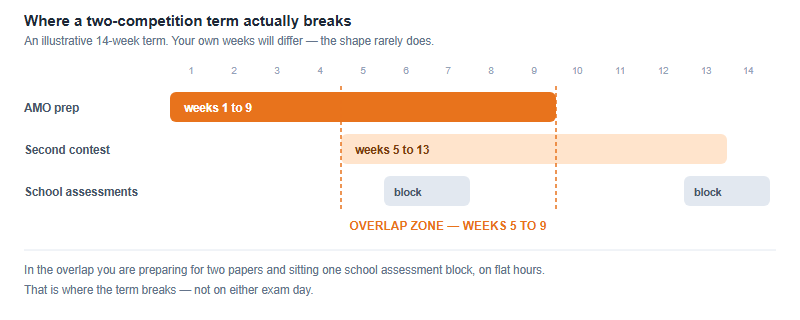
In our experience running registrations for international-school families, a two-competition term fails in one of three predictable places — and none of them is the exam itself.
- The overlapping prep block. A serious preparation run is roughly eight to ten weeks. Two of those in a fourteen-week term must overlap in the middle, and the overlap is exactly where the workload doubles while the available hours stay flat.
- The school assessment weeks. Every international school has two or three blocks where reports, mocks or unit assessments land. Competition preparation is the first thing dropped in those weeks, and it should be. The mistake is planning as though those weeks exist.
- The final fortnight of each contest. The last two weeks before any paper should be a taper: timed practice, reduced volume, sleep protected. If contest B's taper collides with contest A's deepest learning phase, you get neither. This is the collision that damages the result on both papers.
What transfers between competitions, and what does not
The second contest is cheaper than it looks in one respect and more expensive in another. General mathematical capability built for one paper carries over almost entirely. Contest-specific tactics carry over not at all — and worse, carrying them over on purpose is how students lose marks.
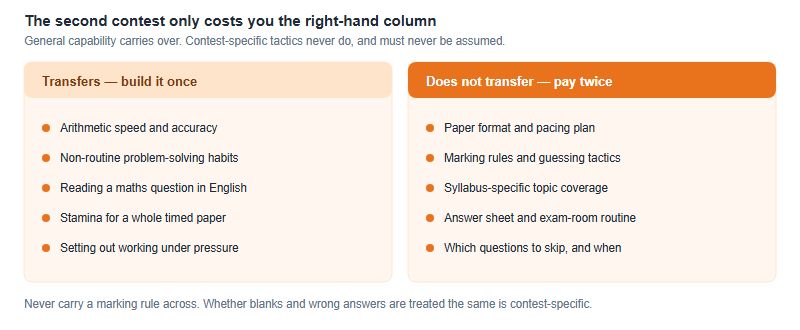
The right-hand column deserves one blunt warning. Marking rules are set by each organiser, and sometimes vary by country within the same contest family. A student coached on one paper's guessing strategy who applies it to another paper is not being efficient — they are gambling with a rule they have not checked. Verify the marking rules for each sitting separately, on that contest's own pages. For AMO, our explainer on how AMO scoring works covers how the award bands are determined, and the official SIMCC / AMO pages carry the current rules.
A prep-hour budget you can check on one page
Here is the arithmetic we walk families through when they ask whether the term has room. The numbers below are an illustrative planning model of our own, not figures published by any organiser — substitute your own and the conclusion usually survives.
| Line | Worked example | Your number |
|---|---|---|
| Weeks in the term | 14 | |
| Discretionary competition hours per week | 3 | |
| Gross hours available | 42 | |
| Less school assessment blocks (2 weeks) | −6 | |
| Less illness, travel and holiday buffer (about 10%) | −4 | |
| Realistic hours in the term | 32 | |
| A proper 9-week block for contest A, at 3 hours | 27 | |
| Hours left for contest B | 5 |
Most families are surprised by that final row, and it is the whole argument of this article. Nothing in the calculation is pessimistic — three discretionary hours a week is a normal, committed international-school student, and two assessment blocks is a light term. The gap is simply that people count fourteen weeks and plan as if they own all of them.
The go / no-go rule — and why finishing one properly beats half-finishing two
Run all four checks. If any one fails, do not enter both properly.
- Dates confirmed, and at least three weeks apart. Confirmed with each organiser or registration partner — not read on a forum. Three weeks is the minimum gap that lets one taper finish before the next begins.
- Realistic hours cover both blocks. Use the table above. If contest B gets fewer than about fifteen hours, it is not being prepared for.
- The non-transfer list is short. If the two papers differ sharply in format and marking, the second entry costs far more than the hours suggest, because pacing has to be rebuilt from scratch.
- The student wants it. Not the parent. A second competition entered on a parent's enthusiasm is the reliable route to a student who wants nothing to do with maths competitions by grade 9.
If a check fails, there is a third option that families rarely consider and that we recommend often: sit the second contest cold, with zero dedicated preparation, and say so out loud in advance. Tell the student the plan is one prepared contest and one experience. That removes the guilt, removes the pressure, protects the main block, and still gives them the exposure — genuinely a good outcome, and far better than two half-prepared entries and a disappointing pair of results.
There is a concrete reason the split-attention approach costs more than it appears to, and it lives in how AMO recognition is structured.
AMO awards are decided by percentile placement rather than by a fixed mark: the top 40% of participants receive a certificate and medal, split as Gold for the top 8%, Silver for the next 12% and Bronze for the next 20%. What follows from the band is where the compounding happens. Gold and Silver awardees are invited to compete in IJMO, the International Junior Math Olympiad; Gold, Silver and Bronze awardees are invited to SIMOC the following year. Separately, each Bronze or higher award earns Individual Scholarship Points, and four accumulated points bring free induction into the International Junior Honor Society.
In other words, the recognition ladder is band-gated, and bands are decided by percentile, not effort. Landing just outside a band does not give you a partial invitation. A student who prepares one contest properly and reaches a band has opened a multi-year route; a student who split the term across two and landed just outside on both has no medal band and no invitation route. This is not an argument against ever doing two — it is an argument for doing the arithmetic first. If you are still working out which level your child should target, start from our guide to AMO grade levels.
One last piece of housekeeping, because it causes real confusion each autumn: AMO is not the AMC. AMO is the SIMCC contest set out in our introduction to AMO, run with Southern Illinois University for grades 2 to 12; the AMC is a separate competition run by the Mathematical Association of America in the United States. If your "second competition" is the AMC, treat it as an entirely separate organiser with its own dates, rules and marking, and never plan one from the other's calendar.
Frequently asked questions
Will AMO clash with another competition's exam date?
Rarely, since different organisers set their own calendars. Still confirm both dates and both registration deadlines before entering.
Does preparing for one maths competition help with another?
Partly. Arithmetic accuracy, non-routine thinking and timed-paper stamina transfer. Format, pacing and marking tactics do not, and must be rebuilt.
Can my child sit a second competition with no preparation?
Yes, and it is often the sensible choice. Treat it as a low-stakes sitting, agree that plan in advance, and protect the main preparation block.
What do we actually lose by half-preparing for two?
Usually the award band. AMO medals go to the top 40% by percentile, and the SIMOC and IJMO invitations follow the band reached.
This site is operated by Hanlin Education as an authorized AMO registration partner for China. AMO (the American Mathematics Olympiad) is run by SIMCC together with Southern Illinois University — we are not the organiser, and we do not set papers or award medals. Sitting windows, registration deadlines, marking rules and award bands are set by the organiser and can differ by season and by region; always confirm current details on the official SIMCC / AMO pages, and confirm any other competition's details with its own organiser. The hour budget shown here is our own planning model, not an official figure. We do not guarantee any result or admission outcome. Corrections are made within 7 working days.